Challenge: Urban species including a wide range of birds and animals are losing natural habitats due to densely populated building infrastructures, with few suitable nesting spaces left in cities.
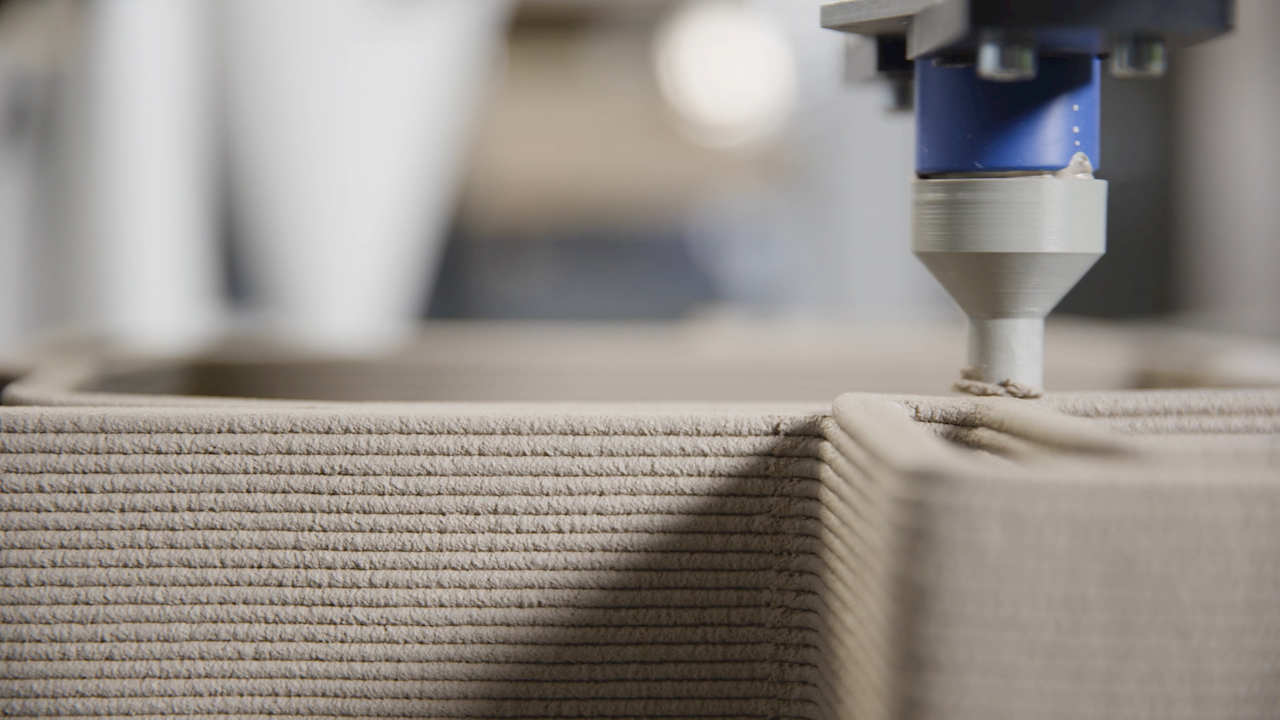
Application: An interdisciplinary team at TUM developed geometrically unique, climate-sensitive façade modules using 3D printing with ceramic clay to serve as modular habitats for birds and small animals.
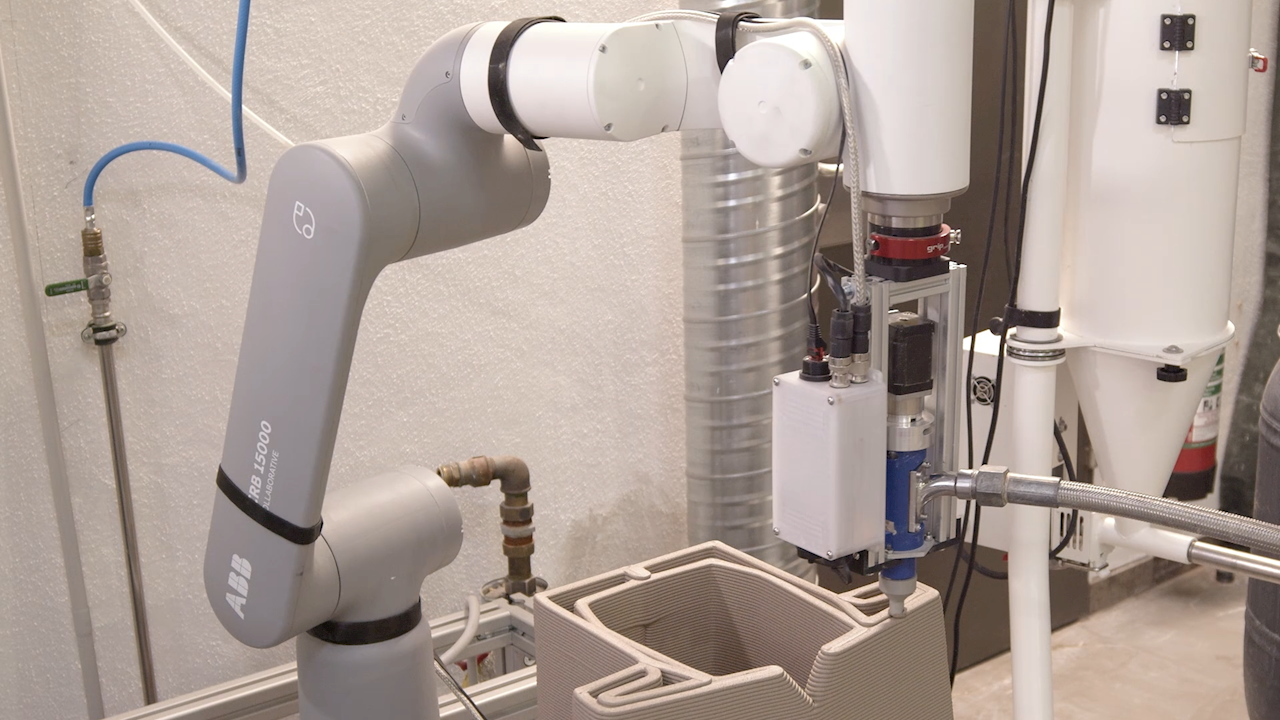
Solution: ABB’s GoFa cobot enabled precise additive manufacturing and delicate post-processing of the fragile clay elements, offering the adaptability, precision, and ease of programming needed in an experimental university setting.
The loss of habitats is one of the strongest drivers of species extinction worldwide. Retreats are also disappearing in cities: old eaves, cracks in facades or hollow tree trunks. In an interdisciplinary research project, a team of architecture and ecology researchers from the Technical University of Munich (TUM) has therefore set itself the goal of using facades as a vehicle for biodiversity. A shining example of this project in the form of a 3D printed façade prototype, inaugurated in July 2025, stands tall at the ‘Suedpolstation’, a children's and youth center in Munich, Germany.
The elements made of ceramic recycled clay not only provide a home for birds and small animals – thanks to their ingenious geometry, but they also create a favorable microclimate on the façade. The depth of the modules was calculated on the basis of solar radiation data so that their surface shades itself. This means that the building’s walls do not extensively heat up in summer.
Cobots make unique geometries possible
Each of the approximately 100 3D-printed modules has a distinct geometric design. To ensure efficient, repeatable, and scalable production processes, it is necessary to apply the soft clay strand with high precision. This is where ABB’s cobot GoFa, known for its class leading accuracy and precision metrics, opened new possibilities. Besides 3D printing, the cobot also assisted with the post-processing and quality assurance of the sensitive blanks. It removed the elements from the print bed, placed them in drying racks to save space or transferred them in a controlled manner for further processing.
In a university environment, the use of collaborative robotics has advantages: the test set-ups change frequently, materials and processes are often experimental - standardized industrial automation quickly reaches its limits here. Cobots such as GoFa create the necessary balance between safety, precision and adaptability.
The cobot was set up using ABB's RobotStudio® software. Its intuitive user interface allowed the researchers to simulate and optimize print paths for motion sequences developed in the Python programming language and then transfer them directly to the robot. For changing geometries and component positions, the possibility of lead-through programming proved to be particularly time-saving – movements could be easily saved and adapted at any time. GoFa also demonstrates strong performance in workstation maintenance or modification, as it can be seamlessly integrated into new process chains.
“The interaction between humans and robots was completely intuitive,” said Julia Larikova, initiator and doctoral student at the Chair of Digital Fabrication. “Thanks to lead-through programming and the graphical programming tools in RobotStudio, we were able to quickly integrate GoFa into our processes – without any time-consuming training.”
Digitally planned, adaptively manufactured
Before 3D printing started, the researchers digitally modeled the 3D geometry of each façade element - based on climate data, building orientation and species-specific requirements. In the digital model, they placed nesting and shelter areas specifically where they make ecological sense: Sparrows prefer to be close to the colony, the black redstart needs distance from its neighbors. Algorithms translated these requirements directly into geometric façade shapes.
Printing with ceramic clay placed special demands on the additive manufacturing process and post-processing: the material viscosity varied and drying began during the printing process. To avoid warping or cracking, the material application had to be precisely orchestrated keeping the temperature and moisture consistent. Minimal vibration and precise movement control were therefore necessary during post-processing, which was achieved using GoFa’s force control and built-in torque sensors. This approach enabled the high surface quality required for this type of nesting façade. Building owners and urban planners often expect facades to have minimal surface contact for dirt accumulation.
Thanks to their modular design, the 3D-printed façade elements fit into standard rear-ventilated façade systems and can be easily removed and cleaned if necessary. This ease of maintenance means that the nesting areas remain usable in the long term.
For facades that live
The Munich prototype will be scientifically monitored over the next three years. The researchers will observe how the animals use the nesting sites and how the microclimate develops. To do this, they will measure temperature curves or surface humidity at various points on the façade, for example. In addition, cameras document the behavior of the animals over several breeding cycles. This data provides the basis for further refining the geometry of the modules and evaluating the ecological impact.
For ABB Robotics, this project underlines how pioneering applications are growing beyond the traditional industry. “GoFa was designed for precisely such flexible, cooperative areas of application,” said Robert Loebach, Cluster Manager Cobot Distribution and Ecosystem at ABB Robotics.
“Cobots like GoFa really demonstrate their strengths when it comes to integrating people, machines and materials into innovative workflows.” Robert Loebach, Cluster Manager Cobot Distribution and Ecosystem
The modular nesting facades capture the spirit of the moment. Because Europe is renovating – and on a grand scale. Millions of buildings are to be modernized in terms of energy efficiency as part of the EU-wide renovation wave, a core initiative of the Green Deal. This is precisely where the concept of the nesting façade comes in: It uses the construction work that is due to be carried out anyway to create new habitats for animals at the same time - without requiring additional space. The prefabricated modules can be easily integrated into existing façade systems, making them ideal for the renovation of existing buildings or urban densification. This creates double added value: a better climate for people and more retreats for animals.
The “Nesting Façade” research project
The modular nesting facades are being developed as part of an interdisciplinary research project. Participants include the Chair of Digital Fabrication (Julia Larikova, Prof. Dr. Kathrin Dörfler), the Chair of Terrestrial Ecology (Dr. Fabio Sweet, Prof. Dr. Wolfgang Weisser) as part of the flagship project for the New European Bauhaus “Creating NEBourhoods Together,” and the EU project ECOLOPES. The research was also funded by the Foundation for Species Protection and Technology. The project was supported by industry partners Tonality GmbH and Feierwerk e.V. – Suedpolstation. Project website on TUM Digital Fabrication.
ABB Robotics & Discrete Automation as one of the world’s leading robotics and machine automation suppliers, is the only company with a comprehensive and integrated portfolio covering robots, Autono-mous Mobile Robots and machine automation solutions, designed and orchestrated by our value-creat-ing software. We help companies of all sizes and sectors - from automotive to electronics and logistics – to outperform by becoming more resilient, flexible and efficient. ABB Robotics & Discrete Automation supports customers in the transition towards the connected and collaborative factory of the future, op-erating leaner and cleaner for a better future. The business area employs approximately 11,000 people at over 100 locations in approximately 53 countries. go.abb/robotics


