How important is energy efficiency for the rubber and plastics industry?
Awareness of the need for energy efficiency is already at a high level. However, environmental considerations are very sensitive in this sector, for both public opinion and the media. That means players in this industry must be one step ahead of the rest, and that explains the huge investments that have been made over the past two decades.
The growing importance of energy efficiency for industry in general is illustrated by the results of a global survey published earlier in 2024 by the Energy Efficiency Movement https://www.energyefficiencymovement.com/insights/main/investment-readiness/.
This survey gathered responses from nearly 1,300 business leaders across multiple countries. It revealed that 99% of businesses are already investing in, or are planning to invest in, making their energy usage more efficient. Notably, the number of businesses actively investing in energy efficiency has increased by 7% from two years ago. And of those investing in, or planning to invest in energy efficiency, 41% said they would make these improvements over the next 12 months.
Moving data to the cloud (71%) is the most common energy efficiency measure currently invested in by businesses, followed by performing energy efficiency audits (69%), and improving energy efficiency of cooling systems (64%).
What might prevent the adoption of the latest energy-efficient motors?
A major advantage of the latest energy-efficient motors, such as those using synchronous reluctance (SynRM) technology, is that they generally offer a drop-in replacement for existing inefficient motors. This enables upgrading to be made with minimal downtime or disruption. In addition, SynRM motors must be installed as part of a package with a variable speed drive (VSD) – the drive is essential for their operation. That means the operator automatically gets the energy efficiency and control advantages of using a drive
Upgrading is easy in practice. Bottlenecks are perhaps more down to perception, because new technology is seen as a large upfront cost. However, saving energy will result in a rapid return on investment, sometimes even in months, depending on local energy costs. That message is now beginning to build momentum.
Another reason why operators can be reluctant to change is that electric motors are in fact very reliable. If correctly specified and well-maintained they often last for 15 to 20 years or even more. Quite reasonably, operators want to know why they should replace their motors when they are still relatively new and performing well? However, motor technology has seen huge developments in energy efficiency, even in just the past decade. That is why it makes good sense both commercially, and for the environment, for operators to embrace the latest technology and to future-proof their operations.
What new motor technology should the rubber and plastics industry look out for?
An exciting development is the introduction of IE5 SynRM liquid-cooled motor technology as an alternative to the traditional induction motor, still the most common technology used in industry. Induction motors have inherent drawbacks that arise from their asynchronous operation – such as rotor heating losses, which decrease efficiency and component and bearing lifetime.
In contrast, SynRM technology is characterized by high energy efficiency and its reliability and low maintenance needs. Indeed, the IE5 SynRM delivers ultra-premium energy efficiency - the highest level of efficiency defined by the International Electrotechnical Commission (IEC). Using SynRM technology as a package with the latest VSD is a recipe for optimal energy efficiency.
Now, IE5 SynRM technology has been combined with the advantages of liquid-cooling to deliver high power-density without increasing size. The result is a motor equally efficient at saving energy and cutting emissions in new projects as it is as a drop-in replacement for older, less efficient motors.
Maximum output in restricted space is ensured through the motor’s compact size, while high power-density means OEMs building rubber and plastics machinery can upgrade to IE5 efficiency with the same or even smaller frame sizes, avoiding the need for expensive redesign work and enabling more compact machines.
Furthermore, the SynRM’s cool rotor with cooling ribs on the bearing assembly extends the lifetime of the bearings, enhancing overall reliability by reducing the chance of bearing failures – the cause of around 70% of unplanned motor outages.
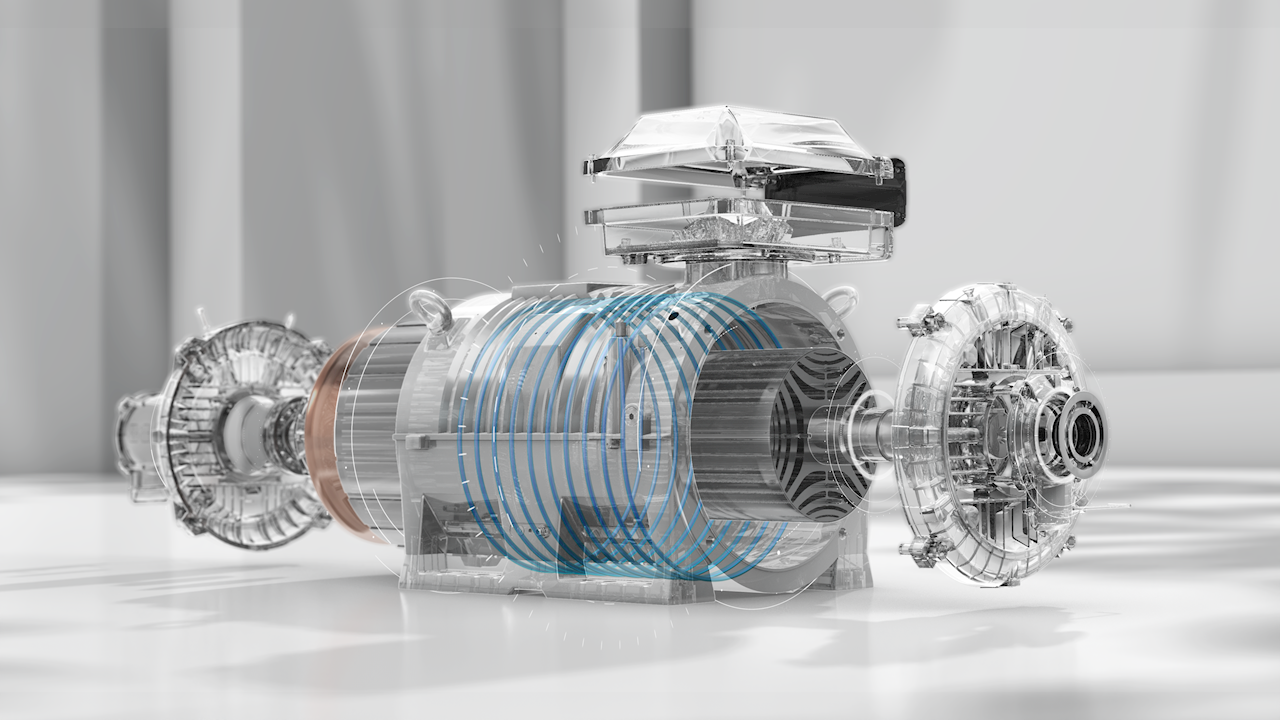
ABB IE5 SynRM liquid-cooled motor for ultra-premium efficiency 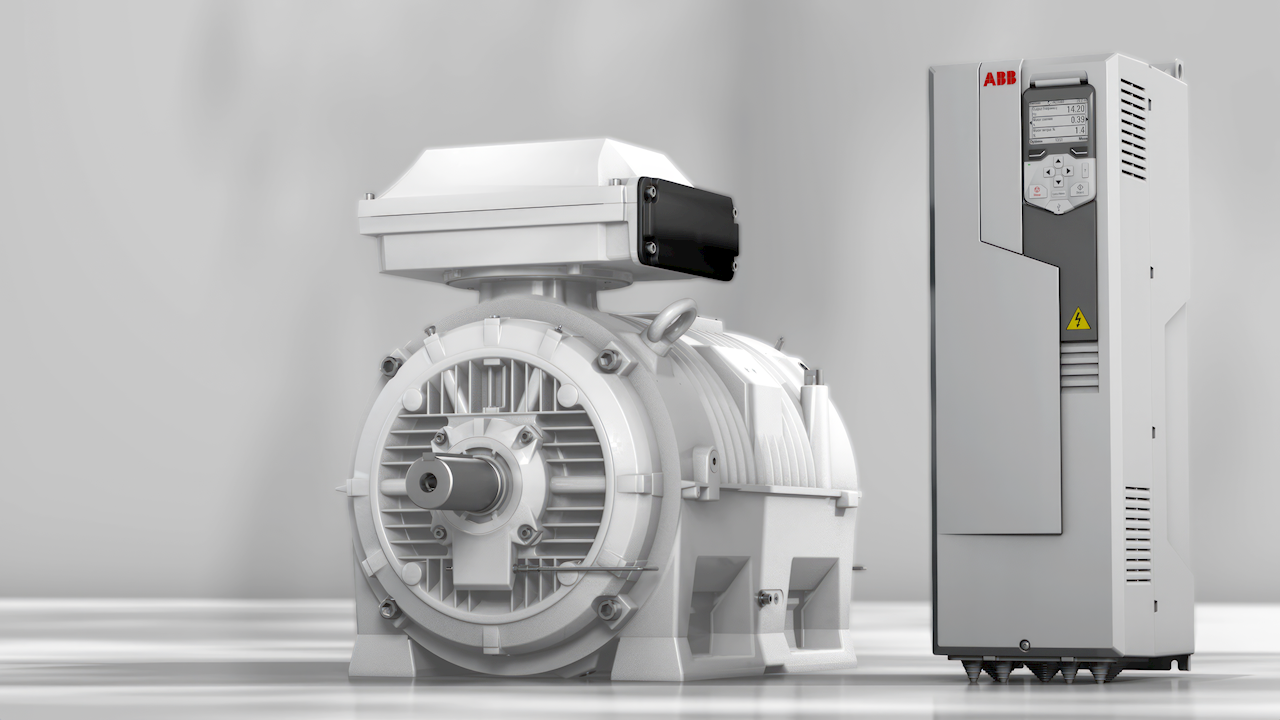
ABB IE5 SynRM liquid-cooled motor and drive package
What applications is the IE5 SynRM most suited for?
Liquid-cooled motors do not need fans or ventilation for cooling purposes, so they do not disturb the surrounding air. This can be critical for processes that are impacted by airflow, such as rubber and plastics production. Quiter running also means that liquid-cooled SynRM motors improve the working environment in industrial plants, especially where noise-sensitivity is paramount.
Their torque characteristics – with a wide speed range for constant torque applications and 100% torque down to zero speed – make these motors very suitable for driving extruders.
In addition, IE5 SynRM liquid-cooled motors enable flexible and accurate control and monitoring of processes for improved overall performance and efficiency.
What impact can an energy efficient motor have on total cost of ownership?
When specifying motors, it is important for operators to look beyond the upfront investment to consider the motor’s total cost of ownership (TCO). Over a long lifetime – say 15 to 20 years - the cost of a motor is far outweighed by the cost of the electricity to power it. For a SynRM, the upfront cost is only around 2% of its TCO, maintenance accounts for 1% and the remaining 97% is spent on electricity.
IE5 SynRM motors have 40% lower energy losses than commonly used IE3 motors. Consequently, the payback time for investing in an IE5 motor instead of an IE3 motor is often under a year. In a typical application, an IE5 SynRM motor could reduce energy usage by 34,675 kWh annually, potentially leading to savings of around €5,200 and a reduction of 13,558 kg of CO2 emissions. Over a typical 15-year life, savings would add up to €78,000 and 203,370kg of CO2.


