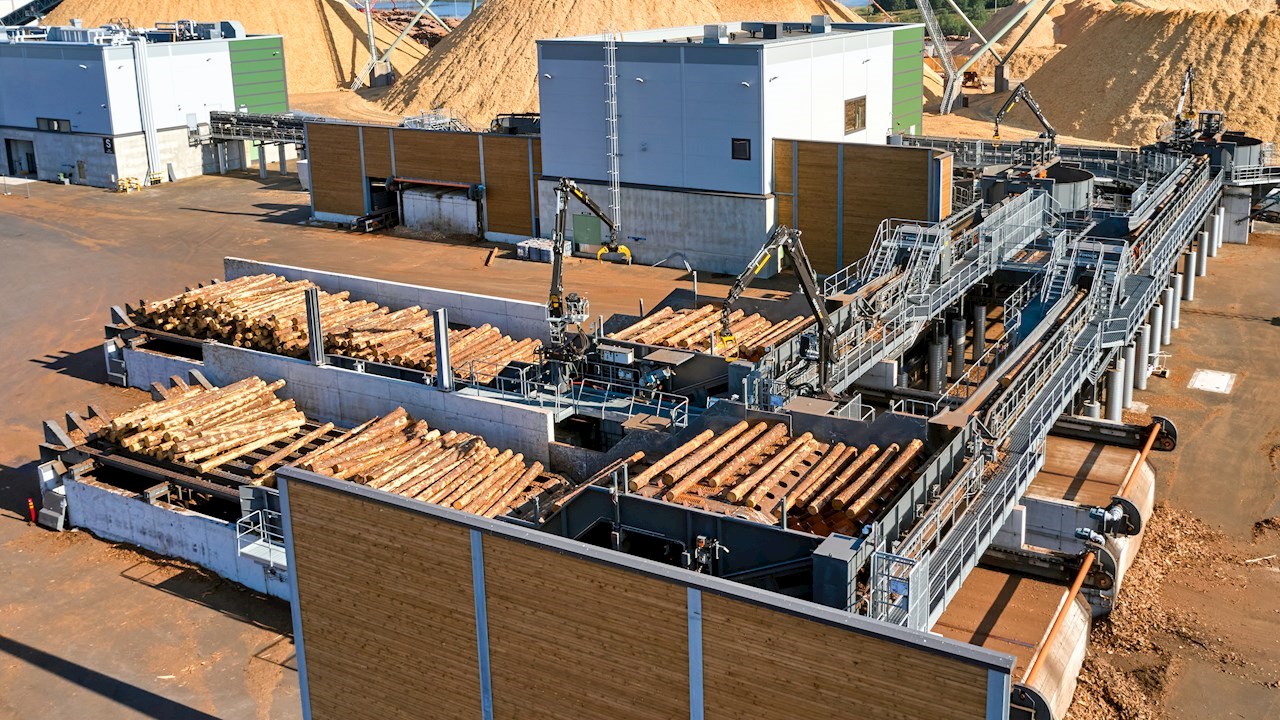
Logs from the forest are sorted using Nordautomation's log sorter, which precisely guides them into the correct lockers using a log kicker. Sorting is mainly based on the diameter of the crown. As long as the log remains round in the sawmill, it is processed using Nordautomation's conveyors and other equipment.
After sorting, the logs move along conveyors to the debarker, where they are aligned end-to-end for consistent processing. After debarking, the desired log gap is created. To achieve this, the speed at the debarker is slightly lower than the feed speed of the sawing machine. The saw infeed relies on ACS880 variable speed drives, which precisely control the process. "Keeping the log gap as short as possible directly impacts production efficiency," explains Raimo Tarkka, Electrical and Automation Manager at Nordautomation.
As the logs progress from debarking to the sawing machine, speeds increase dramatically. At Metsä Fibre's Rauma sawmill, where Nordautomation supplied the log sorting and saw infeed systems, logs travel along conveyors at speeds of up to 250 m/min. This is about twice as fast as on a conventional saw line, giving the sawmill owner more flexibility in capacity. The log gap can be constant or variable, even on a log-by-log basis.
“On the saw infeed, we take into account the desired log gap, which we reproduce with precision,” says Keijo Lamminen, Sales Manager at Nordautomation.
When logs are fed into the saw at 200 m/min, the log gap is accurate to ±50 mm. Compared to earlier solutions, this can lead to an annual increase in sawmill production worth millions of euros.
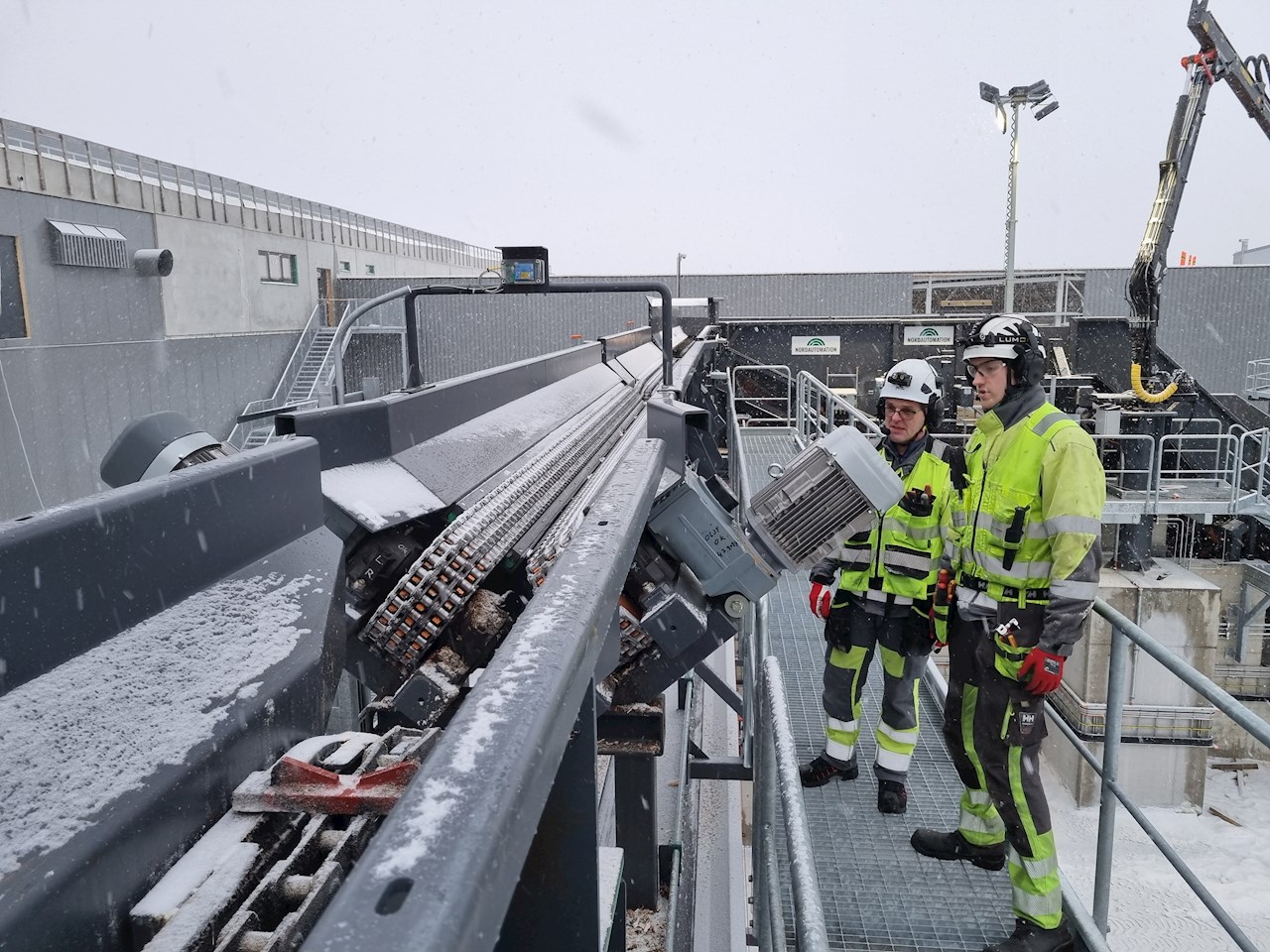
Log conveyors manufactured by Nordautomation move saw logs up to 250 meters per minute. 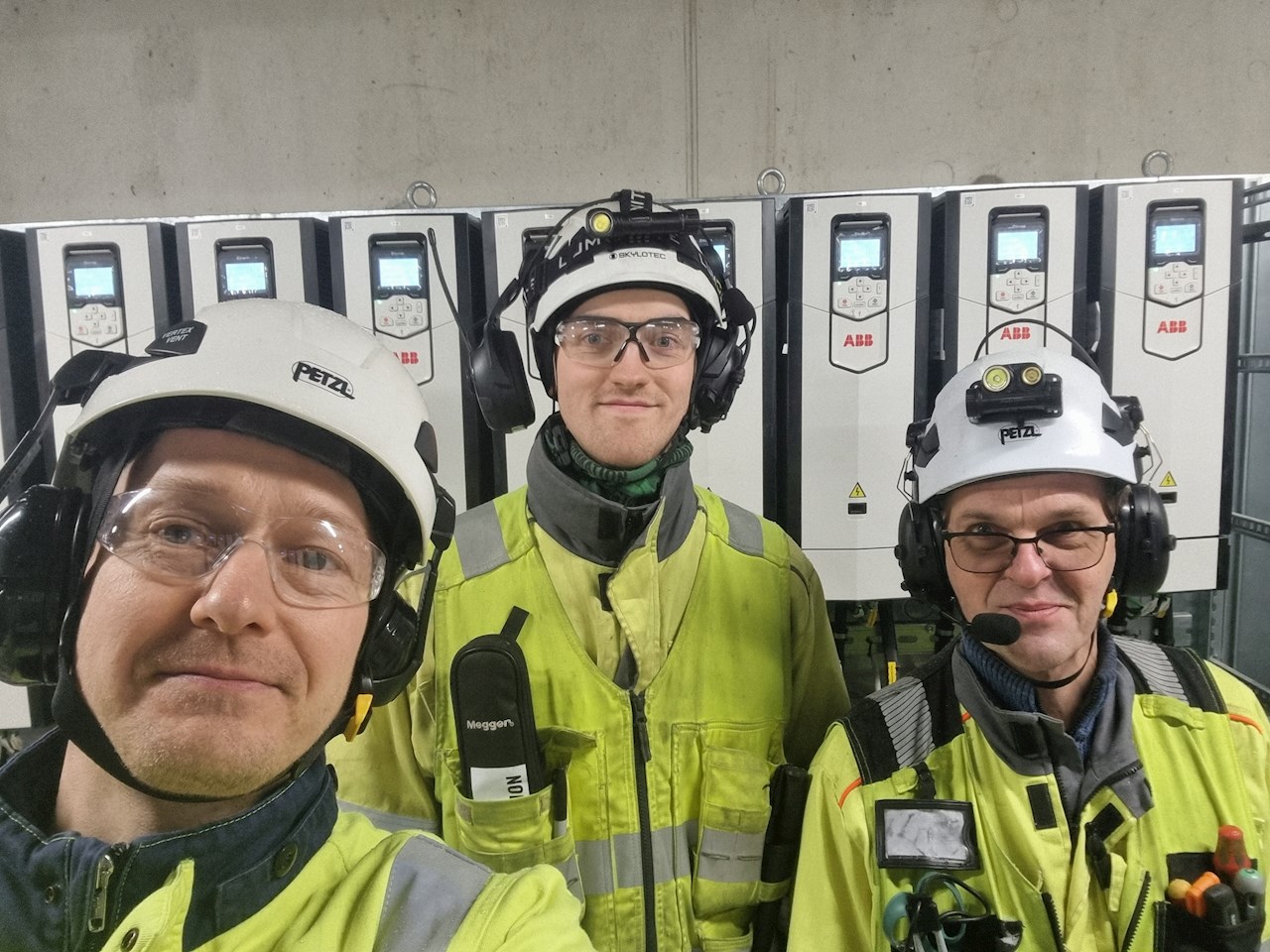
Olli-Petteri Karjalainen from ABB (left), and Janne Leppinen and Raimo Tarkka from Nordautomation pictured with variable frequency converters. 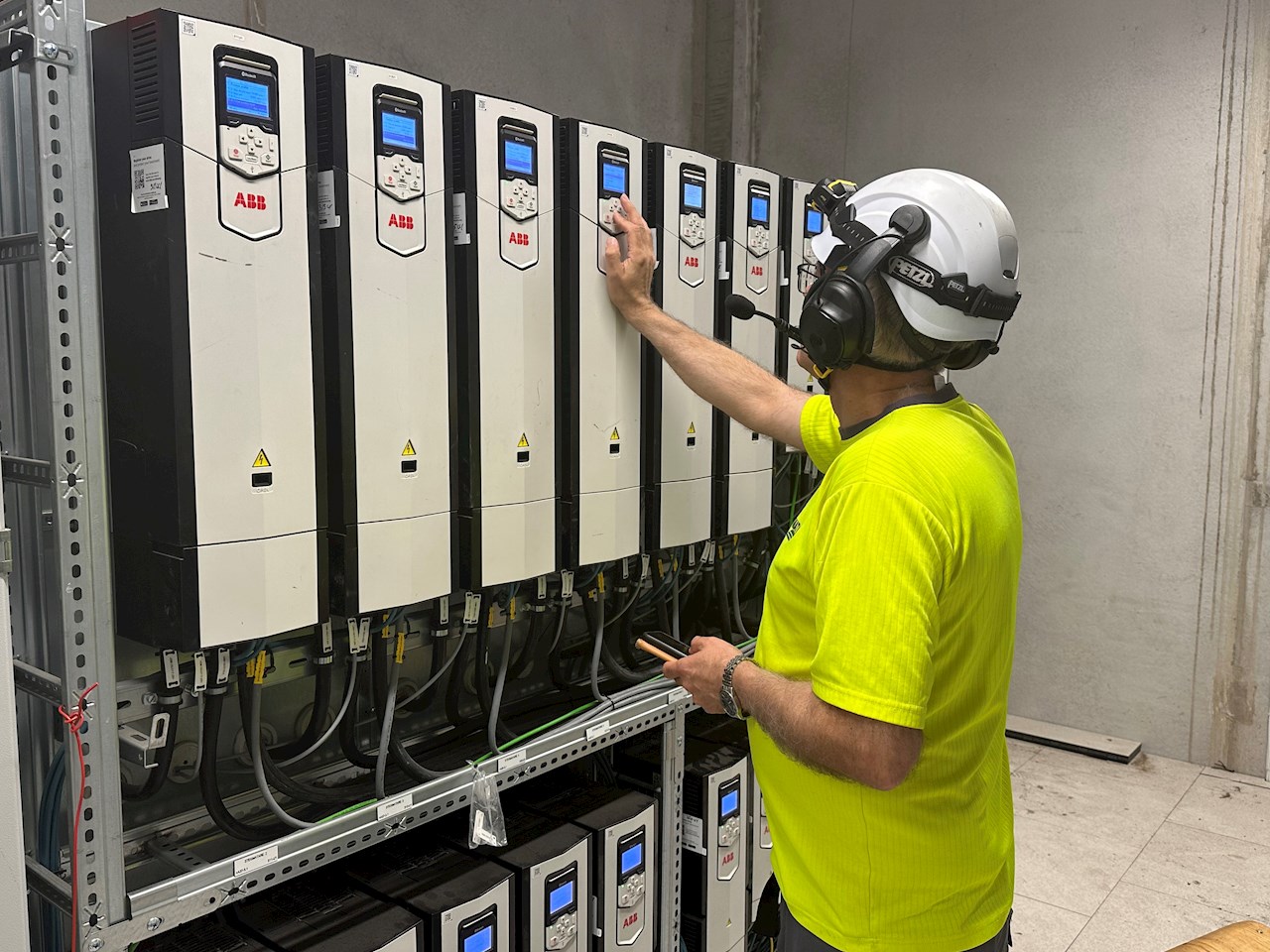
The conveyors operating at the sawmill rely on ABB's ACS880 frequency converters.
A common planning process
The control of the log gap is based on an inverter-integrated application program, developed through close cooperation between Nordautomation and ABB, with support from ABB's OEM Hub Northern Europe in Finland. The OEM Hub is ABB's application expertise center, supporting customers in choosing the best solutions for their needs, testing their applications, and sharing experience and knowledge to achieve results excellence. In Europe, these centers are in Finland, Germany, and Italy. "The OEM Hub was involved in implementing the application program and continues to provide support," says Olli-Petteri Karjalainen, Global Application Manager at ABB.
Nordautomation is pleased that the position control and calculations used for adjusting the log gap can be implemented without encoders, thanks to ABB's DTC motor control technology. "This brings significant cost savings and reduces potential failures, as encoders can wear out or break over time," says Tarkka. Since Nordautomation's conveyors operate outdoors, they face particularly demanding conditions in northern climate.
When discussing the development project, Karjalainen emphasizes the importance of cooperation. "Customers know their machines’ processes, and we know the drives. Our role is to help find solutions that improve production efficiency, enhance energy efficiency, or make machines faster and more accurate. If we can find these together, that's great."
Tarkka confirms that Nordautomation's requirements were fully considered. "We were able to specify exactly what we needed, and ABB delivered it precisely as requested." The first implementation took place at Metsä Fibre's Rauma sawmill, achieving a significant leap in conveyor speeds and control accuracy. The successful application has since been refined on lines installed at various Finnish sawills, including the Pölkky sawmill in western Finland.
Energy efficiency through optimization
In addition to boosting production efficiency, the collaboration has significantly improved energy efficiency. In the past, braking energy from conveyor deceleration was wasted as heat through brake resistors. Now, ABB's Common DC system recycles this energy within the DC circuit for use by other inverters.
“The Common DC system supports the rapid acceleration and deceleration needed to meet high-speed and dynamic performance requirements. By reusing energy within the system, we minimize energy consumption and maximize efficiency,” says Karjalainen.
The system achieves high capacity in an energy-efficient way, using only the energy required at any given moment.
As sawmill capacity and speeds continue to increase, achieving and maintaining the desired log gap remains the priority. “With our log handling technology and log gap optimization, we aim to meet these exact goals,” says Timo Kuusisto, Managing Director at Nordautomation. “Our customers appreciate the efficiency and high utilization rates of our equipment.”


