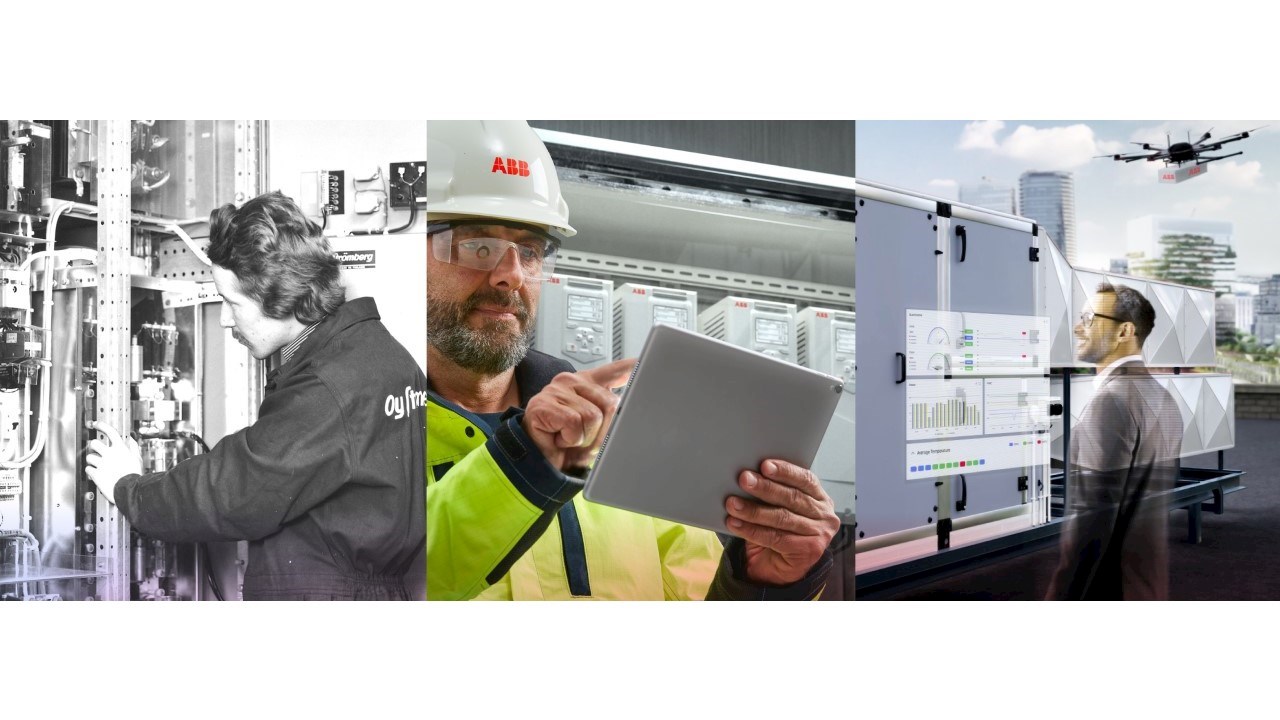
In the early stages of digitalization, such as in 1982 when the Helsinki metro was launched, ABB’s drives were part of significant technological advances. At that time, cybersecurity was not yet a central focus in product development, and development work as well as quality control relied on manual and time-consuming processes. Today, digitalization is an essential part of all business operations. Companies are investing in cybersecurity, predictive maintenance, and automated quality control. In the future, artificial intelligence, machine learning, and virtual reality will further enhance research, product development, and system reliability. ABB’s drives will continue their success story as enablers of energy efficiency and sustainable development.

The early years of ABB Drive Development – Memories from Matti Kauhanen’s career
In the early years of drive development, technological progress was slow and tools were limited. ABB’s Technology Director and honorary doctor of technology at Aalto University, Matti Kauhanen, started his career at Strömberg in 1984. Back then, information was still retrieved from books and libraries. Communication was conducted via telephone or fax. Design work was done by hand, measurements were carried out with analog devices, and reporting was done on paper. All this required time, precision, and patience.
Kauhanen recalls how, for example, the measurement of drive losses was done manually, and the results were calculated using a Fortran program he developed himself. This was a significant step towards more efficient analysis. Today, similar measurements are performed digitally and automatically.
“One of the most significant projects was the Helsinki metro, which accelerated the development of drive technology. The metro became the world’s first alternating current-based system, and its requirements laid the foundation for modern industrial drives,” Matti says.
In product development during the 1980s and 1990s, efficiency and broad expertise were emphasized. Even without digital tools, innovative solutions were created, such as the SAMI STAR – a fully digital drive. It was a top product of its time and laid the foundation for ABB’s global AC drive solutions. For Matti Kauhanen, SAMI STAR is particularly memorable because it was his first project as a young graduate engineer. At the same time, SAMI STAR was a demonstration of how determined development work and technical expertise can lead to internationally significant innovations.
Technological advancements changed product development – Experiences from Mika Kiviniemi
Senior Design Engineer Mika Kiviniemi, who works in ABB’s drive product development and laboratories, shares how technological advancements have affected his work and how the team operates today.
“Digitalization has significantly changed everyday life in the industry. The biggest change has been the shift to remote work and digital tools, which have made collaboration more flexible and efficient,” Mika says.
During Mika's career, analytics and measurement equipment have developed considerably. Data collection, simulations, and quality control have become more precise. In recent years, the rapid emergence of artificial intelligence has been surprising. Its utilization is still in its early stages, but the potential is enormous, particularly in maintenance and lifecycle forecasting. Today, drives play a central role in promoting energy efficiency and low carbon emissions. They are high-quality, long-lasting, recyclable, and at the heart of sustainable development. ABB continually invests in product development. Mika believes that ABB’s products and expertise will ensure the continued success of drives in the future.
The next leap in drive development – Patrik Tikka envisions the future
Digital & Connectivity Product Market Manager Patrik Tikka envisions the future of drives and how digitalization and artificial intelligence will revolutionize product development.
“In the future, virtual simulation tools will speed up the time-to-market for products and enhance design. Artificial intelligence will also ease expert work by improving the management and documentation of large data sets. At the same time, as automation increases, local and remote data processing will take on a new role,” Patrik says.
Patrik emphasizes that cybersecurity will continue to be one of the key themes in product development. ABB’s drives will continue to offer high-level device security and will be increasingly ready to meet future security requirements. The importance of drives as enablers of energy efficiency will become even more pronounced, and digitalization will drive this development. ABB’s drives have been and will continue to be a key part of industrial development – now and in the future.


