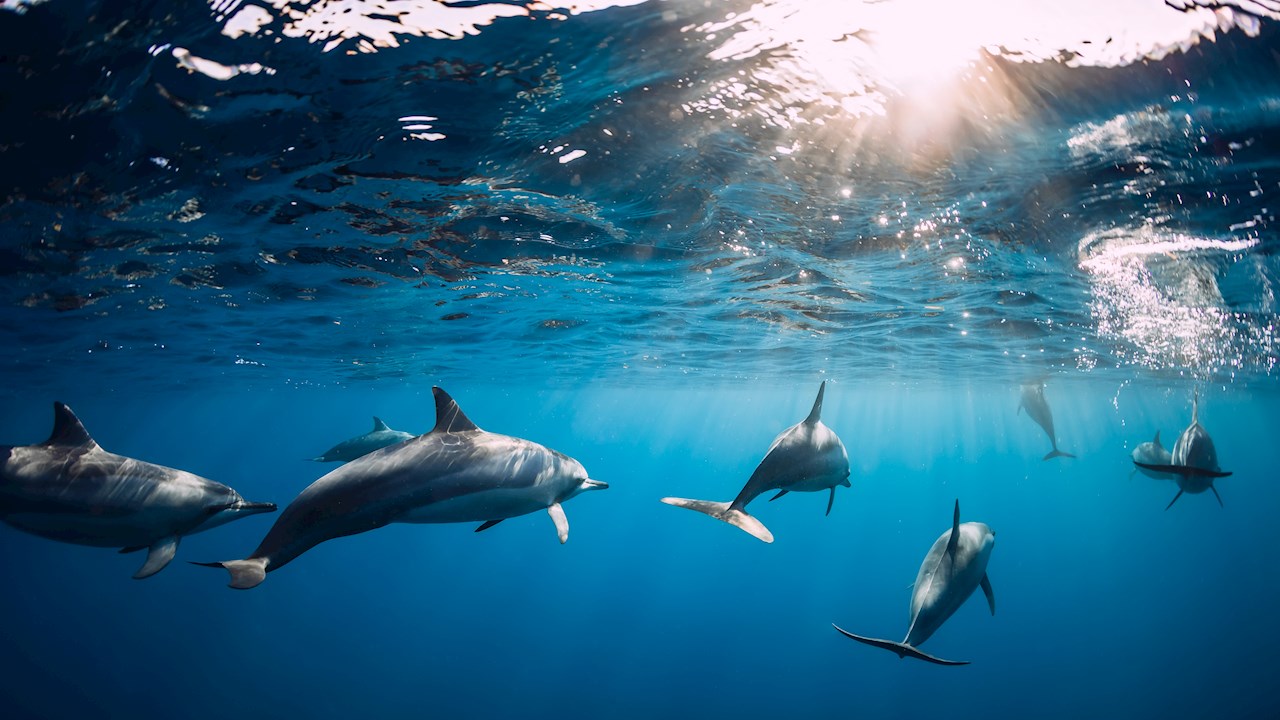
The next phase of regulatory work covering maritime decarbonization will also be key for reducing the underwater radiated noise (URN) from ships that threatens over 130 marine species1.
Roel Hoenders, Head of Climate Action and Clean Air, International Maritime Organization (IMO) Secretariat, says the still-evolving work to cut ship emissions presents an unmissable opportunity to reduce the URN from ships that masks or disturbs the acoustic cues that marine animals rely on for survival.

About 90 percent of world trade moves by sea, and it is therefore no surprise that commercial shipping is the primary source of anthropogenic, low-frequency noise that travel vast distances across the world’s oceans. United Nations2 reporting describes the noise made by propellers, machinery and hull vibrations as a “constant mechanical hum”.
For sea mammals and other species, that noise is both a source of stress and disorientation and can lead to behavioral changes that disrupt hunting and migration routes, and cause habitat fragmentation or even loss. The European Environment Agency3 identifies noise as one of the most widespread human‑induced pressures on the oceans.
Maritime decarbonization and energy efficiency are already driving fleet redesign, which creates a unique opportunity to integrate noise reduction into IMO’s ongoing technical work and change the underwater soundscape.
Cross-cutting sustainability issue
With the International Maritime Organization driving towards net-zero emissions by, or around, 2050, administrations have increasingly recognized how necessary work to make ships measurably more efficient could also result in a quieter, less environmentally disruptive shipping industry.
“Maritime decarbonization and energy efficiency are already driving fleet redesign, which creates a unique opportunity to integrate noise reduction into IMO’s ongoing technical work and change the underwater soundscape,” says Hoenders.
Like decarbonization, URN requires regulators to “break the silos” between different areas of responsibility, adds Hoenders, whose experience includes a decade at the European Commission focusing on emissions in different sectors and over seven years with the IMO Secretariat.
The IMO’s Ship Design & Construction (SDC) subcommittee reports into both the Maritime Safety Committee (MSC) and the Marine Environment Protection Committee (MEPC). MSC adopted the initial Code on noise4 in 2012 which covered personnel on board, while the Marine Environment Protection Committee first adopted voluntary guidelines on URN5 reduction in 2014.
Opportunities to tackle greenhouse gas emissions and URN in tandem were examined by an IMO expert workshop in 2023, Hoenders explains, as a substantive follow up to the Revised Guidelines6 on URN approved earlier that year. In January 2024, IMO adopted an Action Plan for URN7, with a three-year ‘experience-building phase’ launched in June 2025.
Political will to tackle the issue of URN is certainly on the rise. Already, The IMO, the UN Development Programme and the Global Environmental Facility are supporting the Global Partnership for Mitigation of Underwater Noise from Shipping (GloNoise Partnership Project8). The project aims to raise capacity and awareness, establish baselines and advance policy on URN in Argentina, Chile, Costa Rica, India, South Africa, and Trinidad and Tobago.
High noise ambitions
In June 2025, meanwhile, the UN Oceans Conference (UNOC3) in Nice saw the launch of a new ‘High Ambition Coalition for a Quiet Ocean’, including 37 member countries led by Canada and Panama.
In applauding the commitments made across multiple issues of concerns over the world’s at UNOC3, IMO Secretary General, Arsenio Dominguez also invited stakeholders to “turn those words into real, measurable action”9.
The reminder is especially timely in the case of URN, where true progress will rely on improving the understanding of shipping’s impacts at the global level based on experience-building to establish what measurable action will look like.
“The 2023 URN guidelines included a section covering the synergies between fuel consumption, ship emissions, energy efficiency and noise reduction,” says Hoenders. “They offered design recommendations on hull and propeller optimization, machinery noise reduction and recommendations for operational measures like speed reduction.”
Energy saving solutions such as low-friction antifouling coatings, propellers designed for lower cavitation, electrical systems and air lubrication systems are also known for their noise reducing impacts. IMO’s future Fifth Greenhouse Gas Study – due completion in 2027 – could further strengthen the synergies with energy efficiency measures by providing an updated outlook on the uptake of fuels and technologies that would also reduce URN.
Shipping is on board
Shipping industry efforts are also part of the current momentum on the topic, where stakeholders already investing in ESDs to cut emissions are happy to outline the positive impact on URN, as another longstanding environmental challenge.
“Classification societies have also offered valuable support by formalizing best practice in new types of URN ship class notations, developing of a URN Management Plan or other voluntary sustainability certifications. This aligns with the section in the 2023 guidelines on how to incentivize actions, since nothing is mandatory at this juncture,” Hoenders says.
Proactive maritime administrations have been running trials at local level to establish whether and how energy saving devices reduce URN, with “some very impressive in cutting decibels".
Further strengthening cooperation is a new Global Industry Alliance focusing on URN, which will follow the “best-practice” seen in the Global Industry Alliance to Support Low Carbon Shipping. A public-private partnership, the Low Carbon GIA successfully brought together shipowners and operators, class, technology providers, big data, fuel suppliers and ports to identify and develop solutions and best operational practices to enable low- and zero-carbon fuels.
We're trying to identify and fast track what can realistically be done under the Noise Action Plan, including the procurement of a global URN study.
Even so, consistency and truly effective global action will benefit from “establishing a true baseline on URN first – for better or worse”, Hoenders reiterates. “The priority is that the IMO URN correspondence group assisting the experience-building phase, led by Belgium, supports the implementation of URN Action Plan and establishes the terms of reference for a study addressing the areas where knowledge gaps can be identified."
Global benchmark
“We have strong data at a local level covering smaller ship types, and insights on global URN impacts; what we need is more data from large ocean-going vessels. There are also ships that we know have ESDs but the impact on noise is not reported, so it is not possible to estimate how many ships in service merit credit for ‘low noise’.”
One complicating factor is that IMO regulations are often specific to ships trading internationally. With vessels below 5000 GT falling outside the scope of IMO energy efficiency requirements, such as the Carbon Intensity Index. Using data from one tool used by IMO to measure the efficiency of ship operations would leave out smaller ferries and harbor craft operating domestically.
“We're trying to identify and fast track what can realistically be done under the Noise Action Plan, including the procurement of a global URN study,” says Hoenders. “This may be after MEPC 84, which is expected to approve terms of reference for the Fifth IMO Greenhouse Gas Study.”
In contrast to the precise figures covering the contribution of ship emissions to global greenhouse gas (GHG) emissions, and the measurable impacts of different decarbonization solutions, information on the effects of URN on the marine environment and the results of mitigation remain patchy. Threshold URN values to assess environmental status are under development in response to the EU’s Marine Strategy Framework Directive (MSFD).
A quieter future
With the experience-based phase of evidence gathering also underway at IMO, unknowns include the final form of future URN regulatory frameworks. Following UNOC3, IMO SG Mr. Dominguez nonetheless commented: “We now have an action plan to develop mandatory mechanisms learning from this.”
For the moment, it would not be unreasonable to draw further parallels between approach acceptable to IMO administration on decarbonization and the prospects with respect to URN.
“We already have the Energy Efficiency Design Index (EEDI) and the Energy Efficiency eXisting Ship Index (EEXI), for example, and we might expect elements of them to be useful in noise reduction measures,” says Hoenders. In common with other IMO rules, any mandatory URN requirements are likely to be ‘goal-based’ in the sense that a variety of solutions could be deployed to achieve a given goal.
Other working assumptions reflect the fact that different ship types generate different levels of URN. Here, it is worth noting that IMO applied different schedules for different ship types when it came to compliance with EEDI.
ABB’s work on URN
ABB has been working on underwater noise phenomena for more than ten years. This includes internal development as well as collaboration with customers and participation in several international research projects such as Energy and Lifecycle Efficient Machines (EFFIMA) 11, Propeller induced low and high frequency noise (PropNoise)12, Cooperative Research Ships (CRS)13, Underwater Radiated Noise management for ECO-efficient shipping (URNECO)14, and latest in the CIMAC working group WG 22 Radiated Noise, which was founded in April 2025 to enhance compliance by ensuring industry adherence to IMO guidelines on URN reduction15.
Images credit: Adobe Stock
References
[3] https://www.eea.europa.eu/en/analysis/publications/marine-messages-2-2
[9] https://www.imo.org/en/mediacentre/pressbriefings/pages/unoc-imo-call-for-tangible-action.aspx
[10] https://www.imo.org/en/mediacentre/hottopics/pages/cutting-ghg-emissions.aspx
[11] https://cris.vtt.fi/en/publications/effima-ohjelma-p%C3%A4%C3%A4t%C3%B6kseen-menetystarina-fimecc
[12] https://cris.vtt.fi/en/projects/propeller-induced-low-and-high-frequency-noise
[14] Underwater Radiated Noise management for ECO-efficient shipping - VTT's Research Information Portal
[15] https://www.cimac.com/working-groups/wg22-radiated-noise/index.html


