Shipping has often faced criticism for perceived slowness in its regulatory processes, but in October 2025 IMO finds itself at a rare crossroads — one that could redefine its climate trajectory for decades to come.
Following the preliminary approval of the IMO Net-Zero Framework at MEPC's 83rd session in April, attention now turns to the extraordinary MEPC session scheduled for October in London. There, member states are expected to formally adopt the framework, which combines mandatory ship emission limits with a global greenhouse gas (GHG) pricing mechanism.
The framework foresees a global standard for each ship‘s ‘greenhouse gas fuel intensity’ (GFI), calculated using a well-to-wake approach. The GFI must reduce over time, in line with the IMO target of net-zero industry emissions by or around 2050.
Usually moving forward on the basis of consensus, the MEPC agreement required a vote of administrations, in a process from which the US administration had already withdrawn. Some now wonder whether final adoption will proceed as planned when MEPC meets again in October. In contrast, others see the changes already made to maintain the working majority as a pragmatic step to preserve momentum, even if it signals a softening of the IMO’s 2023 GHG strategy.
Toward transition
Charlotte Nonnemann, appointed as Vice President, Regulatory & Public Affairs, Marine Systems, at ABB’s Marine & Ports division earlier this year is among those emphasizing prospects of a “historic achievement” for maritime decarbonization if the Net-Zero Framework proceeds. It would prepare the ground for a legally binding framework by 2027 to support IMO’s 2050 target, she says.
“If adopted, shipping would become the first global industry to combine mandatory emission limits and GHG pricing,” Nonnemann observes. “Ships emitting above GFI thresholds would need to balance emission deficits by trading them for credits earned by those using zero/near-zero GHG technologies.”
It is fair to say we will have to wait for more clarity around investments in alternative fuels until the guidelines around the Net-Zero Fund and how alternative fuels are rewarded are fully agreed.
Under the framework, GFI below a Direct Compliance Target would earn surpluses that can be passed on to other ships or banked for future use, Nonnemann explains. Ships emitting above the Direct Compliance Target but below a Base Target would pay a $100/ton CO₂eq penalty. Emissions beyond the Base Target would lead to a higher $380/ton CO₂eq penalty.
“This would introduce incentives to use lower carbon fuels but also starts to create the type of certainty investors find attractive. As its name suggests, the Net-Zero Framework is a framework, and a lot of the details have yet to be defined and developed within lifecycle assessment guidelines before the GFI is fully developed. It is fair to say we will have to wait for more clarity around investments in alternative fuels until the guidelines around the Net-Zero Fund and how alternative fuels are rewarded are fully agreed.”
Global outlook
A career in regulatory affairs “mostly working with technical people and engineers” brought Nonnemann to ABB early in 2025. With posts at Maersk Drilling, Ørsted, and most recently as Director ESG Public and Regulatory Affairs with A.P. Moller-Maersk, Nonnemann has been closely involved in key renewable and decarbonization projects – in offshore wind, alternative fuels (including green methanol use production) and carbon capture.
Originally from Munich, Nonnemann now lives in Copenhagen, and has a “global citizen” outlook that extends to her work in maritime, energy, sustainability and trade. A political economist by education, she has a decade of experience of the issues in play when regulation and commerce converge. “If I look back, my PhD on energy businesses, industrial policy and regulatory frameworks was quite heterodox at the time, but industrial policy is now a mainstream business concern.”
First crossing paths with her future ABB colleagues as a key note speaker at the Transport Research Arena in Lisbon in 2022, Nonnemann was immediately intrigued by “the eye-opening insights on what could be achieved already in realizing IMO goals by focusing on greater energy efficiency”.
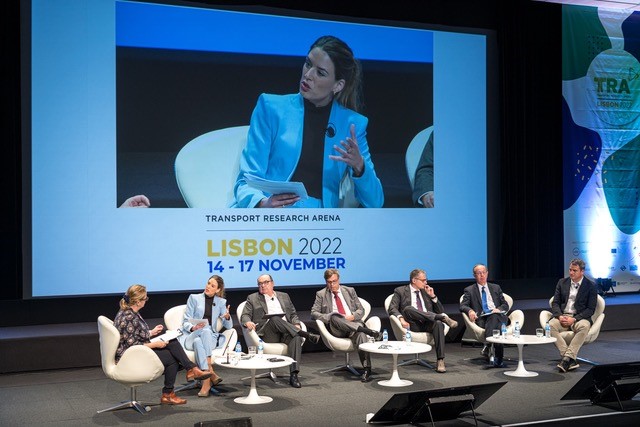
Nonnemann crossed paths with her future ABB colleagues as a keynote speaker at the Transport Research Arena Conference in Lisbon, November 2022. Image credit - TRA2022 
Transport Research Arena Conference, Lisbon, November 2022. Image credit - TRA2022
“I had been concentrating on the e-fuel perspective, where the conversation can quickly focus on challenges around escalating costs to the exclusion of everything else,” she says. “It was refreshing to discuss the significant impact available options can have on sustainability, and the economic and environmental benefits of efficiency whatever the energy source.”
The insights continue to resonate. While maritime decarbonization will require the industry as a whole to adopt a range of solutions that include e-fuels, shore power, zero-emission batteries, wind power and others, every case will demand energy efficiency planning, monitoring and implementation.
“The regulations driving shipping toward decarbonization have been challenging – and sometimes a pain point – for our customers,” says Nonnemann. “New energy sources will be more expensive, which makes optimizing energy efficiency even more critical for the investor, the owner/operator, and for solution uptake.”
Framing net-zero
While many matters remain open for discussion, the framework proposed at IMO would broaden owner considerations on the risks and rewards of investing in alternative fuels, new assets, asset optimization, shore power, carbon capture, etc.
The ambition should be that the fuel buyer is incentivized to buy lower carbon fuel and that the cost of doing so is also persuasive in adopting the most energy efficient systems and technologies. Energy efficiency technologies will thus be a crucial enabler for the uptake of alternative fuels. It’s certainly a very exciting time to join ABB and be part of its contribution on to reducing the GFI.
If IMO moves forward with what was agreed in April, it will bring encouraging guidance for potential investors in lower emission shipping, Nonnemann adds. “As they consider their options, they will also need to know that their favored solution will be verifiable as delivering optimized efficiency.
“We know, for example, that the original Carbon Intensity Index did not hold the charterer accountable effectively for a ship’s CII rating over time. The ambition should be that the fuel buyer is incentivized to buy lower carbon fuel and that the cost of doing so is also persuasive in adopting the most energy efficient systems and technologies. Energy efficiency technologies will thus be a crucial enabler for the uptake of alternative fuels. It’s certainly a very exciting time to join ABB and be part of its contribution on to reducing the GFI.”
Higher fuel costs unquestionably increase the number of energy-efficiency options based on return on investment. Planning, monitoring and implementing those solutions effectively is therefore a business-critical issue.
ABB is a strong participant in the bodies which formulate international standards for marine technology, but Nonnemann draws the distinction between its own needs and the regulations that affect its customers.
“We continuously try to optimize our working relationships for the benefit of our ship owner and yard customers to maintain safety, sustainability, and innovation at the core of our shared mission.”
For example, ABB recently organized a workshop with the American Bureau of Shipping (ABS) to strengthen collaboration and knowledge sharing.
Another early priority for Nonnemann has been cultivating an ABB knowledge hub to monitor and report on regulatory affairs. “This will support our need to share insights with regulators in one direction and in the other inform our organization of external developments to benefit decisions on product and client-facing strategies,” she says. “There are interdependencies in the value chain and multiple channels in regulatory conversations.
“Regulatory affairs is a service to our own business and an advisor on risks and opportunities, but its role is to help build strategy based on regulatory impact assessments. ABB is an interested party, as a supplier of energy-efficient technologies and solutions whose marine business has a mission to enable maritime decarbonization in the most cost-effective ways.”
“Higher fuel costs unquestionably increase the number of energy-efficiency options based on return on investment. Planning, monitoring and implementing those solutions effectively is therefore a business-critical issue.”
Images credit: CIMAC, TRA2022, ABB


