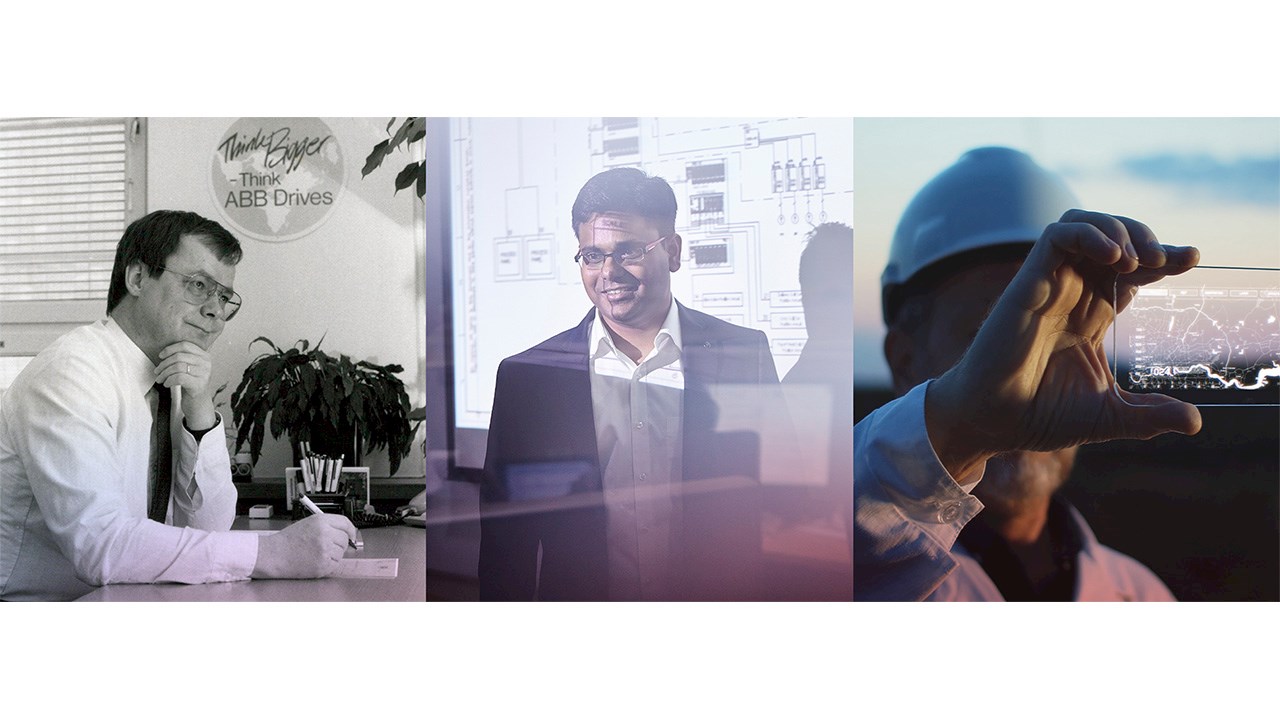
In 2005, ABB introduced a compact revolution: the ACS350, a four-kilowatt drive that proved advanced motor control could fit in the palm of your hand. Two decades later, that same DNA powers machines across the globe, from cranes lifting tons with surgical precision to conveyor lines running at breathtaking speed. But behind every leap in performance lies something more enduring than artificial materials: people.
This is the story of ABB’s machinery drives told through the eyes of three individuals who helped shape them. A pioneer who co-laid the foundation. A connector who brings solutions to the world. And a visionary who builds the future.
Lessons learned on the factory floor
Jussi Rantanen’s journey with ABB began not in a lab, but in a power plant. At sixteen, he spent his first summer job maintaining switchgear during a renovation at his father’s workplace; his first hands-on encounter with ABB technology. That early exposure sparked a career that would span continents and decades.
By 1998, Jussi had joined ABB full-time, starting with medium-voltage drives before moving into low-voltage technology. In 2008, he stepped into product management for what would become the “machinery drives” portfolio. At the time, ABB excelled in simple applications like pumps, fans, and conveyors, leaving more complex machinery equipment underserved.
The ACS350, launched in 2005, was ABB’s first answer for machinery’s technological wealth. It proved there was demand below four kilowatts, but it lacked features like functional-safety shutdown and sensorless control of permanent-magnet motors. Those came with the ACS355 in 2010, kicking off seven years of rapid growth.
Jussi’s approach was always grounded in reality. “Every interaction with the customer is a chance to learn,” he says. Whether it was sticky, sugar-coated conveyors or fine-tuning motor control, the team prioritized on-site testing and real-world feedback over tidy roadmaps. One unforgettable project involved a food-and-beverage conveyor system where the customer demanded double the drive performance. After a year of on-site iteration, ABB hit the target only to lose the order. Still, the breakthroughs from that effort became key know-how for future drives.
Even during COVID, when travel halted, the relationships Jussi had built over the years proved invaluable. One long-time customer in Portugal, running ABB drives for 18 years, faced a precision-stopping issue. A competitor promised a fix, but ABB’s team stayed close, tweaked parameters, and solved the problem, retaining the customer and eventually migrating them to the newer ACS180.
Jussi’s story is one of hands-on learning, relentless iteration, and deep customer empathy. In a world of 10,000 unique machine applications, he believes the speed of learning is the ultimate competitive edge.
Making drives speak every dialect
If Jussi helped build the foundation, Ümit Kahraman is the bridge, connecting ABB’s machinery drives to the world. Based in Helsinki, Ümit leads global machinery sales, a role he took on after 15 years developing OEM businesses in Türkiye.
His mission is clear: sharpen ABB’s focus on machine builders. These customers don’t think in terms of product lines; they want a seamless “drive-and-automation” solution that just works. Ümit’s job is to make sure ABB delivers exactly that.
He understands the complexity machine builders face. Even two machines doing the same job, like extruders, can have vastly different specifications depending on the region or end-user. One might require Profinet, another Ethernet/IP. That’s why ABB’s drives must be compact, configurable, and ready for anything.
The current portfolio reflects this philosophy. The ACS180 is a plug-and-play inverter for simple tasks. The ACS380 offers modular flexibility. And the new ACS380-E integrates Ethernet connectivity, high performance and cyber security on one platform streamlining usability, safety and productivity.
Ümit’s strategy focuses on high-repeat niches: cranes, extruders, blow-fill machines, paint mixers, and, more recently, textiles, ceramics, and automated warehouses. ABB’s edge, he says, lies in its full ecosystem, drives, motors, PLCs, and now servo-motion systems, backed by five decades of expertise.
One standout success came from Brazil, where ABB partnered with Copeland to embed adaptive firmware into ACS380 drives. They are integrated directly into an e-commerce platform, allowing engineers to order pre-tagged drives with a single click. “Outside-the-box thinking,” Ümit calls it, proving what’s possible when ABB listens closely to its customers.
As ABB celebrates 50 years of low-voltage drives, Ümit sees the future not in raw power, but in seamless integration. His role is to ensure that ABB’s solutions fit effortlessly into machine builders’ workflows and stay there, reliably, for decades.
When hardware hit its ceiling
Where Ümit connects today’s solutions to the world, Prabhu Nagavi is building tomorrow’s. As global product manager for the ACS380 and ACS380-E, Prabhu’s focus is clear: future-proofing ABB’s machinery drives.
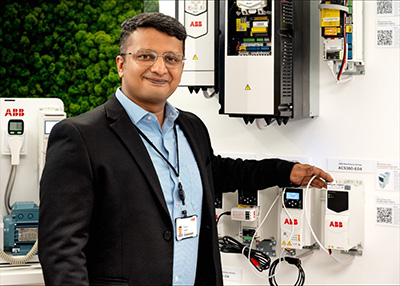
He joined ABB India in 2007, managing solar-pump drives before moving into broader product management. In 2020, he relocated to Finland to lead the next chapter of machinery drives. Just before COVID, Prabhu’s team realized their existing hardware was hitting limits. Memory and computing power were no longer sufficient to meet the demands of future machines. The result? Project Serrano designing the new next-generation drive platform and, as a result, the birth of the ACS380-E.
This new platform is a leap forward. Native Ethernet support (Profinet IO, EtherNet/IP, Modbus TCP) comes standard. It includes a full suite of I/O, SIL 3 functional safety, and a universal USB-C port for easy commissioning. It’s also designed to meet IEC 62443-4-2 Security Level 2 by 2027, embedding cybersecurity into the core of ABB’s offering.
Prabhu’s vision extends beyond specifications. He’s introducing a minimal “status panel” with just two LEDs, keeping costs low for applications that don’t need a keypad. And he’s quietly pushing sustainability: future drives covering will use recyclable plastics, and ABB will refurbish returned panels for reuse.
Performance remains paramount. Customers now expect Ethernet by default, and ABB is delivering. Soon, additional protocols like EtherCAT & Ethernet Powerlink will be unlocked via software licenses, moving toward a subscription model. Speed control has already improved dramatically, from milliseconds to microseconds.
Looking 15–20 years ahead, Prabhu envisions wireless drives and smarter systems where drives take on more control logic, reducing reliance on PLCs. His advice to future engineers? “Listen to customer needs and pain points before applying your engineering abilities.” It’s a philosophy that has guided every step of ABB’s journey and one that will shape its future.
Human stories behind smart machines
ABB’s machinery drives have evolved through four generations, each faster, safer, and more adaptable than the last. But the real story isn’t just about technology. It’s about people.
The Portuguese printer which needed two-millimeter accuracy. The Brazilian chiller line that needed e-commerce integration. The engineers in Finland who built Project Serrano. These aren’t just case studies; they’re proof that when customer problems come first, innovation follows.
What began with a handful of “hammers and carpenters” has grown into a global software powerhouse. Leaders like Panu Virolainen, Mika Pääkkönen, Fausto Belotti, Antti Koponen, Ümit Kahraman, and Linda Stenman-Kuusilinna have each played a role, balancing rigorous engineering with real-world empathy.


