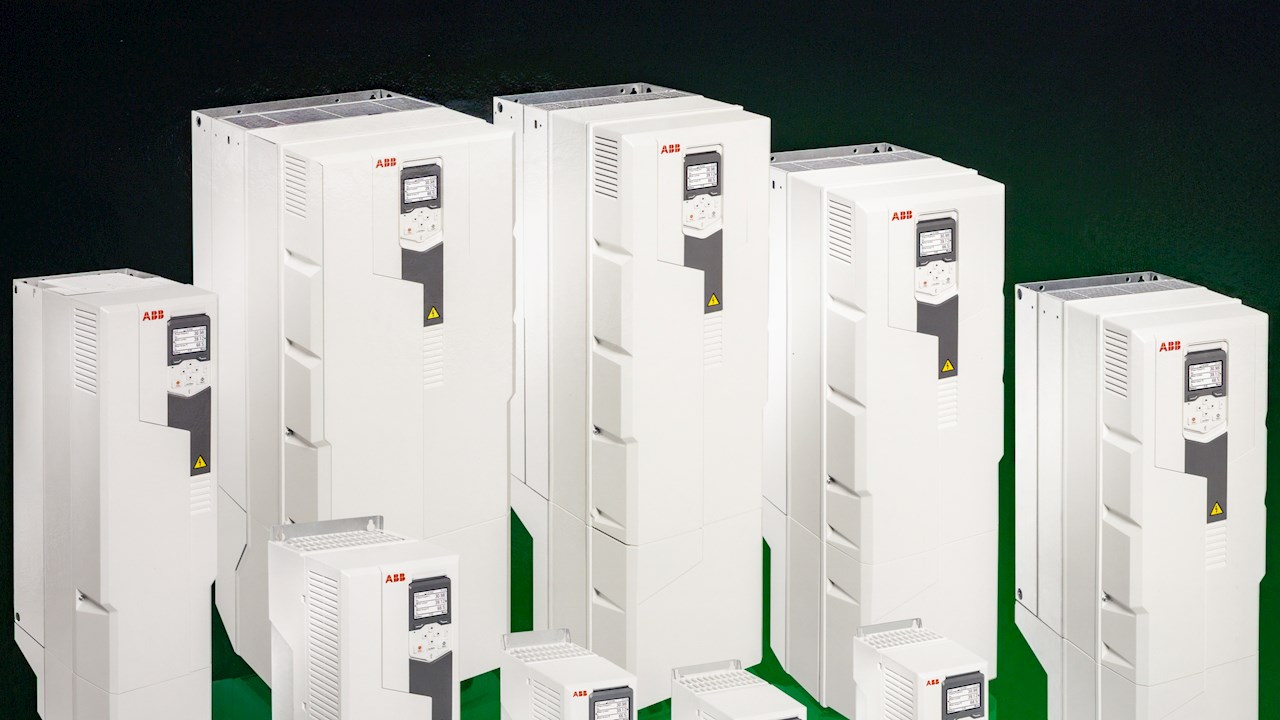
• This month marks the 50th year since ABB’s Low Voltage Variable Speed Drive (VSD) was first brought to market
• Developed by Finnish engineering company Strömberg, which went on to become part of ABB, the VSD has revolutionized industrial energy consumption and decarbonization
• 45% of the world’s electricity is converted by industrial electric motors into motion but less than 25% of those motors are connected to a VSD today
• VSDs already save the EU 41 TWh of electricity per year, but have the potential to save a further 140.7 TWh every year
October 2025 marks the 50th anniversary of the Low Voltage Variable Speed Drive (LV VSD), which was used in a commercial application for the first time at a sawmill in Finland, in 1975. It was developed in the 1970s by Strömberg, a predecessor to today’s global motor and drives industry leader, ABB.
The LV VSD addressed a long-standing limitation of the traditional squirrel-cage induction motor, which had remained fixed-speed since its invention by Nikola Tesla in 1888. Prior to the introduction of VSDs, adjusting motor performance for variable loads typically relied on mechanical throttling methods, such as dampers or valves - solutions that did little in terms of energy efficiency.
“For 50 years, ABB’s low voltage drives have been a part of many era-defining technologies and breakthroughs, from electric public transport to today’s push for energy-efficient, low-carbon industries. Before the VSD, getting a fixed-speed motor to deliver the right output was like driving your car with your foot all the way down on the accelerator, and braking at the same time to control your speed,” explains Tuomo Hoysniemi, President of Drive Products at ABB.
“Commercially, this is an incredibly expensive problem, but in terms of energy efficiency, it’s even worse. With a Variable Speed Drive, you can be precise about output, dramatically improving industrial energy efficiency. Low voltage VSDs were a major breakthrough. They have since become the gold standard and have seen wider and faster adoption, but still to this day, less than 25% of industrial motors worldwide are connected with a drive.”
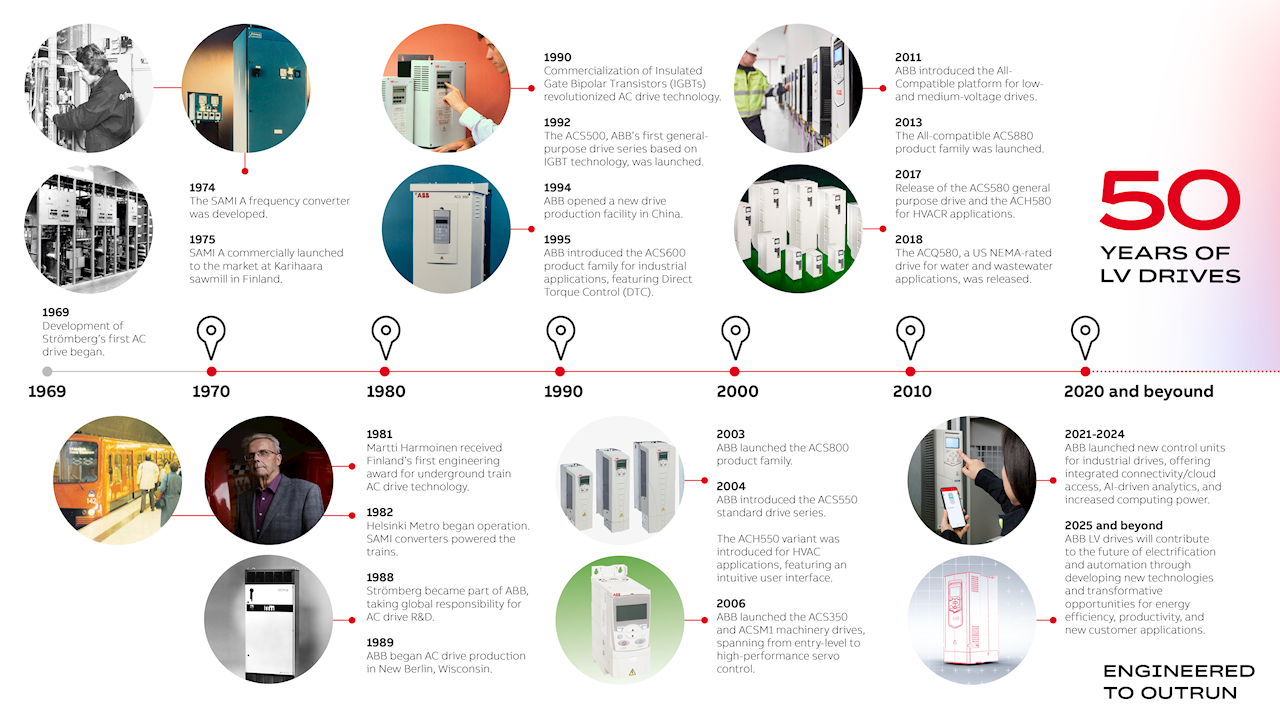
The first real-world installation of the SAMI A took place later that year at the Karihaara sawmill in northern Finland, using three 350 kVA/500 V units. This demonstrated that variable speed control could offer measurable efficiency and reliability benefits in an industrial environment. The technology quickly expanded into new sectors and applications, including Helsinki’s metro system, where it supported smoother, more energy-efficient public transport.
The first commercial LV VSDs were developed in the early 1970s by Strömberg, a Finnish electrical engineering company that would become part of ABB in the 1980s. In 1975, the company launched the SAMI A (Strömberg Asynchronous Motor Inverter), the first low voltage drive capable of precisely regulating the speed of an AC induction motor.
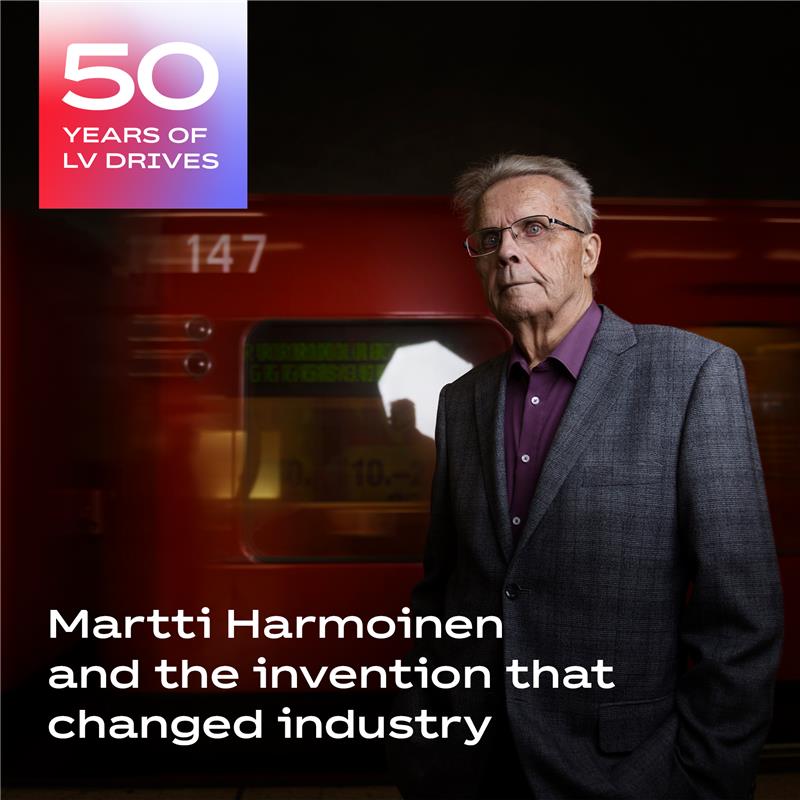
Martti Harmoinen, the Strömberg engineer credited with leading the original development team, received the Finnish Engineering Award in 1981 and the honorary title of Professor in 1995.
“Not every motor on the planet can be fitted with a Variable Speed Drive, but there is no question that most of them should be,” said Chris Poynter, President of Motion High Power at ABB. “There is a perception that sustainability is cost-prohibitive, but energy efficiency and decarbonization in an industrial setting are commercially prudent as well as fulfilling our duty to the planet. The total cost of ownership of running a motor with a VSD is far lower than working it to an early failure.”
Independent studies suggest that if VSDs were applied more broadly, including both constant and variable flow applications like pumps, fans, and compressors, annual energy consumption in EU could be reduced by around 140 terawatt-hours. ABB estimates that using VSDs in these scenarios can lead to energy savings of up to 12% per installation.
Though Martti Harmoinen passed away in 2023, his work remains central to ABB's mission to advance smart, efficient motor systems worldwide. ABB today is a market leader in the design and manufacture of VSDs, and continuously invests in cutting-edge technologies to realize the full energy efficiency potential of global industry. In the next 50 years, we may see further advances and the universal adoption of drives - or something completely new. Whatever the occasion, ABB will rise to meet it.
To find out more about the history and impact of the Low Voltage Variable Speed Drive, visit 50 years of LV drives | ABB.
ABB is a global technology leader in electrification and automation, enabling a more sustainable and resource-efficient future. By connecting its engineering and digitalization expertise, ABB helps industries run at high performance, while becoming more efficient, productive and sustainable so they outperform. At ABB, we call this ‘Engineered to Outrun’. The company has over 140 years of history and around 110,000 employees worldwide. ABB’s shares are listed on the SIX Swiss Exchange (ABBN) and Nasdaq Stockholm (ABB). www.abb.com
ABB Motion, a global leader in motors and drives, is at the core of accelerating a more productive and sustainable future. We innovate and push the boundaries of technology to contribute to energy efficient, decarbonizing and circular solutions for customers, industries and societies. With our digitally enabled drives, motors and services we support our customers and partners to achieve better performance, safety and reliability. To help the world’s industries outrun – leaner and cleaner, we deliver motor-driven solutions for a wide range of applications in all industrial segments. Building on over 140 years of domain expertise in electric powertrains, our more than 23,000 employees across 100 countries learn and improve every day. go.abb/motion
— | ||
Media Relations | ||


