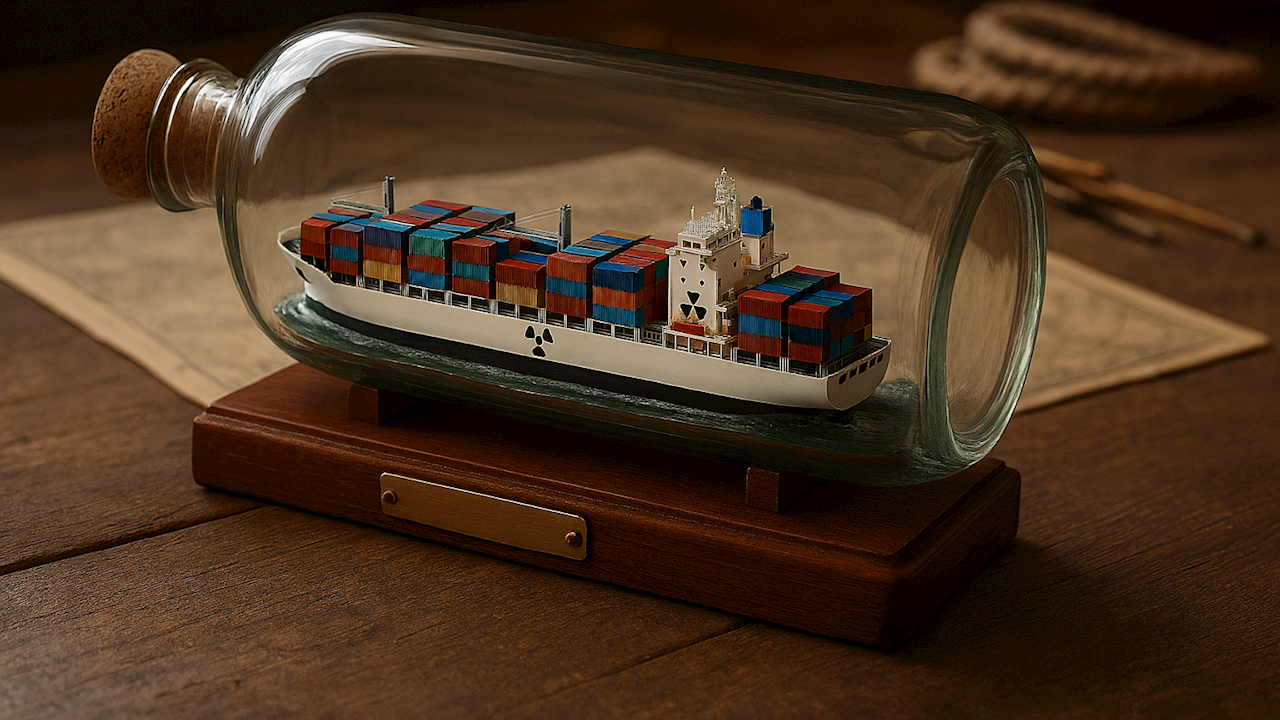
There are growing indications that shipping can add nuclear propulsion to its options for achieving net zero emissions. Recently technologists, national governments and maritime regulators have increasingly highlighted its fast-emerging potential.
Nuclear-powered ships have an extensive history in naval and icebreaker applications. However, it has been the advent of 4th generation Small Modular Reactors (SMR) which has opened the case for the use of nuclear technology also in commercial shipping. Class societies Lloyd’s Register1, ABS2 and RINA3 have already voiced their support for the nuclear option. Previous ABB articles4 have also highlighted ship concept projects in the public domain. Joining the pack, in September, Samsung Heavy Industries (SHI) and the Korea Atomic Energy Research Institute (KAERI) launched an SMR-powered LNG carrier5 concept, in work with ABS and the Liberia flag. According to the developers, its 100 MWt molten salt reactor would power a ship without refueling through-life.
Intense work has been going on behind the scenes through 2025 to ensure that nuclear propulsion can become a realistic option for commercial shipping
In one indication of market sentiment, nuclear propulsion featured as a headline topic at several London International Shipping Week events in September, and was a frequent talking point for financiers, owners, consultants and insurers at other fuel-focused gatherings.
A quieter revolution
Intense work has also been going on behind the scenes through 2025 to ensure that nuclear propulsion can become a realistic option for commercial shipping, says Markus Virtasalo, Solution Manager, Electric Solutions, ABB’s Marine & Ports division.
Virtasalo is working closely with Samuli Hänninen, Segment Manager, Icebreaking ships, and others on harnessing ABB’s expertise in power distribution, control, automation and system integration to convert nuclear reactors’ thermal energy to electricity and propulsion.

Markus Virtasalo, Solution Manager, Electric Solutions, ABB’s Marine & Ports division 
Samuli Hänninen, Segment Manager, Icebreaking ships, ABB's Marine & Ports
Perhaps reflecting historical sensitivities on nuclear power, those approaching ABB to explore the options invariably seek non-disclosure agreements, says Virtasalo. However, he adds: “Interest is coming from every angle – from owners, class, yards, financiers and others. We have been empowered to make an early start on nuclear ship system and propulsion design, which puts us in a strong position to accommodate any surprises for what will be a marathon – not a sprint.”
Patience will be critical because design schedules are linked to SMR developers' roadmaps for developing reactors of various sizes and types, he explains. Concept design work for nuclear-powered ships also involves collaboration with more stakeholders and more documentation than is typically required for conventional vessels without nuclear systems.
“But since the prize is a reliable source of ship power that generates zero emissions even at high vessel speeds, independent of any external decarbonization device or fuel supply chain issue, this is certainly a marathon worth running. It should also be noted that 4th generation nuclear is not only a decarbonization solution, but irrespective of that, it also opens the door to new advanced merchant ship designs with performance that has been previously unachievable.”
Decisive collaboration
In September, ABB signed a memorandum of understanding (MoU) with Swedish nuclear energy company Blykalla to support and accelerate the deployment of small modular lead-cooled reactors to the maritime industry. The agreement builds on the terms of a 2024 MoU between the two companies which targets developing SMR technology to support Sweden’s clean energy requirements.
Blykalla’s Swedish Advanced Lead Reactor (SEALER) is a highly compact, passively safe reactor with inherent safety features ensuring stability even without external control. SEALER is also one of three reactors identified in the Nuclear Propulsion for Merchant Ships I (NuProShip I) project, which aims to adapt a 4th generation SMR to the requirements of maritime vessels – in particular, larger ships.
Working with ABB’s Marine and Ports division will offer Blykalla “a unique opportunity to lead the way in maritime nuclear propulsion – a solution uniquely positioned to meet the sector’s demand for clean energy”, said Jacob Stedman, CEO at Blykalla, at the time of the MoU. “Realizing this vision will require an ecosystem of committed partners, and this collaboration is a critical building block.”
Pre-dating the recent Blykalla announcement, ABB’s work on maritime nuclear power has already included concepts for several different vessel types.
We are looking at everything from icebreakers, containerships and tankers, LNG carriers and yachts – and more.
“We are maturing our thinking, while working with other stakeholders,” says Virtasalo. “The work itself is confidential, but as a general example, we are considering high-power electric propulsion, up to and beyond the limits conventional combustion engines place on propulsion power for ultra-large containerships. Our thinking includes one or two SMRs per ship, depending on the desired output.”
Internal work involves clarifying the upper limits and discussing the implications for control technology and automation, says Virtasalo.
Nuclear intervention
Stamina for the long game will also be needed to align with the timeline of regulators as they reframe maritime legislation to accommodate nuclear-powered ship propulsion.
The legal position on nuclear maritime was the subject of a separate article from ABB6 earlier this year, although shipping’s global regulatory landscape on emission reduction remains uncertain. The long-awaited decision on the International Maritime Organization (IMO)’s Net-Zero Framework has been postponed by one year, leaving questions open about next steps. The proposed measure would have required shipping to pay for its emissions at a global scale, while at the same time incentivising alternative fuels via the proposed Net-Zero Fund.
In the absence of a clear global framework, there are ongoing doubts about the readiness and availability of biofuels, methanol, ammonia, batteries and fuel cells to achieve net-zero goals by replacing heavy fuel oil (HFO) and liquefied natural gas (LNG) as marine fuels.
In June 2025, IMO’s Maritime Safety Committee (MSC110) agreed to begin updating legacy regulations governing nuclear-powered ships, tasking the Sub-Committee on Ship Design and Construction (SDC) to start work on a framework to bring nuclear propulsion into the mix to achieve net-zero emissions by around 2050.
In July, the IMO gave NGO status to the Nuclear Energy Maritime Organization (NEMO), whose members include shipowners, shipyards, classification societies, insurers, legal companies and port authorities. ABB is a member of the NEMO ‘task force’ which has been invited to develop formal proposals to bring to IMO for consideration, which Hänninen once again puts in the context of the ‘marathon’ analogy.
Patience will be critical because design schedules are linked to SMR developers' roadmaps for developing reactors of various sizes and types.
Reviewing rules written for 3rd generation Pressurized Water Reactor technology and evaluating which parts to keep, which to update and which will need to be reinvented for 4th generation SMR technology will take time. Pilot projects may need to anticipate overarching global regulation, so that pioneering ship owners can make the running in dedicated ‘green corridors’ that work within bilateral agreements.
Working with nuclear

"If ABB’s knowledge and experience of working with maritime regulations will be key to the success of the ABB-Blykalla partnership, so will the broad scope of its expertise in maritime technology," says Samuli Hänninen.
“They are the reactor specialists, while we offer expertise in naval architecture and marine engineering, and insights into what our customers are seeking, to bring the kind of certainty Blykalla can build on to accelerate its development work in this application.”
“From a naval architect’s perspective, interfacing a nuclear reactor with versatile ‘steam-electric’ power plant and integrating it with electric motor driven shaft lines or Azipod® propulsion involves familiar thought processes, and practical knowledge of the flexibility of steam-electric power as a suitable solution across diverse vessel types”, Hänninen points out. “Currently, it is possible to work on generic system solutions, while reactor-specific interfaces can be handled later.”
As well as zero emission power, SMRs will enable other innovations in ship design: the reactor could run the ship without refueling and carrying any additional fuel on board, freeing up space for more cargo, for example, or support faster speeds and so disrupt the market with new transport logistics, Hänninen says.
Pioneering ship owners may make the running in dedicated ‘green corridors’ that work within bilateral agreements.
“We have a clear view on the way steam plant will work, but the interface with the reactor is a key area of focus for our collaboration,” adds Virtasalo. “Of course, we are looking together at issues relating to SMR weights and dimensions, dynamic tolerances, the shielding needed and how installation would integrate into normal shipbuilding practice.”
Detailed work will also include developing the economic case for any new controls that will be needed to ‘marinize’ the SMR. It is a legacy of earlier developments in nuclear ship propulsion that key marine tests remain rooted in analog circuitry and, while there is no technical reason to impede digitalization, Virtasalo explains, this economic case has also yet to be investigated.
There is therefore plenty of distance left to cover in the nuclear maritime marathon, he acknowledges. However, with Blykalla foreseeing its first SMR “reaching criticality” by the early 2030s, the ambitions are also clear.
“We have moved on from the general discussions with class and regulators on the potential of nuclear – to guidelines from class, and working with owners on several ship concept cases, working with different designers, shipyards and other stakeholders,” comments Hänninen. “We are looking at everything from icebreakers, containerships and tankers, LNG carriers and yachts – and more.”
References
- Nuclear propulsion could transform maritime | LR
- ABS Approves Nuclear Power Module for Maritime Decarbonization - Maritime Technology Review
- Application of nuclear technology for superyachts - RINA.org
- View ahead for nuclear ship propulsion | News center | ABB
- "First Step Toward Reactor-Powered Ships"...Samsung Heavy Industries and Korea Atomic Energy Research Institute Obtain Approval in Principle - The Asia Business Daily
- Radical thinking needed on nuclear ship regulation | News center | ABB
Images credit:
- Adobe Stock
- Markus Virtasalo with Gen AI using dedicated prompts


