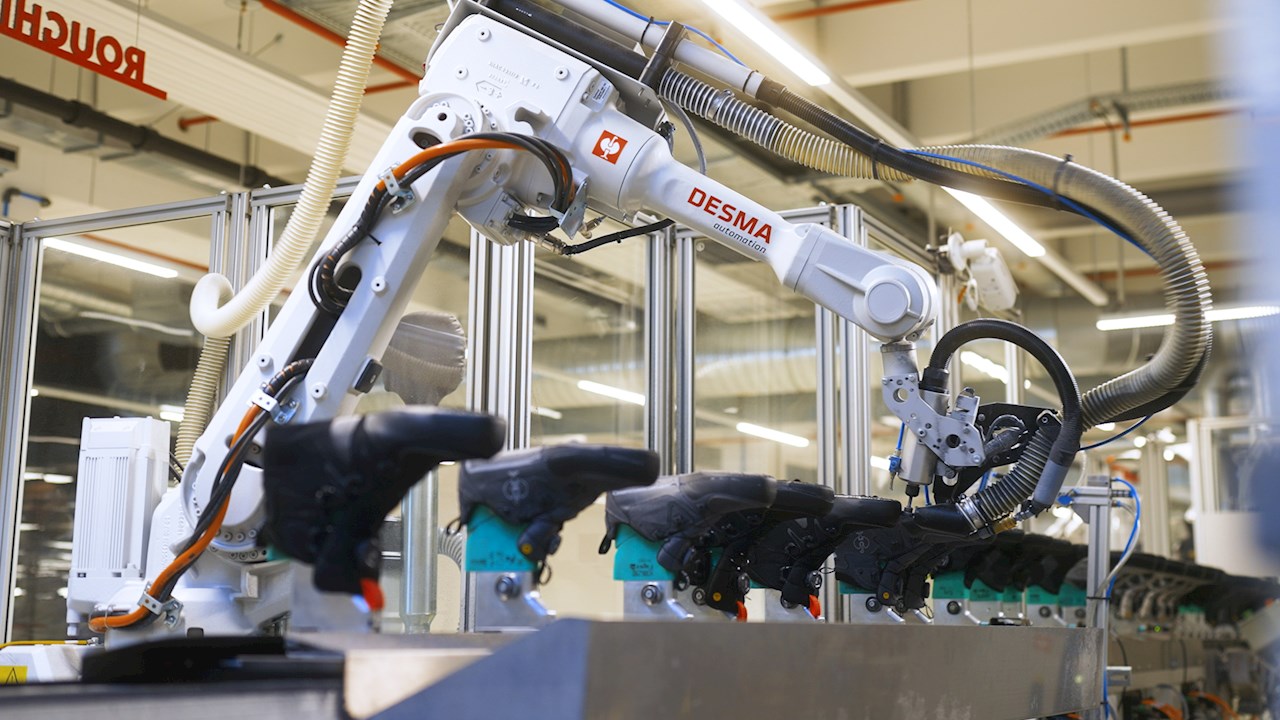
One of these customers is Strauss, a leading international workwear brand. At Strauss’s CI Factory in Germany, DESMA systems powered by ABB robots are helping produce high-quality children’s and safety shoes with new levels of flexibility, precision, and efficiency.
An ideal pairing that has shaped an industry
Since the 1980s, DESMA Schuhmaschinen has been redefining industrial shoe manufacturing through automation. Its first pilot installation with ABB Robotics marked a turning point that proved the feasibility of robot-assisted footwear production and opened the way for widespread adoption across the industry.
Following the pilot’s success, DESMA and ABB Robotics demonstrated the system at trade fairs around the world, prompting many manufacturers to rethink their reliance on manual processes. By 1990 alone, 70 ABB robots were delivered for shoe production applications, handling tasks including roughening, applying adhesives, and spraying release agents.
Today, more than 1,700 ABB robots are in operation in DESMA systems globally. For DESMA’s customers, the enhanced performance delivered by the robots brings a range of benefits, such as consistent high quality, reduced exposure to hazardous materials for workers, and more sustainable use of materials with less waste and fewer offcuts. Automation also enables factories to run around the clock with no loss in performance, boosting production efficiency and cost-effectiveness.
Turning innovation into practical solutions
Over the years, the collaboration between DESMA and ABB Robotics has deepened, with the two companies co-developing production solutions designed specifically for the footwear industry.
“When you work together on solutions for over 40 years, you get to know each other really well from a technical perspective,” says Tobias Giron, Sales Specialist at ABB Robotics. “Our robots are now an integral part of DESMA systems.”
A core goal has been to simplify robot control so that even operators without programming experience can use the systems confidently.
Working closely with DESMA over several intensive development cycles, ABB Robotics created an intuitive control system that enables robots to be run and supervised with minimal technical expertise during the day and totally unsupervised during night shifts.
Precision and flexibility for a complex product
Producing footwear, especially safety shoes, demands exceptional precision. While they come in pairs, every shoe is unique, with left differing from right, and sizes varying widely. Safety footwear also requires more material combinations and intricate processing steps than everyday shoes.
Traditionally, many robots lacked the sensitivity needed for contour-critical tasks, limiting their use to basic pick-and-place operations. ABB robots, however, offer contour accuracy, force control, and repeatability required for high-precision operations such as roughening and processing complex geometries.
Strauss utilizes these capabilities at its CI Factory, where DESMA machines equipped with ABB robots manage a range of demanding production tasks with consistent accuracy.
Automated shoe production at Strauss
Located in Hessen, the Strauss CI Factory showcases state-of-the-art shoe manufacturing across 6,000 m² of production space. Since opening in 2019, the facility has produced over 300,000 pairs of shoes. Many of them are made using an innovative direct soling process in which the sole is molded directly onto the upper in a single integrated step.
At the heart of this process are five ABB robots that carry out the key production tasks. Two IRB 1600 units spray release agents, and carry out laser-assisted roughening, while a further two IRB 2600 robots handle tasks between the rotary table and the laser cell. A third IRB 2600 then lays the steel soles and performs additional roughening operations.
“The combination of the DESMA system and ABB robots enables us to produce top-quality safety shoes right here in Germany,” says Thomas Schwieder, Production Manager at Strauss Deutschland GmbH & Co. KG. “The system is flexible, efficient, and sustainable – exactly what modern manufacturing needs today.”
The solution also offers exceptional versatility. The system can switch within seconds from producing a children’s shoe in size 25, to a women’s safety shoe in size 39, to a men’s safety shoe in size 43, with no hardware adjustments needed. Robots complete these operations at speeds up to 100 mm per second while maintaining tolerances to as little as 3 mm, even on small children’s shoes where precision is critical.
Paving the way for local, sustainable production
As well as changing how shoes are made, automation is also opening opportunities for DESMA customers to adapt their business models. According to Christian Decker, Managing Director of DESMA Schuhmaschinen, robotics is becoming a decisive factor in bringing manufacturing closer to consumers.
“Robotics is the key to cost-effective manufacturing in high-wage countries like Germany,” Decker explains. “It allows our customers to save materials, reduce costs, and respond flexibly to market fluctuations.”
The use of robotic automation in shoe production is also improving working conditions. Tasks that expose workers to fumes, dust, noise, or vibration, such as adhesive spraying, material abrasion, or surface treatments, are now handled by automated, enclosed robot cells. This greatly improves workplace safety and comfort while lowering both material use and energy consumption. By ensuring higher product quality, it also supports greater sustainability by reducing the amount of lower-grade output.
The power of collaborative innovation
The relationship between ABB Robotics and DESMA demonstrates how long-term collaboration can reshape an entire industry. Through co-development, shared learning, and continuous refinement, the two companies have pioneered robotic solutions that are now standard across global footwear manufacturing.
The partnership will continue to evolve to explore new opportunities in sustainable production, next-generation robot control, and advanced automated processes tailored specifically for the footwear market.


