The AI-Driven Power Surge
The rapid expansion of artificial intelligence and machine learning applications is fundamentally transforming data center power requirements. Modern AI servers and GPU-intensive workloads demand unprecedented power densities, with individual racks now consuming 30, 50, or even 100 kW - far exceeding the traditional 5-10 kW per rack. This dramatic increase in power demand places extraordinary stress on electrical distribution systems, particularly at the sub-distribution level where busway tap-off units feed these high-performance server racks.
The Critical Challenge: Limiting Let-Through Energy
As power densities soar, the ability to limit let-through energy and current during fault conditions becomes paramount. In high-power environments, short-circuit events can release devastating amounts of energy in milliseconds, potentially damaging sensitive and expensive AI computing equipment, disrupting critical operations, and compromising safety.
The stakes are high. Data center downtime costs average $5,600 per minute, with over 60% of failures incurring at least $100,000 in losses(1). In AI-powered facilities where individual racks consume 30-100 kW, a single fault can cascade across multiple systems, threatening both equipment and revenue.
Traditional protection devices may not provide adequate current and energy limitation for these demanding applications, creating vulnerabilities in the infrastructure supporting mission-critical AI workloads.
As these risks intensify, the focus for consultants, operators and installers shifts from understanding the power surge to defining exactly what kind of protection can withstand it. High-density racks accelerate fault energy, reduce tolerance margins and demand protection that reacts faster and more predictably than traditional devices were ever designed to. This is the point where the discussion moves from the broader challenges facing AI-era data centers to the technical requirements that truly determine system resilience – current limitation, peak fault behavior and compliance with the standards governing modern low-voltage assemblies.
A New Standard for Circuit Protection
Addressing these challenges requires circuit breakers that combine exceptional breaking capacity with superior current-limiting performance - all within the space constraints of modern busway systems and rack power distribution units (PDUs). The protection solution must not only interrupt fault currents reliably but also minimize the peak current (Ipeak) and let-through energy (I²t) that downstream equipment experiences during short-circuit events.
This is where advanced circuit breaker technology makes the difference, providing the robust protection that AI-era data centers demand while meeting the stringent requirements of international standards for low-voltage switchgear assemblies.
How ABB Can Support
Effective protection in high-density environments requires deep understanding of real-world operations. With our technology integrated in approximately ¼ of the world's data centers, ABB brings proven expertise to high-density environments.
Our S800 range is a high-performance circuit breaker (HPCB) that perfectly fits installation in busway tap-off units, ensuring reliable protection against short circuits and overloads to high-power density server racks.

How it stands out:
- Compact and high-performing: Offers unbeatable short-circuit performance up to 50kA with rated current up to 125A in only 1.5 module width per pole
- Current and energy limiting technology: Designed with two arc chambers per pole
- Standards compliant: Wide range compliant to IEC/EN 60947-2 and UL 489 standards
- Flexible configuration: Different currents and tripping characteristics cover diverse customer needs
- Remote monitoring ready: Compatible with a wide set of accessories including signal and auxiliary contacts to identify device status, and shunt trip units for remote and controlled fast-opening of the circuit
Superior Current-Limiting Performance
The S800 features two arc chambers per pole - a design specifically engineered to limit let-through energy (I²t) and peak current (Ipeak) during short circuits.
Why Ipeak matters:
Ipeak represents the maximum instantaneous fault current during a short-circuit event. It's the highest current that can flow through the MCB to downstream equipment at any moment during a fault. The lower the Ipeak, the better the protection for sensitive components like AI servers.
Meeting IEC 61439-1 Requirements
IEC 61439-1, the standard for low-voltage switchgear assemblies, includes section 10.11.12 which exempts certain circuits from short-circuit withstand strength verification - a provision applicable to data center rack PDUs. This exemption applies when assemblies are protected by current-limiting devices with a cut-off current (Ipeak) not exceeding 17 kA.
The S800 delivers exceptional protection:At the highest rated current of 63A and maximum short-circuit value of 50 kA, the S800S series achieves a maximum Ipeak of approximately 12.5 kA at 415 VAC. For lower rated currents and short-circuit conditions, Ipeak values are even lower. At short-circuit conditions up to 25 kA, Ipeak stays below 10 kA.
The result? Maximum S800 Ipeak current remains below 17 kA under all conditions, providing maximum safety to the installation and ensuring compliance with industry standards.
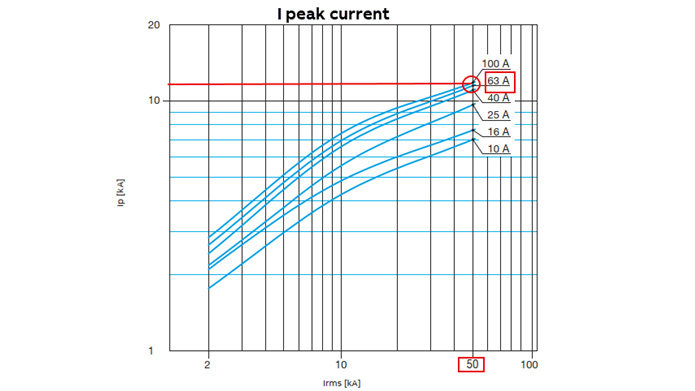
The proper protection device selection should account for expected short-circuit conditions in the installation, including the impedance of cables and whips connecting the S800 inside tap-offs to downstream rack-PDUs.
Advanced Features for AI-Ready Infrastructure
Beyond current-limiting performance, the S800 offers integration capabilities essential for modern data center operations. The HPCB is compatible with signal and auxiliary contacts for status monitoring, as well as shunt trip units for remote circuit control.
High-density AI racks increasingly rely on liquid cooling systems to manage extreme heat loads. When a cooling system fails, servers face immediate risk of overheating and damage. The S800's shunt trip functionality enables remote, controlled fast-opening of the circuit the moment a cooling failure is detected - protecting expensive AI hardware before damage occurs.
This integration capability ensures the S800 works seamlessly within broader data center management systems, providing both protection and intelligent control where it matters most.
Protecting What Powers the Digital World
From megawatt- to gigawatt-scale, ABB helps data centers innovate with speed. The S800 HPCB range is part of our comprehensive source-to-rack approach that makes data centers more efficient, reliable, and scalable.
As power densities continue to rise and AI workloads expand, having the right protection at every point in the distribution chain becomes increasingly critical. The S800 delivers that protection - combining proven performance with the flexibility to adapt to evolving requirements.
Ready to enhance your data center's protection strategy? Learn how the S800 HPCB range can support your high-density power distribution requirements.


