
Shore power expert and decarbonization champion, Chris Poyner is also an engineer who describes his approach as “using ordinary solutions to solve extraordinary problems”.
This type of understatement surfaces even in the briefest encounters with Poyner, beneath which lies a passion that has brought to pursuing opportunities at ports worldwide since he was appointed as the Head of Shore Power at ABB’s Marine & Ports division in 2022. Poyner is also a Board Member of the European Onshore Power Supply Association since December 2024 and is regularly invited to speak at shore power events.
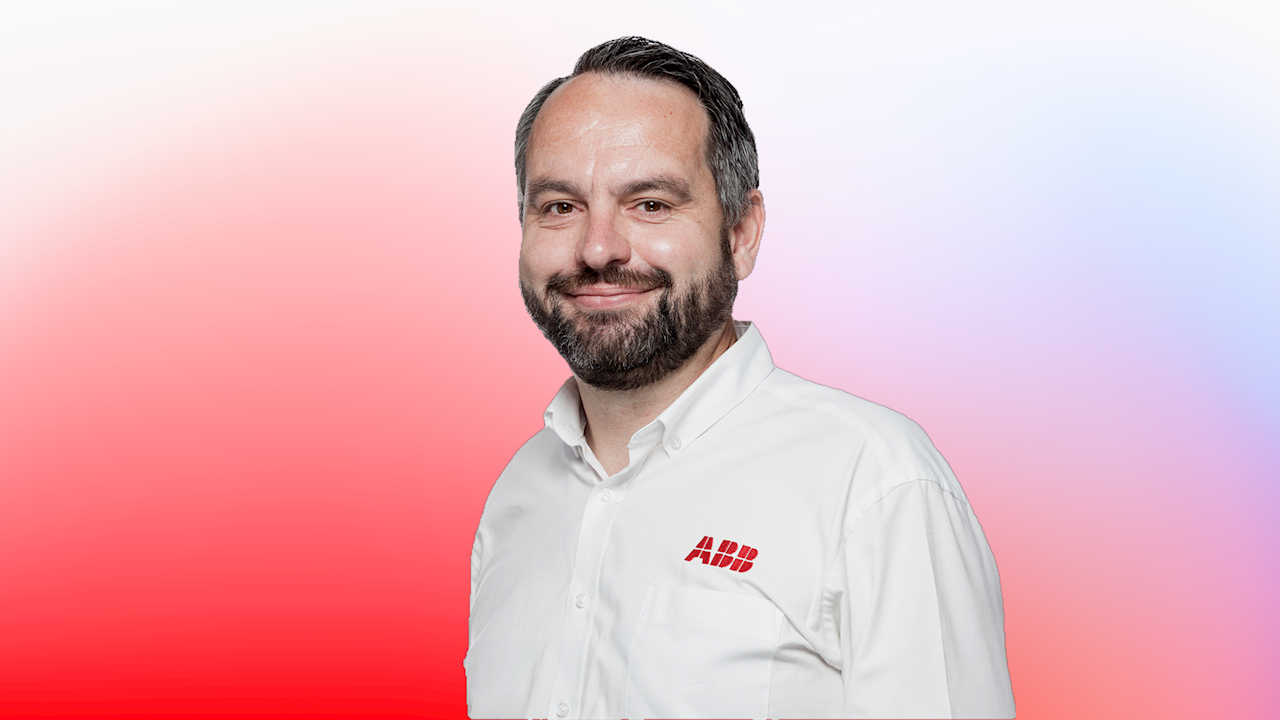
In his 23-year ABB career Poyner says he has “always been somewhere on the decarbonization curve, supporting tidal energy projects during my time in Motion, integrating energy storage and charging solutions into train propulsion, or now in shore power. Even if decarbonization is challenging on the technical level, we need to work toward it if we want also future generations to enjoy the planet,” he adds.
With ABB shore connection technology already integrated in numerous ports worldwide – and rising – Poyner’s agenda is also to focus on explaining what’s possible, what the technical challenges are and what’s being done in practice. “Ports are under pressure to improve air quality but installing shore power brings logistical as well as cost challenges, especially when the facility is in an urban area. People understand best when they see what has been delivered for themselves.”
The practical approach is also a feature of Poyner’s spare time, where he has been tackling another power challenge that is now familiar to shipping. A keen drag-racing enthusiast, Poyner has recently undertaken his own alternative fuel project, recently installed a methanol-fueled engine in his beloved Volkswagen Beetle.
“I guess I’ve been going through an energy transition of my own,” he says, “and when green methanol becomes available I’ll be ready to race on it because while I love drag racing, the emissions don’t sit well with me. For ship owners out there – I’ve felt your pain: having to implement major changes that go beyond the purchase of the fuel.”
“When green methanol becomes available I’ll be ready to race on it because while I love drag racing, the emissions don’t sit well with me."
Electric starter
Poyner’s recognition of technology implementation as a route to success has been a defining feature of his career. It started when his father, an electrical engineer at a shipyard, pushed an advertisement for apprentices at a paper mill under his teenage nose. Poyner went on to complete his four-year electrical engineering apprenticeship and spent two more years as a maintenance engineer at the mill.
“But once you've been an apprentice somewhere, you'll always be the apprentice to a certain extent,” says Poyner now. “In some ways, you have to move on. And luckily for me, the paper mill was part of a wider project to build a combined heat and power station that involved working in a separate company.”
The sideways step, taken at the age of 22, led shortly after to an opportunity to join ABB. “At that time, I thought, ok, I’ll join ABB for a couple of years, figure out what I want to do and take it from there. If you'd have asked me then if I'd be at the same company for 23 years, I would have said ‘not a chance’.
“But ABB has always given me roles that I’ve found interesting and challenging, and allowed me to work with others in problem solving. When I've felt I'm getting to the end of a challenge, there's always been a new one.”
Shore powering ahead
Poyner relishes his current role, both as a challenge and as an opportunity to make the most of the broad set of skills he has developed at ABB.
He initially joined ABB as a field service engineer providing maintenance services to the paper industry. After “a great five years as a young guy driving all over the UK in the early 2000s learning all the time and delivering what the users needed”, the decline of paper and rise of the internet began to bite into the UK’s mill businesses.

For Poyner, too, it was a moment of transition, as he switched into a design and commissioning-focused role in ABB’s drives engineering in our motion division. It was an important career phase, as Poyner focused on developing his technical expertise at work and – with support from ABB – completed a Bachelor of Engineering (hons) in Electrical and Electronics Engineering in any spare time.
He fully acknowledges the mentorship role of senior colleagues in “turning a field service guy into a technically competent project engineer, for which I’ll always be grateful.”
The period also saw him promoted to team leader and for the first time take responsibility for a complex automation system commissioning project, working with ABB service engineers in Switzerland. But it was also a five-year period which culminated in Poyner asking himself whether his future lay in internally-facing roles.
“I felt I was a competent engineer but that I had other things to offer, so I approached management to raise the idea that my skills would be better used in a sales role.”
The request initially led to a post in ABB’s power conversion business, then a move into a systems drive sales manager role. Subsequently, an opportunity came to join ABB’s Traction team in its efforts to decarbonize railways, where Poyner became UK division manager in 2019. As before Poyner responded to the trust placed in him by working towards an Open University MBA.
Quayside calling
“When the shore power lead role came up at ABB’s Marine and Ports division in 2022, there were parallels with what I’d been doing but also a big challenge. It was an opportunity to join a good industry at a critical moment when there is a strong need for what ABB has to offer,” says Poyner now.
Subsequent milestones have included the completionof a major project in Toulon in 2025 [1], France’s largest-ever shore power solution went through its final acceptance period. The facility offers connections at 11kV and 6.6 KV voltage levels and frequencies of 50Hz or 60Hz, supporting port calls by three ferries simultaneously, or one cruise ship.
“Toulon is an exceptional project, because of the collaborative approach taken by local authorities, the port and its customers, but also because the system is highly flexible in encompassing solar panels, battery energy storage and the potential to connect to hydrogen in the future,” says Poyner. “In the long term, I think the energy management potential will be seen as one of the most significant aspects of this installation.”
The ongoing Sea Change project at Portsmouth International Port [2], which is heading towards completion in 2026, is also close to Poyner’s heart as a native of Hampshire – even though he moved to North Wales over three decades ago at the age of 10.
In January 2026, Poyner can also cite ABB’s contract with Rotterdam Shore Power [3] as a major new shore reference, as the Port of Rotterdam-Eneco joint venture moves forward with the largest combined shoreside ship power ever delivered in a single project. More than 100 megavolt-amperes (MVA) of emission-free power will serve three container terminals at Europe’s largest port before the end of 2028 at 35 connection points. In addition to designing, delivering and installing the shore power systems, ABB will be responsible for commissioning and testing on site.
“A project of this scale highlights what an exciting time it is for this part of the maritime industry and it is an exciting time for me. Long may it continue. From an ABB point of view we continue to focus on offering options to the cruise ship, ferry and merchant shipping markets based on experience of multiple solutions.”
Poyner acknowledges that Europe provides a particular focus in current workload because of the impetus provided by the FuelEU Maritime regulation in making it mandatory for container and passenger ships of 5,000GT and over to connect to shore power in main EU ports from 2030 [4].
In early 2026, Poyner says the target remains attainable, and that ABB is in position to support the level of equipment and implementation capacity required. However, the onus lies on EU port organizations to push on with the studies, administration and tenders needed to make things happen, rather than “planning to leave until 2029, because these projects aren't delivered overnight”.
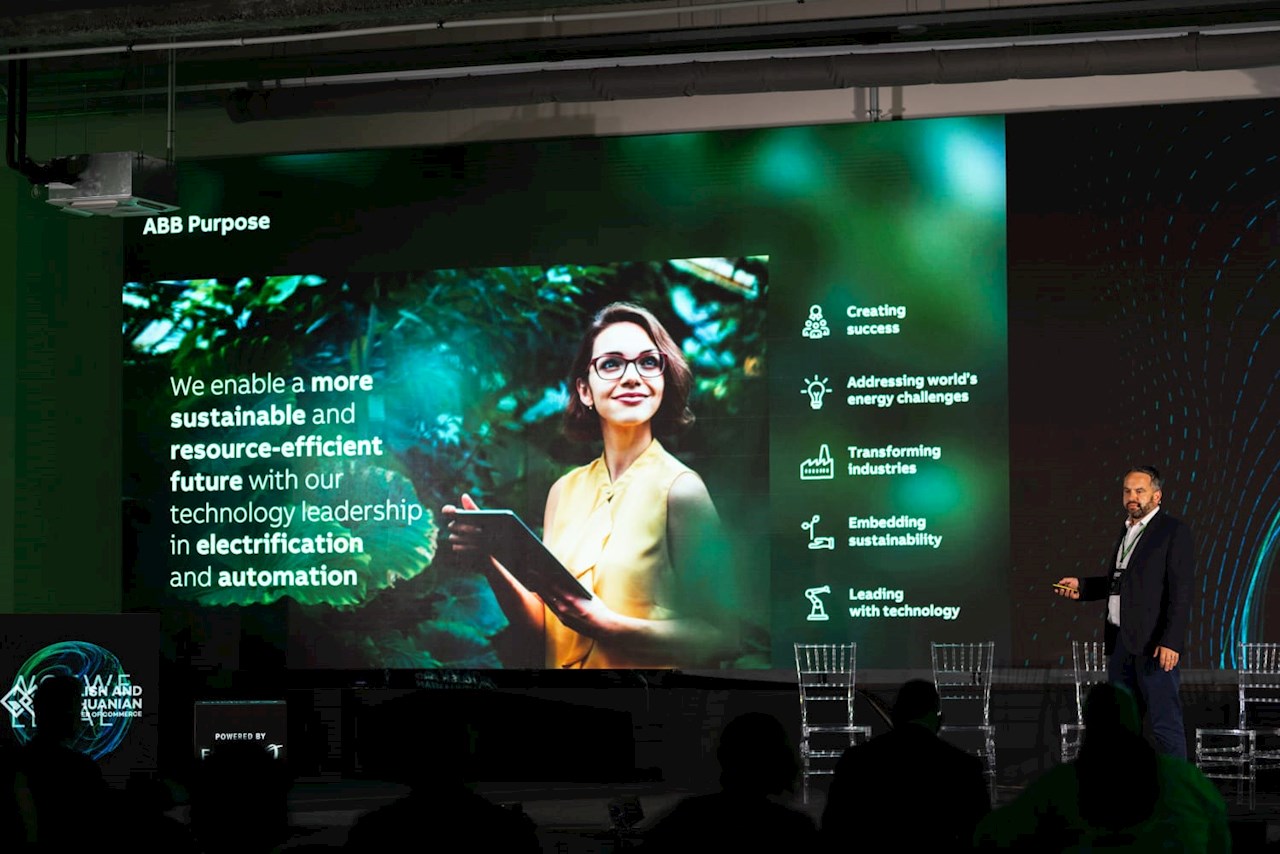
Energizing the bigger picture
Nevertheless, Poyner says the switch into shore power also satisfied a long-held ambition to take on a global role and an itch to work across a variety of cultures. The 2019 MBA has come into its own by offering groundwork for developing strategy and managing remote teams, he adds.
“ABB’s reach – in ports, shipping and offshore, but also within other industries in the power sector – is a key advantage when developing shore power opportunities. Globally, Asia is on the move and there is a push for shore power in South America, leading to plenty of opportunities for ABB to share its mature industry knowledge.”
While some argue that the infrastructure investment required will mean that shore power is only feasible at high-traffic ports, Poyner emphasizes that flexible systems can adapt to regional needs, while phased implementation at smaller ports can yield gradual emissions reductions without massive upfront costs.
If the ports industry as a whole is receptive to shore power as a concept, however, practically-minded Poyner does not underplay the challenges ahead.
Finding the shore power solution to satisfy all stakeholders in a given case may not be easy,” he says. “It won’t be surprising to hear me say that ABB has market-leading technology and also leads on R&D, but I actually encourage ports to approach several suppliers to establish the best fit for their requirements. Unlike some, we offer a portfolio of solutions, and my engineering experience helps me provide feedback to our product management to make sure customers get the solution they need rather than one that they have been told to have.
Practical complications often arise at the interface between ports and vessel owners, where owners may feel they have made sufficient efforts by investing in shore power sockets and expect ports to sort out variable socket locations or even incompatibility.
“The Toulon project was a good example of a project where all parties were willing to work together from the outset, which I believe provides a model for others,” says Poyner.
In addition to the troubleshooting, however, Poyner is also committed to expanding conversations on the practical benefits of shore power beyond their focus on zero emissions and silent power at the quayside.
“For example, while the customer has ownership of its own solution, from the practical engineering point of view there is a real opportunity for ports to become more self-sufficient as energy hubs, rather than simply being the power consumer at the end of the line. With the additional supplementary technologies such as solar photovoltaic or battery energy storage, this can really support the business case and help these projects to be realized sooner.”
There is a real opportunity for ports to become more self-sufficient as energy hubs, rather than simply being the power consumer at the end of the line.
There is a strong case to develop incentives for shipbuilders that help them reduce the cost burden of ensuring compatibility with shore power setups, Poyner suggests.
“I can’t say that realizing the full potential of shore power as a contribution to maritime decarbonization will be easy. However, moving forward can be straightforward if your starting point is that shore power is not simply a component of the port’s equipment, but a system that works to benefit everyone connected to it.”
References:
[1] https://new.abb.com/news/detail/126251/port-of-toulon-celebrates-milestone-installation-in-france-with-abb-shore-power-technology
[2] https://new.abb.com/news/detail/112975/abb-to-supply-shore-connection-solution-to-portsmouth-international-port
[3] https://new.abb.com/news/detail/132181/rotterdam-shore-power-selects-abb-for-worlds-largest-shore-power-project
[4] https://transport.ec.europa.eu/transport-modes/maritime/decarbonising-maritime-transport-fueleu-maritime_en


