
Marshall Trigona has been in the air conditioning and refrigeration business for over 20 years. He works for ABB USA and is the Director of OEM Compressor Business for low voltage drives. He and his team work with OEMs that manufacture industrial refrigeration and chiller systems, heat pumps, and turbo-blower equipment. These are critical components of the systems serving the district and campus market. Campus energy is an ideal platform to focus attention and resources. The answers in this interview reflect ABB’s capabilities.

How is the district energy market in North America evolving today, and what factors are most strongly shaping its growth?
Energy costs in North America continue to rise every year. Campuses, whether they be college/university, industrial manufacturing, airports, or resorts, realize there are sustainable and efficient solutions to control and lower the energy usage on each campus. Decision making is based on sustainability goals and return on investment.
What are the segments where you see renewed interest in campus and district energy systems? What’s driving this resurgence in North America specifically?
Campus energy systems increasingly incorporate heat pumps – especially ground-source (geothermal) and air-source types – as part of broader efforts to decarbonize and improve energy efficiency. Manufacturers are overcoming challenges to develop high temperature heat pumps for industrial applications exceeding 100°C.
How do North American district energy systems differ from European or Asian models in terms of design priorities, energy sources, or operational strategies?
One big difference in district energy is that European governments are actively driving and supporting operational strategies and renewable energy sources. As an example, Europeans have EED* and RED** directives which include specific demands for data centers to recover excess heat and deliver it to the district heating network.
Many North American energy systems grew up around campuses, hospitals, and military bases rather than broad municipal networks. Fossil fuels remain common in the sector, while renewables are emerging but modest. Older urban steam heating systems in places like New York or university campuses still exist, while Europeans move to low-temperature heating which is based, for example, on sewage water.
Many campus energy systems are driven by private utilities or concessions, with operational strategies focused on cost competitiveness, while in Europe they are often municipally owned or regulated, allowing coordinated long-term planning e.g., for reaching climate targets.
How important is operational flexibility in today’s campus energy systems, and how are operators balancing efficiency with reliability?
Operational flexibility for district energy systems is critical due to fluctuating demand across seasons and daily load profiles, as well as the integration of renewable and backup energy from solar and wind. The belief should be that both efficiency and reliability are achievable, particularly thanks to variable speed drives. They provide efficiency and reliability by controlling the speed of applications within campus energy facilities to match production to actual needs while preventing issues that create wear and tear on the equipment.
Short cycle protection within drives reduces mechanical stress on the system by limiting repetitive starts and monitoring minimum run time. Drives can go further by solving cavitation and electrical harmonic issues to prevent failures or stoppage of service.
In your view, which parts of a district energy system offer the greatest untapped potential for efficiency improvements today?
Capturing waste heat and using it as a resource to efficiently assist and improve system performance is one area of potential. One example is data centers. Mentioned above were European directives to recover excess heat and deliver it to the district heating network. Another potential area within the system is the adoption of advanced controls. Drives and PLCs help accurately and efficiently control systems.
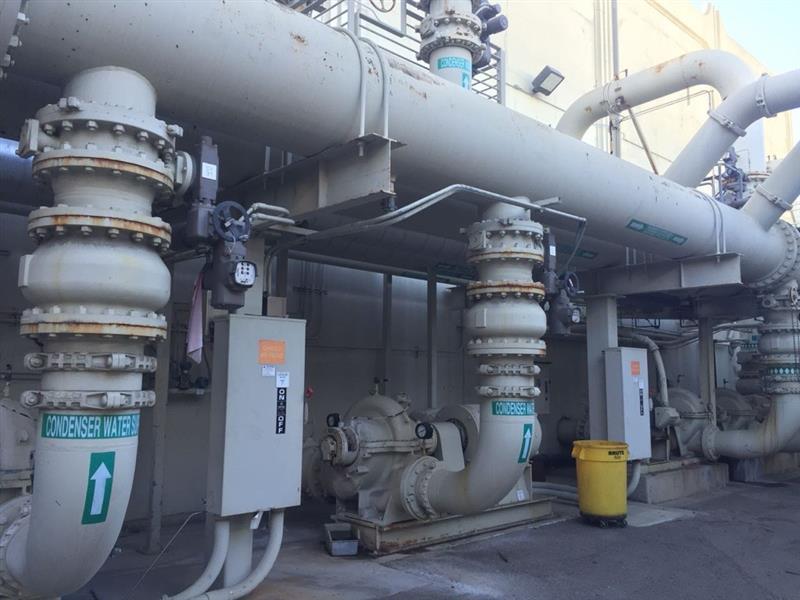
A typical district cooling facility supplying a university campus in California, USA. 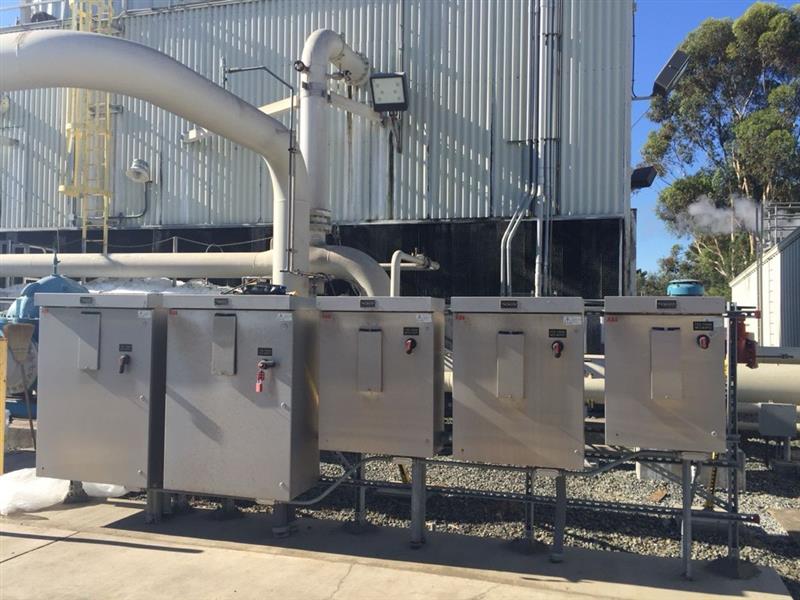
ABB drives in control cabinets control chilled water pumps for higher energy efficiency.
Can you explain specifically how variable speed drives (VSDs) improve control and efficiency in key district energy applications such as pumps, fans, and chillers?
Drives have controls for pump, fan, and compressor/chiller applications that drive efficiency across multiple speeds based on set points. They measure incoming and outgoing pressures and temperatures of air, water, and refrigerants to efficiently control application speed, and there is connectivity with all major automation networks in the system to make processes truly efficient and aligned with ever-changing needs.
What kind of energy savings and operational benefits are North American district energy operators typically seeing when they move from constant-speed to variable-speed solutions?
Because drives provide precise control and vary the speed of the application, this lessens wear and tear on system components because they are not used when not needed. Depending on the application and other components of the system, drives can reduce energy consumption by 30–50%.
How do VSDs contribute to system resilience, especially during partial outages, load shedding, or emergency operating conditions?
Drives help maintain performance in abnormal situations such as short supply voltage breakdown, heavy variations of torque, a motor already rotating, and cable short circuits. Some drive types may be part of power backup solutions that provide redundancy that allows for use of AC or DC power supply. There are also ultra-low harmonic drives that maintain power quality, minimizing electrical disturbances in the network and providing unity power factor.
How do VSDs integrate with modern building management systems, SCADA, or energy management platforms in district energy networks?
Drives provide a wide range of fieldbus adapters that enable connectivity with all major automation networks. When integrated into a PLC, the system offers a scalable I/O solution that integrates across a wide range of communication protocol options. This provides precise control from entry point to advanced and complex automation solutions.
What role does data from VSDs play in predictive maintenance and long-term asset optimization for campus energy operators?
Drives collect data on temperature, pressure, run times, repetitive starts, torque, voltage fluctuations, etc. The drives communicate and report abnormalities in advance so that action can be taken before issues and failures occur.
If you were designing a new district or campus energy system in North America today, how central would variable speed technology be and why?
The best district and campus energy systems efficiently move heat and cold to the areas in the district/campus where they are needed. Drives support sustainability by improving the performance of systems. Because drives optimize operational performance based on actual demand, they help deliver energy savings with flexibility and adaptability.
*The revised Energy Efficiency Directive (EU/2023/1791) entered into force on October 10, 2023, aiming to make the EU more energy-independent and accelerate decarbonization.
** The Renewable Energy Directive (RED) requires each EU member state to achieve, among other things, a renewable energy target of at least 42.5% by 2030.


