Selection: According to customer's needs
In today's market, we encounter numerous requests for DC (direct current) motor replacements. In many cases, the buyer is simply looking for a direct DC replacement to get them up and running again; while other times, they want to select a long-term solution that achieves a high level of performance for a variable speed application while reducing maintenance costs and equipment downtime.
The first consideration is the customer’s needs. They may already have the infrastructure and components, including spare parts, to continue the use of a DC motor. Ease of replacement may be a concern, as shaft height, motor position and difficulty accessing the area to remove or install a motor may make a complete replacement unfeasible. Time and cost of a conversion may be the limiting factor as well, if it is critical to have the application running again as soon as possible. However, if the request is for a new application, or if they have an opportunity for scheduled downtime, the customer may want to consider a DC-to-AC (alternating current) motor conversion for the application.
As a general guideline, ABB Baldor-Reliance motors have the following DC capabilities:
- Small DC motors from 1-5 Hp are available from 12 - 250v DC depending on winding type, speed and horsepower
- Medium DC motors from 1-500 Hp are available from 115 - 500v DC depending on speed and horsepower
Baldor-Reliance DC motors have a maximum rating of 500 Hp (375 kW) @ 1,150 RPM (or greater nominal RPMs) with open (DPG-FV, or drip proof guarded force ventilated) enclosures.
If decreased speeds are required, ABB Baldor-Reliance DC motors are available with the following ratings:
- 850 RPM, max rating 370 Hp (275 kW)
- 650 RPM, max rating 300 Hp (210 kW)
- 500 RPM, max rating 220 Hp (165 kW)
- 300 RPM, max rating 130 Hp (96 kW)
- 250 RPM, max rating 110 Hp (82 kW)
- 150 RPM, max rating 50 Hp (37 kW)
It is ABB’s recommendation that any rating outside of these parameters be converted to an AC design.
Enclosures available for AC motors include:
- TENV = Totally enclosed non-ventilated
- TEFC = Totally enclosed fan cooled
- TEBC = Totally enclosed blower cooled
- DPG = Drip proof guarded
- DPG-FV = Drip proof guarded force ventilated
- SPG = Splash proof guarded
- SPG-FV = Splash proof guarded force ventilated
- TEAO = Totally enclosed air over
- PIPO = Pipe in pipe out
- TESV = Totally enclosed separate vent
Advantages of AC motors over DC motors
AC motors offer many advantages over DC motors, including reduced maintenance, reduced operating costs and continuous operation at zero speed; however, the primary advantage of an AC motor over a DC motor is the difference in the motor’s maintenance requirements. Both AC motors and DC motors require periodic regreasing of the motor bearings; however, a DC motor has the additional maintenance requirement of periodically replacing the carbon brushes and cleaning and refinishing the commutator.
The next advantage is operating costs. In addition to the increased maintenance costs of a DC motor over an AC motor, the variable speed drive required to run the DC motor will have increased power costs due to poor power factor when compared to an AC motor drive. While a DC drive will have a power factor inversely proportional to the speed (meaning a reduction of speed results in a poorer power factor), an AC drive will have a high power factor at all speeds.
The final advantage of an AC motor over a DC motor is continuous operation at zero speed. Both AC and DC motors are capable of producing full torque at zero speed. The AC motor, with proper design, can produce full torque continuously at zero speed; however, the DC motor cannot produce full torque continuously at zero speed. This limitation is because continuous operation at zero speed will result in unbalanced heating of the DC motor commutator which will damage the commutator.
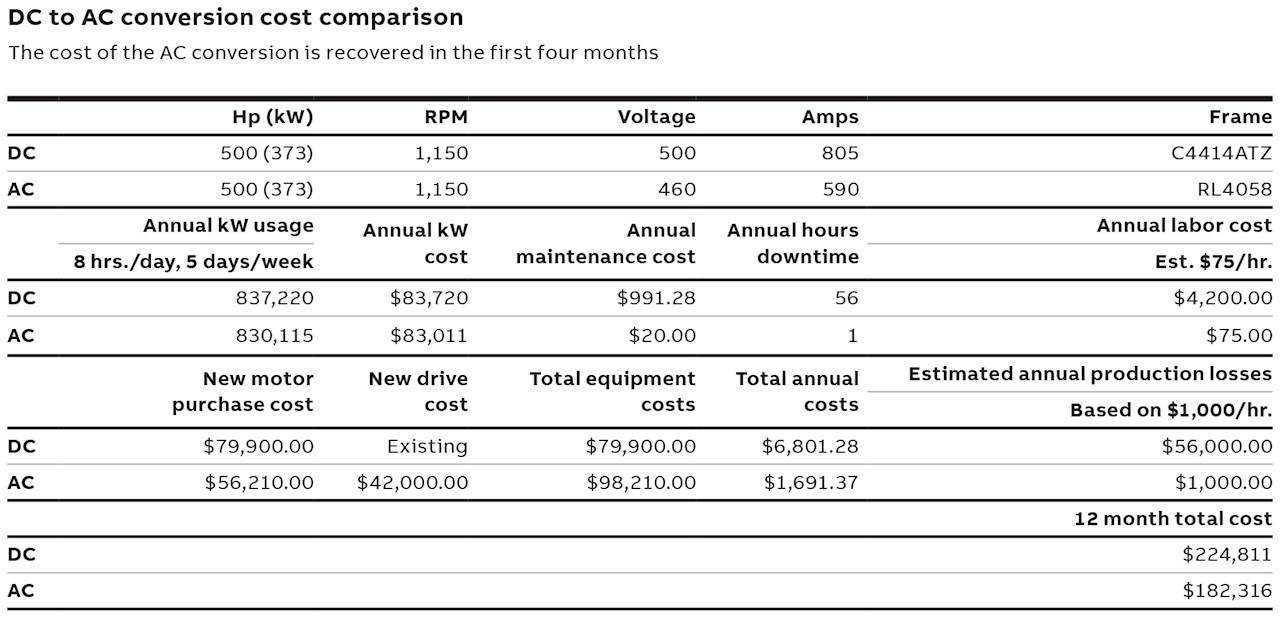
The below scenario compares a 500 horsepower DC motor replaced with a 500 Hp RPM AC motor and variable speed drive. Standard assumptions made were $75/hr. labor costs and $1,000/hr. production loss during down time. These numbers are based on a five-day week, eight hours per day. The conversion costs are recovered in the first year.