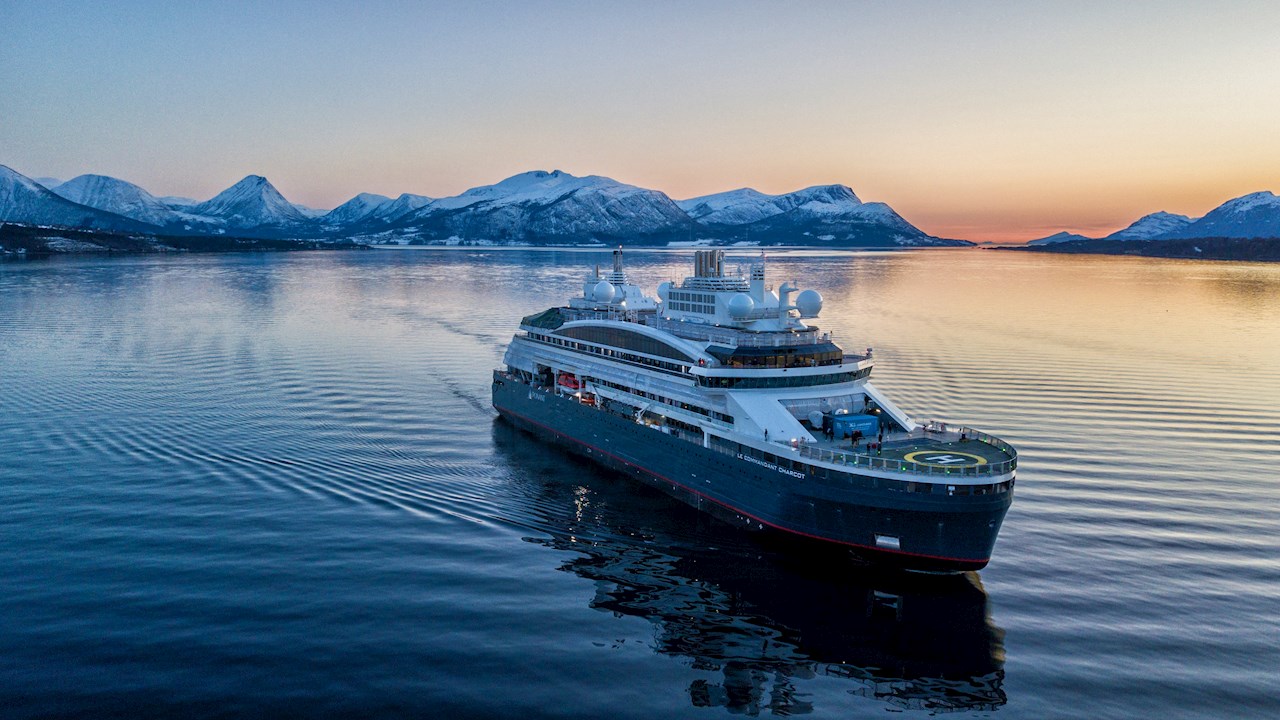
Le Commandant Charcot is the most advanced icebreaking exploration vessel at sea and the only cruise ship in the world with a Polar Class (PC)-2 icebreaking hull. Jointly developed by naval architecture firm Stirling Design International, ice technology partner Aker Arctic, and luxury expedition cruise operator PONANT EXPLORATIONS, the unrivaled vessel is equipped with dual 17-megawatt PC-2 Azipod® propulsion units. The double-acting design enables the ice-strengthened ship to move forward in open water and backward through ice, allowing efficient navigation in severe conditions. The vessel is capable of breaking ice with its stern and handling ridges up to 15 meters high, while providing enhanced comfort for passengers and crew due to reduced noise and vibrations.
As the only PC 2-rated cruise ship in operation, Le Commandant Charcot has access to locations that are off limits to other vessels.
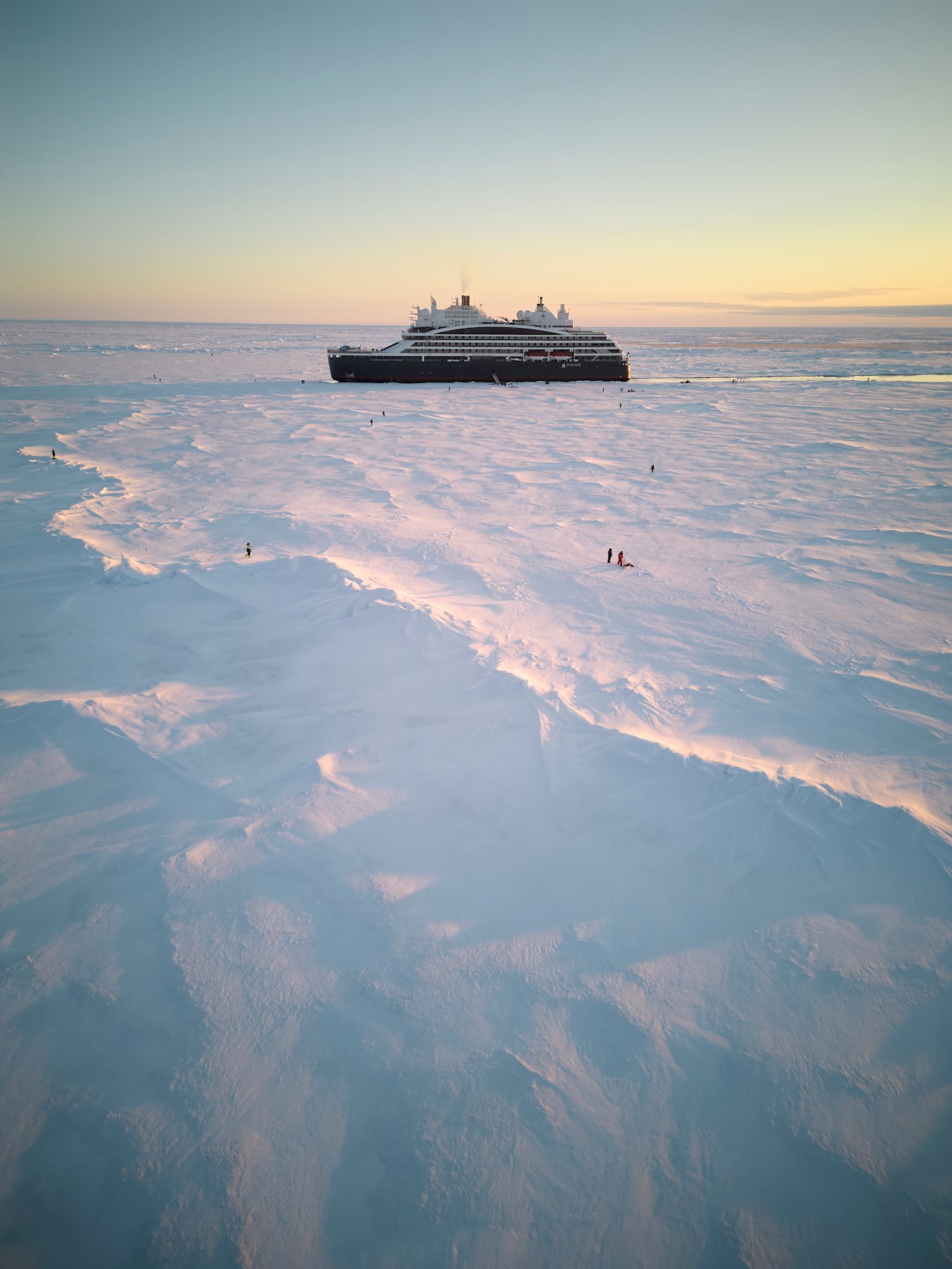
In addition, Le Commandant Charcot ‘s operations differ from traditional ice-going ships. Usually icebreakers and ice-going ships are purpose-built and designed for specific operations and sea areas. However, Le Commandant Charcot sails in almost all sea ice areas of the world, including Antarctic waters, North Pole, North-west Passage and North-East Greenland. In September 2024, the vessel completed a 20-day trans-Arctic voyage, traversing both the geographic and magnetic North Poles and becoming the first ship to reach the Northern Pole of Inaccessibility1.
Already ahead of the expedition, PONANT EXPLORATIONS, Aker Arctic, and ABB’s Marine & Ports division had recognized that the ship’s extreme operational environment offered a unique opportunity to gather data for ice load research. This information could be used to support advancements in polar shipping and inform the owner about structural loading with various operation methods and areas.
The three parties agreed to measure ice loads on Le Commandant Charcot as the vessel navigated the often challenging ice conditions between Nome, Alaska, and the Norwegian archipelago of Svalbard. This was the first time the responses to ice conditions of a ship’s hull and propulsion system were monitored simultaneously.
Proven resilience in challenging conditions
ABB has been measuring ice loads from the Azipod® propulsion unit on board Le Commandant Charcot already since the ship was delivered to her owner in 2021. ABB’s ice-load measurement system uses a series of strain gauges, accelerometers, and shaft speed indicators mounted to the internal hull structure. These instruments monitor longitudinal and transverse loads acting on a ship’s propulsion unit in various ice conditions, both when operating ahead and stern first. Ice load data is recorded with the ship’s navigational data such as speed and heading, and propulsion data such as power, rpm, torque, and steering angle for a comprehensive overview.
Late 2023 PONANT EXPLORATIONS, Aker Arctic and ABB agreed formally on the collaboration and information sharing about hull and propulsion unit ice loads measurements. In February 2024 Aker Arctic installed their ice load monitoring system ARC ILMS on board Le Commandant Charcot, a platform for measuring loads that the ship's structure experiences when operating in ice-covered waters. At the same time, ABB further improved their Azipod® propulsion ice load measurement system for a more accurate understanding of the ice loads.
Following the various Arctic voyages, in December 2024 Le Commandant Charcot called in to Helsinki, Finland, where Aker Arctic and ABB presented the initial findings from their respective ice load measurement systems to the ship’s senior officers2.
As one of the focus areas was high and critical load incidents, it is notable that longitudinal loads acting on the propulsion units were measured to be nearly twice as high as transversal loads, with the greatest forces transmitted through the propeller and propulsion unit strut, as expected. However, even more notable are results to date which show that – even in the most challenging conditions – the ice loads on the Le Commandant Charcot’s hull and propulsion units have remained well below design thresholds. This underscores the exceptional design and engineering of both the hull and propulsion systems, delivering unmatched safety.
“As the only PC 2-rated cruise ship in operation, Le Commandant Charcot has access to locations that are off limits to other vessels,” said Mathieu Petiteau, Director of New Builds and Research & Development, PONANT EXPLORATIONS. “Even the highest ice loads encountered in East Greenland and the extreme north of Canada were far short of upper limits. Given the demanding nature of our operations, these findings represent a highly reassuring indication that the ship is being operated safely and effectively.”
We are proud to continue our cooperation with Aker Arctic and PONANT EXPLORATIONS as we seek to further optimize ice load monitoring and ultimately ensure safer and more efficient operations in even the harshest of polar waters.
According to Captain Étienne Garcia, who has first-hand experience of navigating the ship through ice conditions: “Given the extent of our operations, navigating various ice types and venturing deep into polar regions, the results are remarkable. We now have clear evidence that we are using the ship safely and in line with design recommendations.”
A trial by ice
The still-accumulating data is used for R&D purposes and design validations to optimize operational safety and efficiency in extreme Arctic environments.
“This is the first time that ice loads on the hull and podded propulsion units have been measured simultaneously,” noted Mika Hovilainen, Chief Executive Officer, Aker Arctic. “Thanks to Le Commandant Charcot’s unique operational profile – with the vessel sailing in a wide variety of ice conditions throughout the year – the data we continue to collect enhances our understanding of loads on ships operating stern-first in ice, offering additional validation for the double-acting concept.”
“Le Commandant Charcot’s trans-Arctic expedition in 2024 can be considered a trial by ice for both the vessel and our collaborative project, and it has been truly inspiring to see all stakeholders rise to the challenge,” commented Samuli Hänninen, Global Segment Manager, Icebreakers, ABB’s Marine & Ports division. “We are proud to continue our cooperation with Aker Arctic and PONANT EXPLORATIONS as we seek to further optimize ice load monitoring and ultimately ensure safer and more efficient operations in even the harshest of polar waters.”
References:
[2] https://akerarctic.fi/news/collaboration-on-ice-load-measurements-onboard-le-commandant-charcot/


