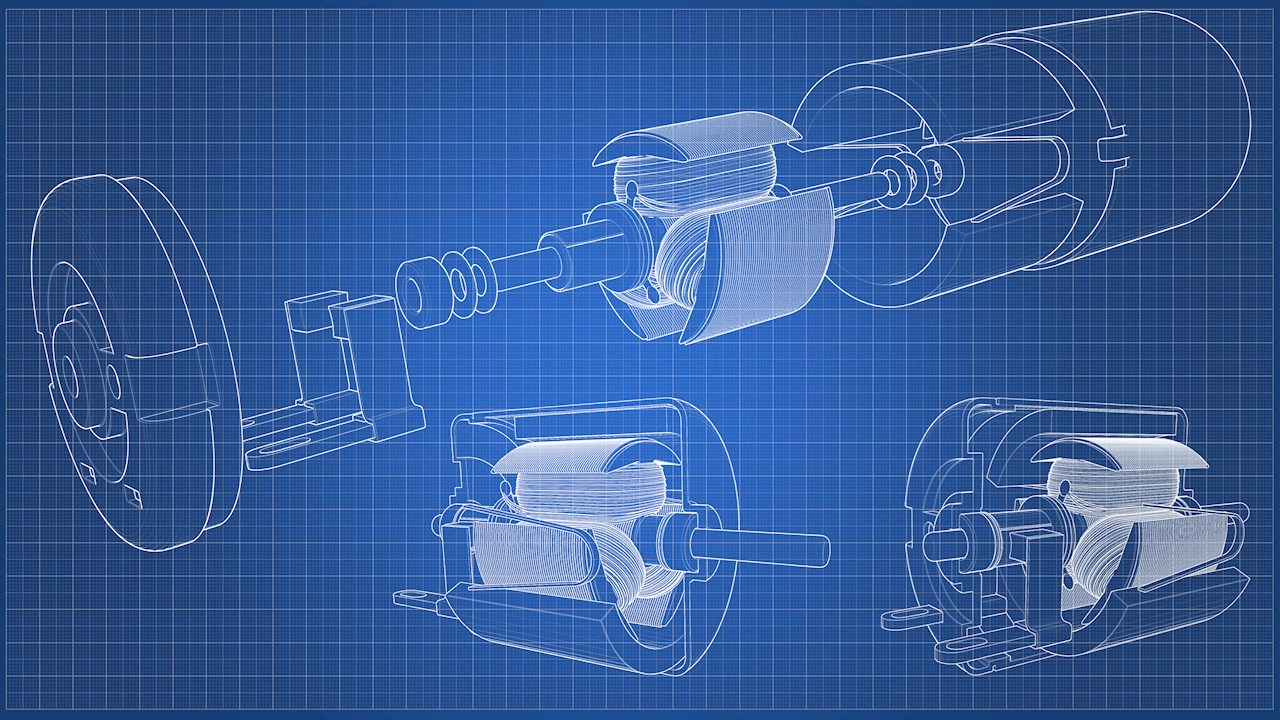
DC motors have been a cornerstone of electrical engineering since the 1800s. Despite competition from AC motors and newer technologies, they remain essential for applications requiring precise control, high starting torque, and quick response. ABB and other companies have refined DC motor design over decades, making them reliable and durable.
Today, DC motors continue to play a vital role across diverse industrial applications. where precise control is paramount. Winders, presses, grinders and extruders exemplify manufacturing equipment that demands the unique characteristics of DC motors: high responsiveness to load changes, rapid starting and stopping capabilities and fine-tuned speed control. These characteristics enable manufacturers to achieve consistency and quality that would be difficult or impossible with alternative motor technologies.
The precise speed regulation of DC motors is achieved through simple voltage adjustment at the armature. Unlike AC motors, which require complex variable speed or variable frequency drives (VSDs or VFDs) to alter operating speed, DC motors offer straightforward speed control through potentiometer adjustment or electronic control circuits. This simplicity translates to lower complexity in control systems and more predictable performance across varying operating conditions.

DC motors have found renewed relevance in the electric vehicle revolution. Hybrid and fully electric vehicles utilize DC motors for their superior torque characteristics at low speeds and their efficiency across a wide range of operating conditions. The ability to provide full torque from zero speed proves invaluable during acceleration and hill climbing. Furthermore, DC motors serve as generators in regenerative braking systems, converting kinetic energy during deceleration into electrical energy that recharges vehicle batteries, extending driving range and improving overall efficiency.
Small DC motors power countless consumer products and tools. Power drills, cordless screwdrivers, handheld sprayers and battery-powered appliances all rely on DC motors operating from rechargeable batteries. Their simplicity, low cost at fractional horsepower ratings and ease of control make them ideal for portable applications. Medical devices, industrial robots, conveyor systems and automated handling equipment all incorporate DC motors where precise speed and torque regulation prove essential to performance.
In agricultural settings, DC motors eliminate human and animal muscle power from essential tasks such as grain handling and water pumping. Submersible pumps, grain augers and other farm equipment use DC motors to improve efficiency and reduce labor demands. Infrastructure applications including water treatment facilities, sewage systems and specialized industrial processes continue to depend on DC motors where variable load conditions and precise control requirements favor this technology over alternatives.
The fundamental advantage of DC motors lies in their unmatched ability to control speed and torque across a broad operating range. Unlike AC induction motors that operate most efficiently near their rated speed and frequency, DC motors maintain excellent control characteristics at speeds well above and below their rated values. For applications such as winding processes, where precise tension control is critical, or manufacturing operations requiring rapid acceleration and deceleration, DC motors deliver capabilities that AC motors cannot match without sophisticated electronic controls.
DC motors excel at producing full rated torque instantly from zero speed. This characteristic makes them ideal for applications requiring quick acceleration from rest or operation at very low speeds under load. Series-wound DC motors develop their maximum torque at low speeds, making them particularly suitable for traction applications such as elevators, hoists and cranes. The rapid response to load changes ensures consistent performance and prevents the speed variations that might occur with other motor types under similar conditions.
Despite perceptions that AC motors are simpler, DC motors may offer certain advantages in installation, commissioning and troubleshooting. Their control requirements are fundamentally simpler: voltage adjustment directly translates to speed control without requiring frequency conversion or complex power electronics. For facilities familiar with DC technology (and many industrial operations that maintain such expertise), maintenance and repairs are straightforward. The more than 70-year heritage of ABB DC motors reflects the reliability and longevity that users can expect from well-designed, properly maintained DC motor systems.
A technical advantage often overlooked in modern discussions is that DC motors generate no harmonic distortion. In certain applications, AC induction motors may produce harmonics (voltages at multiples of the primary frequency) that can cause heating, noise and problems in other equipment sharing the electrical system. Facilities sensitive to power quality issues or those operating in electrically challenging environments benefit from DC motors' harmonic-free operation.
For fractional horsepower applications, DC motors offer a cost-effective and practical solution. The required power electronics are often less expensive than the variable speed drives needed for AC motor control. Installation simply requires connecting the motor to a DC power source; no specialized knowledge of AC frequency or three-phase distribution is necessary. This economic advantage remains significant despite over a century of motor development.
ABB remains at the pinnacle of DC motor engineering and manufacturing. With more than 70 years of dedicated experience in DC motor production, ABB has established an unparalleled reputation for reliability, performance and innovation. This heritage reflects not merely longevity, but a continuous commitment to advancing DC motor technology and meeting evolving industrial requirements.
ABB offers an extensive range of DC motors encompassing fractional horsepower models through integral horsepower designs and large frame motors rated up to 3,000 horsepower at voltages from 120 to 600 volts DC. This comprehensive portfolio ensures that facilities operating diverse equipment can find ABB DC motors tailored to their specific applications. Fractional wound field and permanent magnet motors are manufactured in Westville, Oklahoma, U.S., while larger frame motors are produced in Gainesville, Georgia, U.S.. All motors are customizable and motors up to 500 Hp are maintained in inventory for rapid deployment, ensuring customer supply chain reliability.
ABB DC motors incorporate design features reflecting decades of accumulated engineering expertise. Heavy-duty steel frames with removable bases accommodate diverse installation configurations and facilitate maintenance. Laminated square frames are engineered for high power density, maximizing efficiency within compact dimensions. Motors are available to meet both NEMA and IEC frame standards, ensuring compatibility with global equipment and infrastructure.
Material quality and manufacturing processes set ABB motors apart. Constant-pressure brushes maintain consistent performance and extend brush life, reducing maintenance intervals. High-grade electrical steel laminations with insulated cores reduce eddy current losses and improve efficiency. Coated armature designs prevent damage from electrical arcing, enhancing reliability. High-performance molded commutators minimize flash and arcing phenomena. Class H insulation systems ensure longevity and reliability in demanding operating environments.
ABB DC motors employ patented bearing lubrication systems that enhance maintenance efficiency and extend bearing life. Wide ingress protection ratings from IP23 to IP65 enable these motors to operate reliably in diverse environmental conditions. Whether in clean, temperature-controlled manufacturing environments or harsh outdoor applications, ABB DC motors maintain performance through intelligent design and material selection.
Recognizing that motors perform optimally when paired with compatible control systems, ABB offers DC drives specifically optimized and performance matched for ABB motors. These integrated solutions ensure peak performance and precise control, allowing customers to achieve the full potential of DC motor technology. The synergy between ABB motors and drive systems exemplifies ABB's commitment to comprehensive, integrated solutions rather than standalone components.
Innovations in permanent magnet materials continue to expand the capabilities of DC motors, enabling smaller, lighter motors with superior performance. Improved magnetic materials also enhance efficiency and enable more precise torque control. ABB maintains active development programs in permanent magnet motor technology, ensuring our product portfolios incorporate the latest material science advances.
Contemporary power electronics and microcontroller technologies have expanded the capabilities of DC motor control systems far beyond what was possible a few decades ago. Digital controllers with sensing capabilities enable adaptive control algorithms that optimize performance across varying operating conditions. These advances ensure DC motors remain competitive even as alternative technologies improve. The simplicity of DC speed control actually provides advantages in rapidly evolving Industry 4.0 environments where straightforward integration with digital systems is increasingly important.
As industries pursue aggressive sustainability goals and energy efficiency improvements, DC motors continue to contribute meaningfully. Their high part-load efficiency characteristics mean they often consume less energy than alternative motor types operating under variable load conditions. The longevity and reliability of ABB DC motors also contribute to sustainability by reducing manufacturing and waste associated with more frequent motor replacement.
Direct current motors have journeyed from experimental curiosities in the nineteenth century to indispensable industrial components in the twenty-first century. The trajectory from William Sturgeon's first commutator motor through Frank Julian Sprague's practical industrial design to modern brushless DC motors and integrated drive solutions reflects continuous innovation and responsiveness to changing industrial needs. Despite the proliferation of alternative technologies, DC motors remain uniquely suited to numerous applications where their combination of characteristics provides superior performance.
ABB exemplifes the continued relevance of DC motor technology. Our 70-year heritage, comprehensive product portfolios and commitment to manufacturing excellence ensure customer access to motors designed for demanding industrial applications. The presence of our trusted brand in the marketplace is not nostalgia for older technologies, but rather recognition that DC motors solve real problems that remain unsolved by alternatives.


