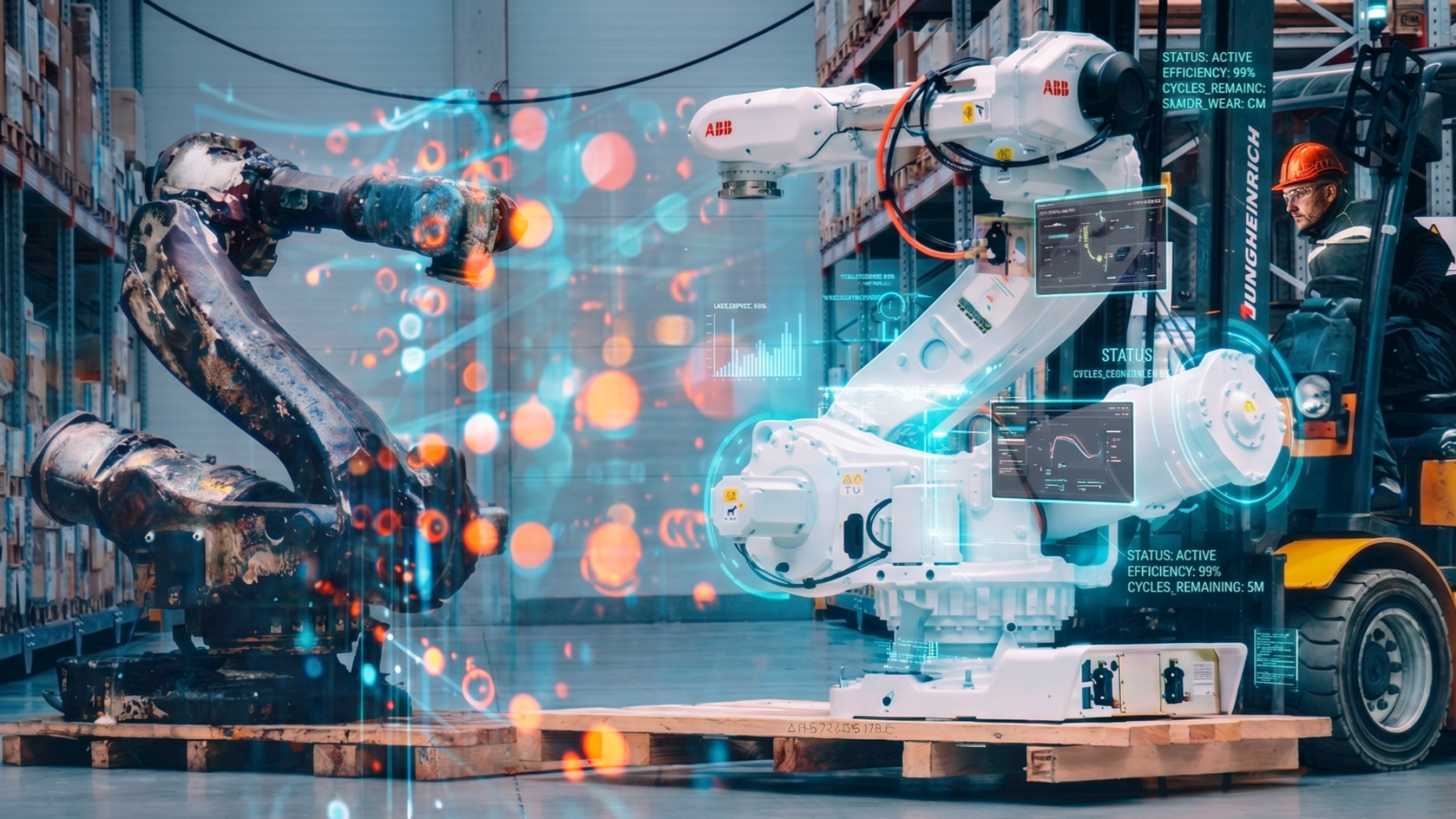
In most factories, robotic systems don’t fail. They quietly fall behind. They continue to run, meet production targets, and give every outward sign of continued reliability and performance. To the onlooker, they appear to be doing exactly what they were designed to do. But while the robots themselves may still be performing, the world around them is moving on, as technology moves on faster than ever.
When things appear to be working well, and with production targets to meet and budgets under pressure, keeping things running as they are may seem the safest and most economical choice. After all, as the adage goes, if it’s not broken, don’t fix it. Right?
In many cases, this approach almost always proves to be false economy. While it may save money in the short run, the potential costs of failing to upgrade and keep pace with the latest improvements can result in manufacturers effectively accumulating a ‘modernization debt’, where a short-term saving incurs a far greater expense in the long term. By the time the problem becomes visible, the cost of catching up is already significantly higher than the cost of ongoing investments in upgrades would have been.
The longevity and durability of robots have been one of their defining strengths, with many examples of well-maintained systems delivering consistent output year after year. However, these same strengths can also create a false sense of security. When nothing appears to be broken, it’s easy to assume that nothing needs to change.
It is important to remember that robotic systems do not exist in isolation. Even if the mechanical elements remain sound, the broader production environment is constantly evolving. Software platforms advance, cybersecurity expectations tighten, connectivity becomes fundamental, and production systems become increasingly data-driven.
Don’t ignore the warnings
The impact of failing to keep pace with change is likely to be subtle, at least at first. Maintenance teams may start noticing that issues take longer to diagnose and resolve. Downtime events may become more frequent. Spare parts that were previously easily obtainable may take longer to become available. While none of these developments are catastrophic by themselves, they are the first warning signs that the robot or system is no longer operating with the same efficiency or predictability it did when it was first installed.
As time passes, these warning signs will become more pronounced. Components that reach the end of their lifecycle are less likely to be supported by manufacturers, making replacement parts scarcer with limited availability through secondary channels. At the same time, the software environment surrounding these systems grows increasingly outdated. As connectivity becomes increasingly central to modern manufacturing operations, this increases the risk of legacy platforms, which often lack the cybersecurity protections expected in modern industrial settings, becoming exposed in ways that were never anticipated when they were first installed.
As manufacturing is becoming more integrated, more intelligent, and more flexible, the challenges of connectivity also extend into the production architecture itself. Today’s robotic systems are expected to be able to communicate seamlessly with digital factory platforms, advanced control architectures, machine vision technologies, and AI-driven applications. Older robots, even if mechanically sound, can struggle to operate within this new joined-up environment, with little or no capacity to easily exchange data or integrate with new processes, reducing their ability to support the level of responsiveness that modern production demands.
It is easy to see how a continued failure to modernize can lead to a steady erosion of competitiveness. Manufacturers find it harder to respond quickly to changing customer demands. Production becomes less flexible, less efficient, and more expensive to maintain. Opportunities to improve throughput, enhance quality, or optimize processes are missed.
Eventually, a tipping point is reached, either in the form of a critical failure, the unavailability of a key component, or the realization that a legacy system can no longer be integrated into a new production line. At this point, the organization is reacting under pressure. Replacement becomes urgent, costly, and disruptive, often requiring significant unplanned downtime and capital expenditure – this is the point where the benefits of modernization become apparent.
The strategic advantage of modernization
The best way to ensure that a robot is kept upgraded to deliver peak performance throughout its lifetime is to plan for it. Planned, incremental modernization allows manufacturers to extend the life of their existing assets and make sure they can adapt to handle current and future production requirements. By upgrading controllers, software, and key components, organizations can improve reliability, enhance connectivity, and reduce total cost of ownership without the time, cost and disruption of wholesale replacement.
Crucially, modernization is not just about avoiding failure or reducing risk. When approached strategically, it becomes a means of unlocking new capabilities, such as enabling existing robotic systems to be integrated into digital factory environments, enhanced with machine vision, or equipped with predictive maintenance capabilities. Through a continuous commitment to modernization, older and/or fixed-function assets can become a flexible, data-driven component of a modern production system.
Proven in practice: real-world modernization success
The benefits that the modernization services approach can bring in real-life applications is demonstrated by a recent project for Italian wine producer Bodegas Faustino. With its ageing robotic bottling line no longer able to keep pace with changing requirements and increased demand, the company was looking for options to enhance production capacity and efficiency.
To replace the entire system would have required significant capital investment, together with extensive disruption to production incurred by downtime. To avoid this, a targeted modernization strategy was instead carried out, with the existing robots being upgraded with new controllers, software and digital tools while retaining the core mechanical assets. This approach allowed the bottling line to benefit from improved motion performance, enhanced programming capabilities and better system connectivity without the need for a full replacement.
With upgrades carried out in just three days, improvements were able to be realized quickly and with minimal disruption.
For Bodegas Faustino, the decision to modernize rather than replace has delivered increased throughput and operational efficiency while significantly lowering investment costs compared with installing a new line. Furthermore, the addition of modern diagnostics and monitoring will also enable any operational issues to be spotted before they escalate, helping to reduce downtime and improve overall reliability.
Avoid the cost of standing still
In today’s fast-paced and rapidly changing manufacturing environment, a robot that continues to operate is not necessarily one that continues to deliver value. The greatest risk is not that systems will fail, but that they will fall behind without anyone noticing, until the gap is too large and too costly to close.
As can be seen from this article, carrying out planned modernization offers clear economic and operational benefits. By spreading investment over time, minimizing disruption, and allowing organizations to keep up with technological progress, it avoids the cost, risk and disruption of delaying action until the last minute.
As production efficiency and productivity are increasingly defined by connectivity, data, and adaptability, the manufacturers who succeed will be those who do not stand still but continuously evolve their robot systems to ensure that their technology keeps pace with the demands of modern production.

Michael Hose
Managing Director,
Customer Service, Robotics


