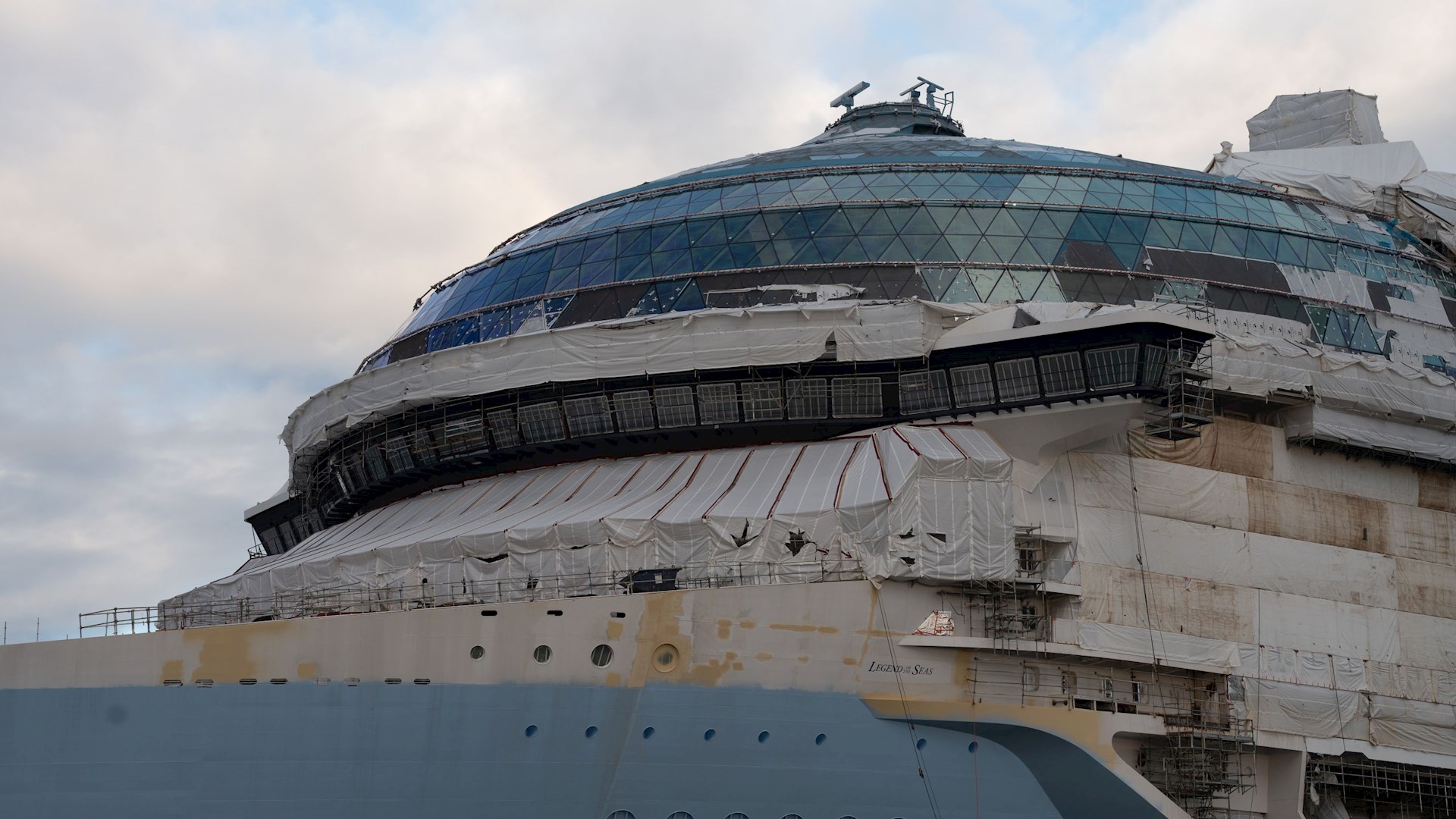
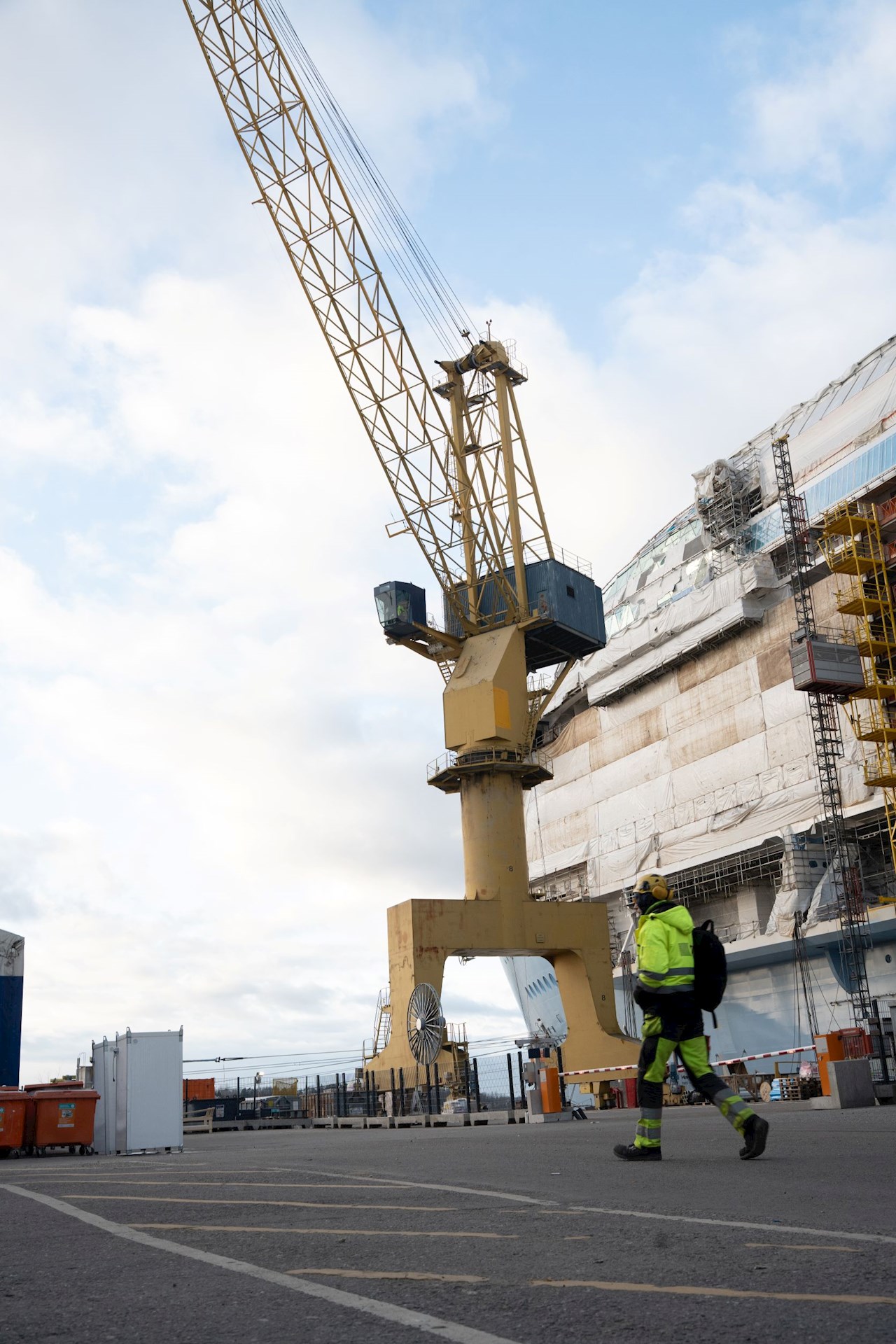
Meyer Turku builds some of the world’s most advanced ships at one of the largest shipyards in the industry. The K8433 stiff boom crane operating at the outfitting quay is one of the shipyard’s most critical individual machines: it handles all lifting operations related to ship outfitting, from pipe sections and surface materials to large equipment and structural elements.
Jaakko Riuttamäki, Maintenance Engineer at Meyer Turku, explains that aging technology had begun to create challenges for the shipyard: “This is the most critical crane at the outfitting quay. Its reach and lifting capacity make it a cornerstone of the shipyard’s logistics.”
The largely original technology, which had reached the end of its lifecycle, caused unpredictable downtime. Spare parts and expertise required for maintenance were becoming increasingly difficult to find.
“The steel structure of shipyard cranes can last 70–90 years, but the technical lifespan of electrical systems like these is at most around thirty years, which had already been exceeded in our case,” says Riuttamäki. “On the electrical side, we started seeing regular minor faults that stopped both the crane and the work.”
Our customers are interested in the reliability of our cranes. Every summer, a significant share of Finland’s GDP sails from here toward the United States.
Jaakko Riuttamäki, Maintenance Engineer, Meyer Turku
A comprehensive technical upgrade
Algol Technics served as the main contractor for the modernization project, handling both engineering design and practical implementation. The goal was to improve not only operational reliability, but also safety, energy efficiency, and predictability.
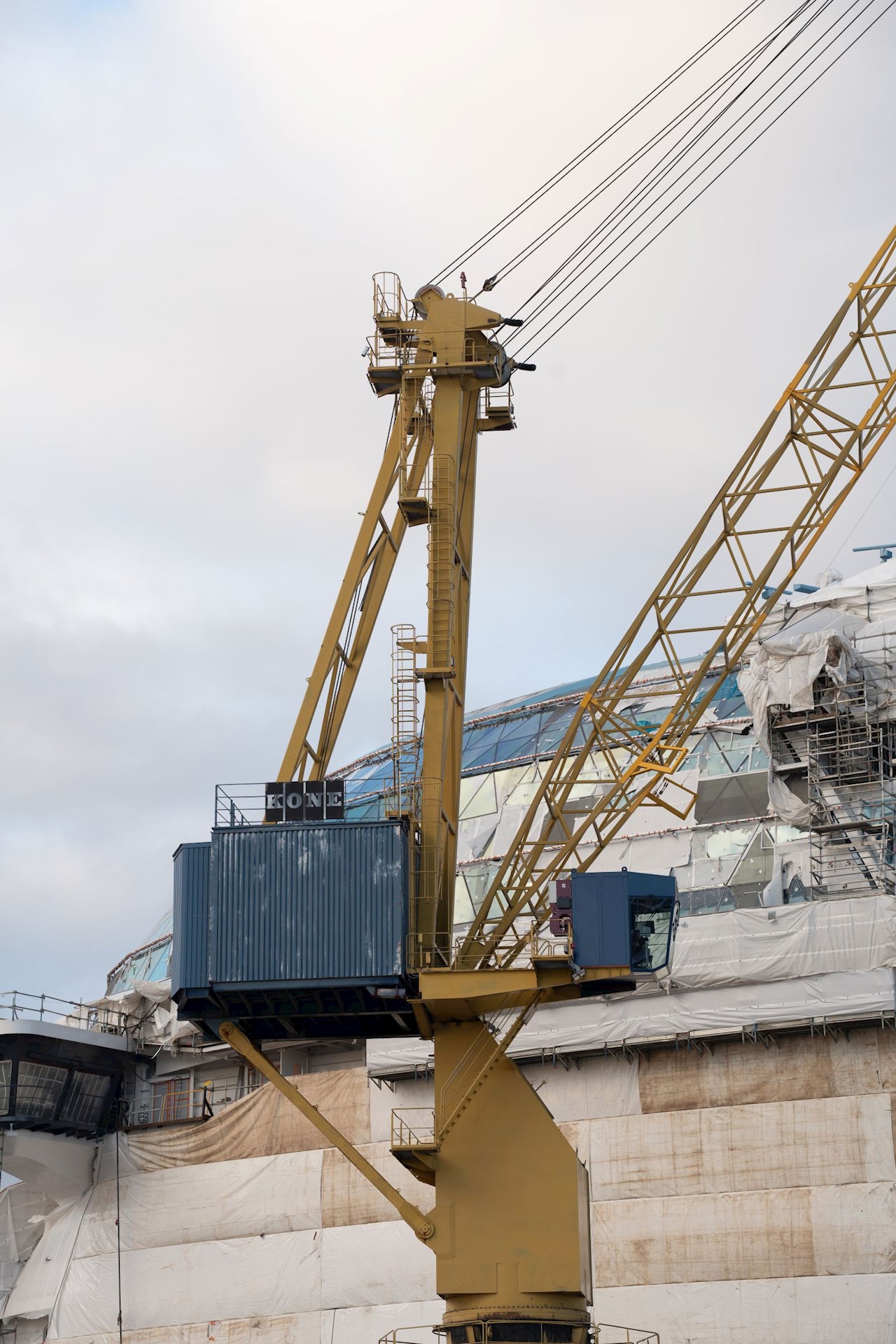
“Basically the entire technology package was renewed: all electrical systems, motors, drives, automation, and load measurement. In addition, the old operator cabin was dismantled and replaced with a new one that significantly improved driver ergonomics and visibility,” says Tomi Miettinen, Senior Project Manager at Algol Technics.
The technical solution was supported by ABB Motion motors equipped with SIL2-level safety sensors, next-generation ACS880-11 and ACS880-17 regenerative drives with FSO-21 safety function modules, as well as expert support from ABB throughout the project. The modern technology consumes less electricity and operates more efficiently.
At Meyer Turku, the modernization is seen as a strategically important and necessary investment for maintaining competitiveness.
“Our customers are interested in the reliability of our cranes. After all, a significant share of Finland’s GDP sails from here toward the United States every summer,” Riuttamäki notes.
Energy efficiency also extends service life
The regenerative drive technology supplied by ABB reduces the overall energy consumption of the heavy-duty crane.
“Braking energy is recovered and fed back into the grid instead of being wasted as heat through braking resistors,” explains Ville-Matti Pätäri, Segment Manager at ABB Motion.
Minimizing the heat load also reduces the cooling demand in the machinery room, especially during summer, and helps extend the lifespan of the electronics. Depending on the application, regenerative drives can pay for themselves in as little as two to three years.
Braking energy is recovered and fed back into the grid instead of being wasted as heat through braking resistors.
Ville-Matti Pätäri, Segment Manager at ABB Motion.
The benefits of the investment are visible in everyday shipyard operations
Following the modernization, the crane’s reliability has improved significantly, replacing monthly downtime with smooth day-to-day operations.
“Now logistics can function as planned without surprises, and that’s a big deal in an environment like this,” says Riuttamäki from Meyer Turku.
The new control system also enables more accurate fault diagnostics than before.
“Operational reliability is now much better. Maintenance shutdowns can be shorter and better planned,” summarizes Tomi Miettinen from Algol.
The new operator cabin features expanded visibility through additional cameras and larger window surfaces, significantly improving workplace safety. The operator no longer needs to leave the cabin to check for obstacles behind the crane.
Riuttamäki says the crane’s handling has also taken a huge leap forward: “The controls now respond almost intuitively. Crane operators have been especially pleased with the motion control. The new control technology and ABB drives understand and execute commands extremely well, making precise and controlled movements possible. The old control system lacked feedback to the operator.”
“The budget and schedule stuck right to the plan”
The crane modernization required approximately four months of downtime. Preparations had begun nearly a year earlier.
During implementation, Algol Technics used ABB Shop, ABB’s online store, to order electrical components and manage delivery schedules. According to Senior Project Manager Tomi Miettinen, real-time visibility into deliveries made coordination easier and reduced uncertainties.
The crane was commissioned exactly on the promised day. We are very satisfied with the project and will certainly continue the cooperation with other cranes as well.
Jaakko Riuttamäki, Maintenance Engineer, Meyer Turku
Algol’s experts carefully scheduled the installation work according to the shipyard’s operations: the project was carried out during a phase when the previous vessel had already been launched, allowing the crane upgrade to proceed in a controlled manner.
“The crane was commissioned exactly on the promised day,” Riuttamäki says with satisfaction. “We are very happy with the project and will certainly continue the cooperation with other cranes as well.”
A similar modernization of “Kasi’s” sister crane at Meyer Turku’s dry dock has also just been completed.
“This was an exceptionally well-executed, smooth, and memorable project,” praises Risto Tiihonen, Regional Application Engineer at ABB Motion. “Credit must be given to Algol’s highly skilled professionals for their excellent work: the electrical engineering was accurate, reliable, and fully under control on site, even under demanding conditions. Their software expertise is also of a very high standard. The entire cooperation was carried out professionally and in a great spirit.”
ABB and Algol have worked closely with the ABB OEM Hub in Helsinki. The OEM Hub supports similar modernization projects through system dimensioning, commissioning, and technical expertise. The Helsinki OEM Hub is part of ABB’s global application expert network that supports original equipment manufacturers (OEMs) by providing local presence and tailored technical support. The hubs focus on product development in close cooperation with customers.


