
By Mike Mustapha, Division President of ABB Smart Buildings
There is a moment when you look at the data behind buildings, where things stop quite adding up.
Not because the numbers are wrong. But because of the story they tell when you put them together.
These figures may be familiar:
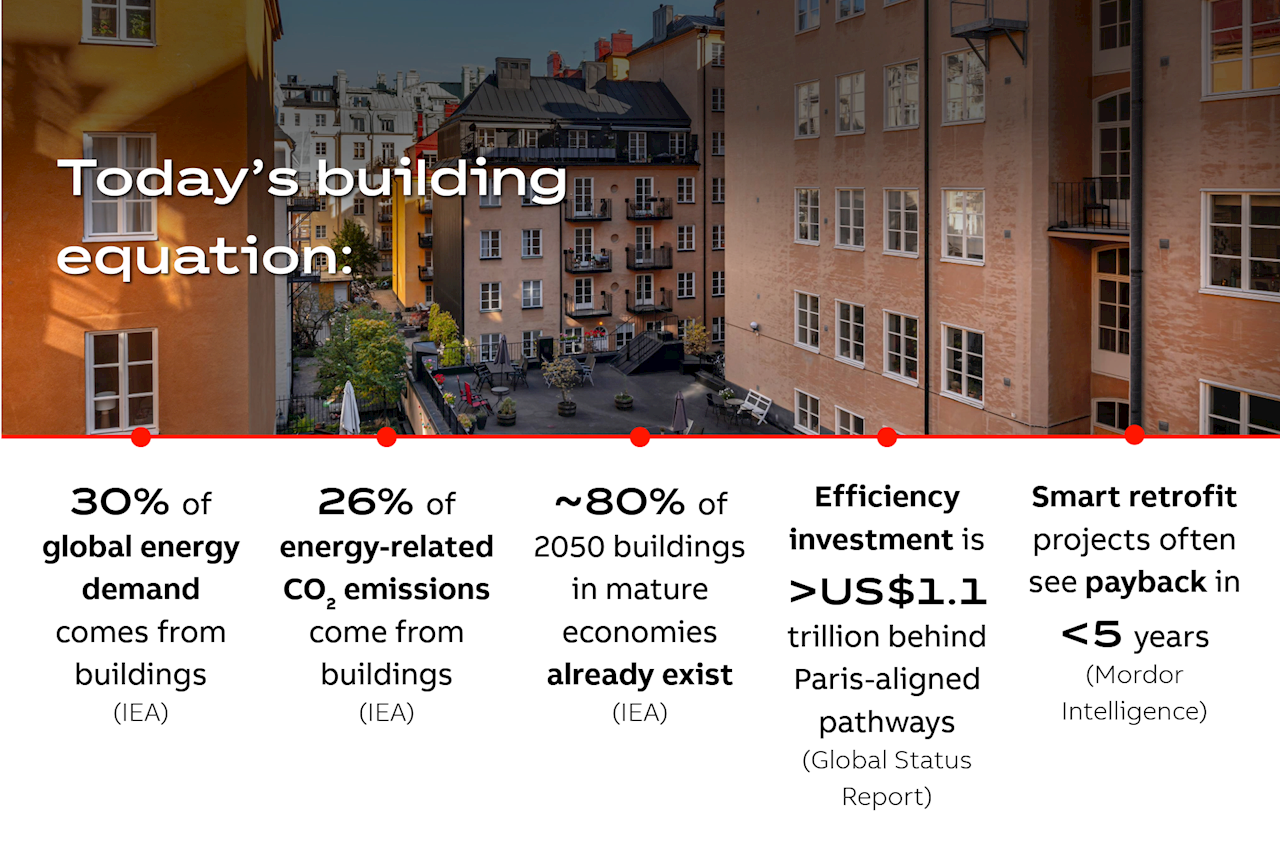
- Buildings account for roughly a third of global energy use and around a quarter of emissions1.
- At the same time, close to 80 percent of the buildings we will rely on in 2050 already exist2.
On their own, these numbers make sense. But when you add one more – a trillion-dollar gap in efficiency investment versus what is needed to stay on track3 to align with net-zero carbon and climate resilience targets by 2050 – the picture starts shifting.
If buildings are 26 percent of emissions, 80 percent of 2050’s stock is already built, and efficiency investment is still more than a trillion dollars short – the numbers simply do not match the level of change we need.
If most of tomorrow’s buildings are already in place, then most of the opportunity lies in how we improve what we already have.
That is the equation we need to solve.
The first number: scale
Buildings sit at the center of the energy system. They are one of the single largest contributors to global energy‑related CO₂.
At scale, small improvements add up quickly. A 10 percent reduction across a large portfolio can equal the full consumption of several smaller buildings.
For years, the industry has responded by improving efficiency, with better materials, stronger design, smarter systems. And that progress matters.
But scale changes how you think.
The second number: constraint
This fact – ‘Around 80 percent of the buildings we will rely on in 2050 already exist’ – changes the equation completely.
We are not starting from a blank sheet. We are working with what is already in place.
And while we continue to shape the future of buildings, we also need to get more from what we already have.
The third number: where the market is moving
The market is starting to reflect this shift.
Today, the majority of investment in smart buildings is going into retrofit projects. In many cases, those upgrades deliver measurable energy savings with payback in under five years4.
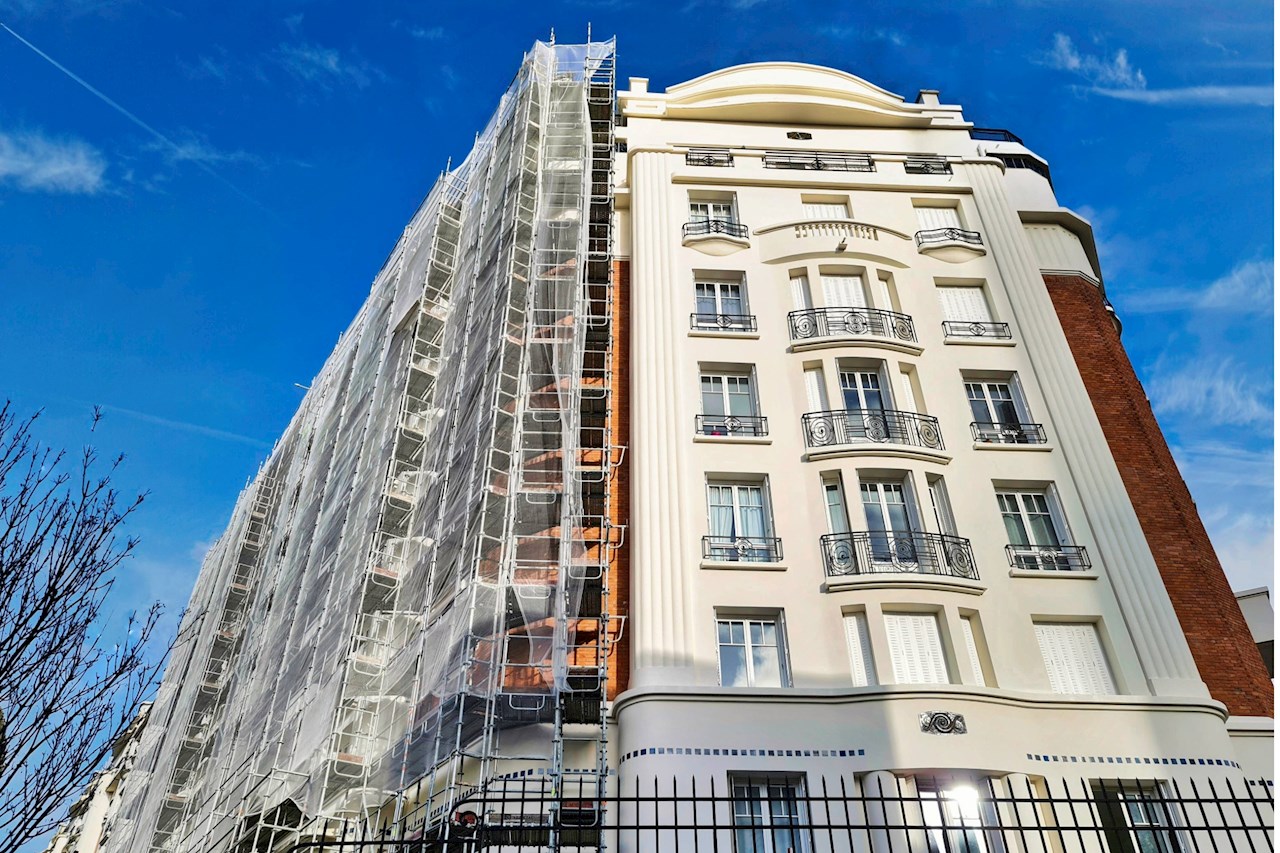
Take a typical city office building. Not new. Not failing. But not performing at its best.
With relatively focused upgrades – better control, better use of data, attention to where performance is lost – energy use can improve quickly. The impact is measurable quickly, often within months rather than years.
The building looks fundamentally the same, but the equation has changed.
When performance improves, it can be measured quickly. When it can be measured quickly, it becomes easier to scale. And when it scales, it starts to reshape the industry.
The equation we have been solving
For a long time, the equation was simple:
Better design + more technology = better buildings
And in many ways, that equation worked.
New buildings today are more efficient, more connected and more capable than ever before. They set the benchmark for what high performance can look like.
That still matters and it always will. But it is no longer the full picture.
That equation assumed two things: that most of tomorrow’s buildings were still to be built, and that newbuild performance would trickle down to the rest of the stock over time.
But the data tells us the opposite: We are still adding new buildings, with global floor area expected to grow by more than 50 percent by 20505. But most of the stock we rely on is already in place.
The equation we need to solve today
Existing buildings + performance at scale = real impact
Or more simply:
Performance = technology × integration × continuous management
A building with advanced systems but poor integration behaves like technology × 0. The capability is there. But the outcome is not. Technology on its own is not enough. In the same way that data on its own is not enough.
Performance comes from how systems work together and how consistently they are managed over time.
This is where the focus now shifts.
Not just on what buildings can do, but on how actively they are managed, optimized and adapted over time.
Adding it up
If you take the numbers together, the direction becomes clearer.
A sector responsible for a significant share of energy and emissions. A built environment that is largely already in place. And a market increasingly focused on improving what exists.
Closing the gap now requires sustained improvement – according to The Global Status report, roughly ten percentage points every year to 20306.
The conclusion is important. We are not solving the wrong problem. But we are starting to approach it differently.
A more complete equation
This doesn’t need to be a choice between new build and retrofit. It is about achieving balance.
New buildings will continue to lead. They show what is possible. They set the standard. Existing buildings provide the scale. They are where the majority of impact will come from.
Together, they form a more complete equation. One that reflects how buildings actually exist in the real world.
The next step
The industry has spent years adding capability. Now it needs to multiply performance.
That means focusing less on what buildings are designed to do, and more on how they operate, every day.
Not what buildings are capable of. But how they actually perform.
This, after all, is about the spaces we live and work in. And about creating a more sustainable, low-carbon future for the people who rely on them today, and for the generations that follow. Because in the end, that is the only number that really matters.
About the author
Mike Mustapha

Mike is the Division President of ABB Smart Buildings and was appointed in February 2022. In this position he has full accountability for the performance of the global Smart Buildings business in ABB, which includes a broad portfolio of market leading home and building automation solutions as well as the portfolio for energy distribution systems and products. After starting his career in the U.S. in 1990 as an Application Engineer with Rotoflow Corp. Inc., a leading supplier of high-speed rotary and cryogenic machinery for process industries, Mike built global leadership experience with Altas CopCo, a multinational industrial company, where he held various leadership positions. In January 2009, Mike founded the new Pre-Engineered Buildings and Hot Rolled Structured Steel Group, headquartered in Jeddah, KSA with its own independent Board. Mike assumed overall accountability for the company, overseeing the Middle East. Mike joined ABB in August 2011 as Low Voltage Division Regional Manager for India, Middle East & Africa. In June 2014, he was promoted to Global Managing Director for the Building Products Business Unit prior to his 2018 appointment as Head of Global Markets for the Electrification business. Mike currently resides in Dubai and holds a Master’s degree in Mechanical Engineering from the University of Southern California (USC), U.S.
Sources
[1] Buildings - Energy System - IEA
[2] Net Zero by 2050 – Analysis - IEA
[3] Global-Status-Report-2024_2025.pdf
[4] https://www.mordorintelligence.com/industry-reports/smart-building-market


