
Every time the lights stay on during a storm, every time a hospital keeps running through a blackout, every time a factory floor never skips a beat — there's a lot more happening behind the scenes than most people realize.
There are dedicated scientists and engineers, complex simulations, failed prototypes, and years of persistent R&D. There are people who have chosen to dedicate their careers to solving some of electrification's hardest challenges.
Step inside ABB’s U.S. Corporate Research Center in Raleigh, North Carolina for a behind-the-scenes look at how scientists are helping build more resilient energy systems.
Why microgrids matter: the global energy challenge
The global electrical grid is under unprecedented stress from multiple converging pressures:
- Surging global energy demand: power consumption climbs as electrification accelerates across industrial, residential, and transportation sectors.
- Renewable energy integration: solar and wind generation create variability that traditional grids were not designed to manage efficiently.
- Extreme weather and grid failures: climate-driven weather events increasingly cause cascading blackouts. When the main grid fails, consequences are severe: industrial facilities lose millions per day, hospitals face life-threatening outages, data centres go offline, critical infrastructure becomes vulnerable.
- Shift from centralized to decentralized energy: legacy grids operated on centralized generation and distribution models. Modern systems require distributed generation, local storage and intelligent coordination.
Microgrids address these challenges by enabling local energy resilience, reducing dependence on centralized infrastructure, and creating systems that adapt to renewable energy variability while maintaining grid stability.
What are microgrids?
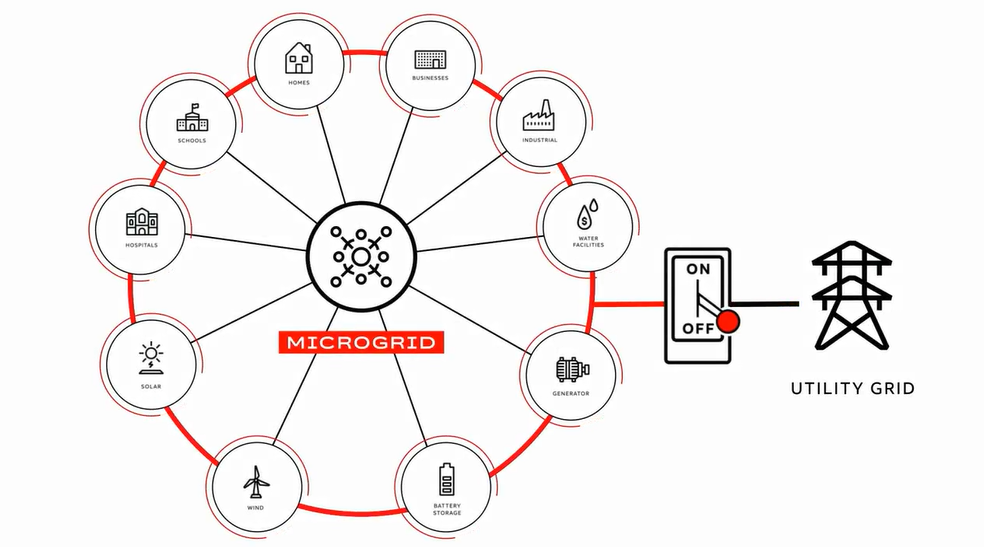
A microgrid is a localized electrical system that integrates distributed energy resources (DER)—including solar panels, battery energy storage systems, backup generators, and controllable loads—into a single coordinated unit.
Key characteristics:
- Operate connected to the main grid or independently
- Provide reliable power and energy resilience to critical loads
- Configured to meet specific energy demands of local communities
- Enable decentralized, smart grid architectures
Microgrids solve a critical problem: they enable communities, industrial facilities, hospitals, and data centers to maintain continuous power supply even when the main electrical grid experiences outages or disruptions.
How microgrids work: the control challenge
Every microgrid is unique. Variations in distributed energy resources, loads, cable configurations, communication architecture, and local grid regulations mean no two systems are identical.
The core challenge lies in coordinating complex, bi-directional energy flows from multiple distributed energy resources while maintaining balance and stability with precision down to the hundredths of millisecond level, and ensuring compliance with local grid codes and regulations.
A microgrid's control system must act like a conductor in an orchestra: ensuring that every component plays in perfect harmony, responds instantly to disruptions, and maintains system stability even when configurations change or failures occur.
ABB's microgrid research and development to build a resilient energy future
At ABB’s US Corporate Research Center in Raleigh, scientists and engineers advance microgrid technologies on multiple fronts. From next-generation control systems that enable grid code compliance across global markets to advanced simulation capabilities that allows customers to pre-validate microgrid designs before deployment, to ultra-fast protection technologies for AC and DC microgrids.
This work addresses one of the most pressing challenges in modern electrification.
Microgrids represent a critical solution to global energy challenges.
They enable:
- Local energy resilience and decentralized power architectures
- Higher renewable energy penetration with grid stability
- Reliable power for critical infrastructure (hospitals, data centres, industrial facilities)
- Faster response to grid disruptions and outages
- Cost-effective energy management and optimization
- Expansion of electricity access to underserved regions
From powering homes to keeping industries running, microgrids deliver reliable power to meet growing demands. They are foundational to the future of electrification—one where grids are smarter, more resilient, and more decentralized.


