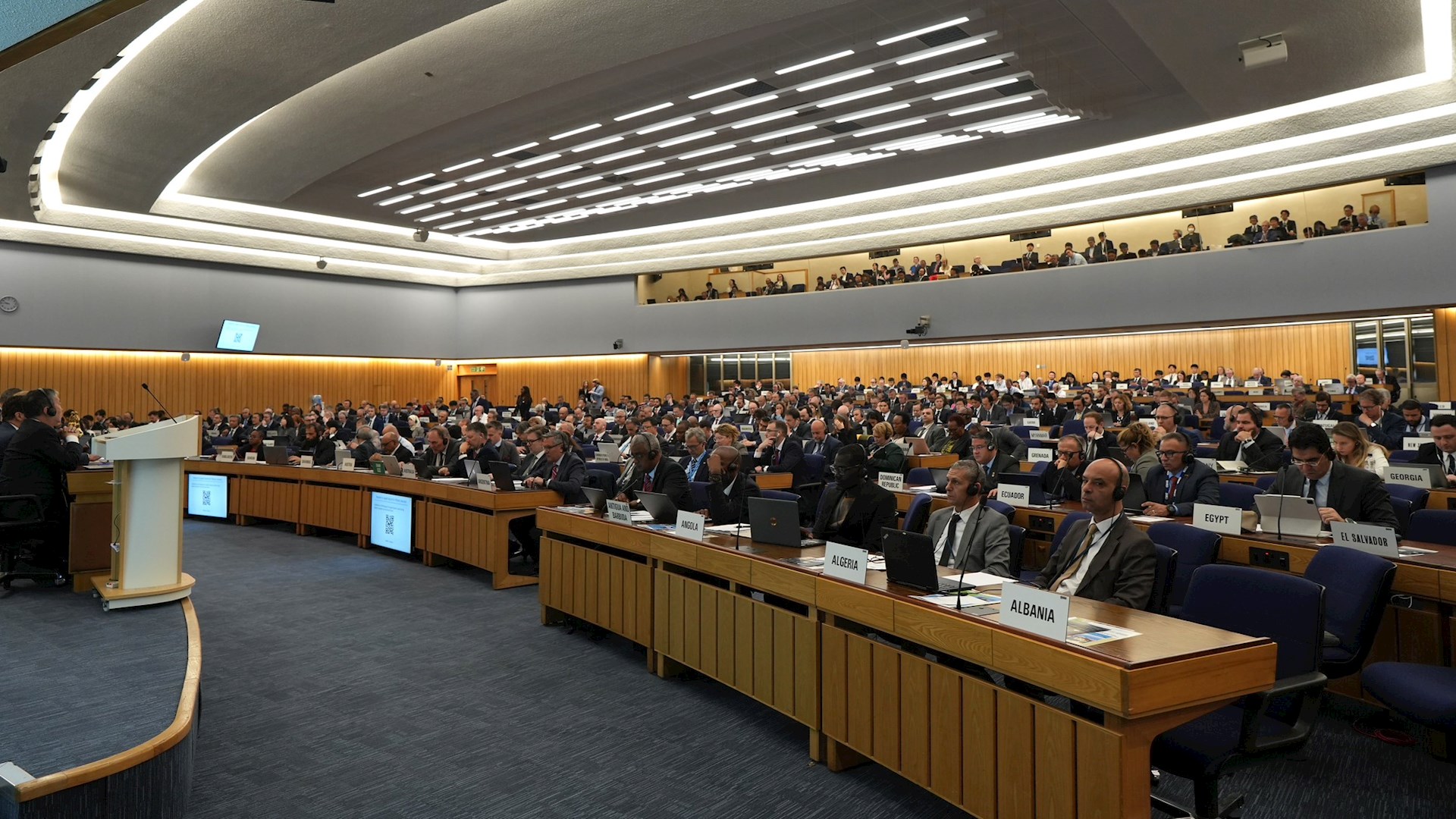
A step change in ship-to-shore connectivity over the past two decades has allowed IoT-based remote maintenance, performance monitoring, routing optimization and verified emissions reporting to drive digital transformation across the maritime industry.
But realizing the operational benefits available relies on whether the regulations that uphold ship safety and protect the marine environment also adapt. This can take time, especially when engineering defines “real time” as a 200-microsecond feedback loop, while legal language refers to “best possible haste” and “without undue delay”.
While many ship systems continue to work on a standalone basis, an increasing number of vessels communicate with each other as well as to shore. Sharing data on how mutually dependent technologies respond to changing sea conditions can help fleets optimize overall performance.
As systems interact, it becomes more difficult to model or predict the behavior of a ship as a whole in changing environmental conditions.
“Ships are made significantly safer and more efficient when technologies on board operate on an integrated basis,” comments Daniel Erdmann, Deputy Secretary General CIMAC. “A ship today should be seen as a system of systems, whose safety and performance is enhanced when managed as a unified data ecosystem.”
Digitalization needs integrated thinking
CIMAC’s interests have evolved far beyond its roots in combustion engines and today span almost all aspects of ship propulsion, train drive and power generation. A neutral forum with 14 National Member Associations and corporate members in eight countries globally, CIMAC’s technical exchanges, guidelines and work with regulators and standardization bodies also covers hybrid propulsion systems, distributed power management and digital control technology.
With its own ‘GHG Strategy Group’, CIMAC reviews the International Maritime Organization’s (IMO’s) discussions on how to achieve net zero greenhouse gas emissions in shipping by around 2050. However, the association’s view on the significance of system integration has also been a main driver for seeking consultative status at the IMO.
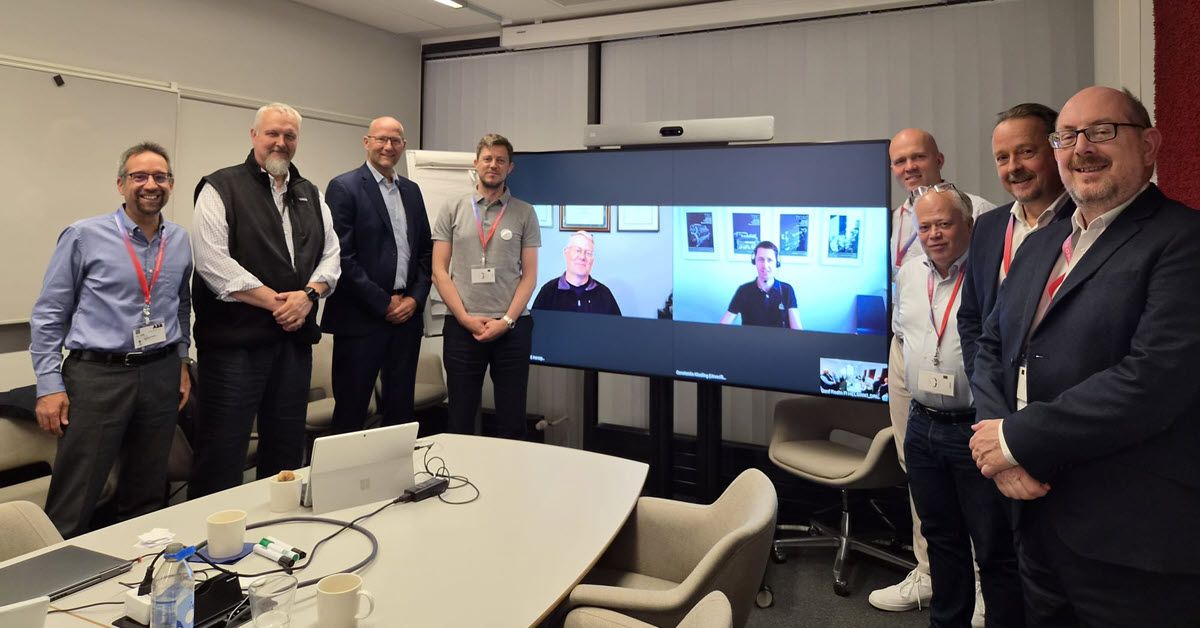
CIMAC Digitalization Strategy Group met in Helsinki, Finland 16 July, 2026 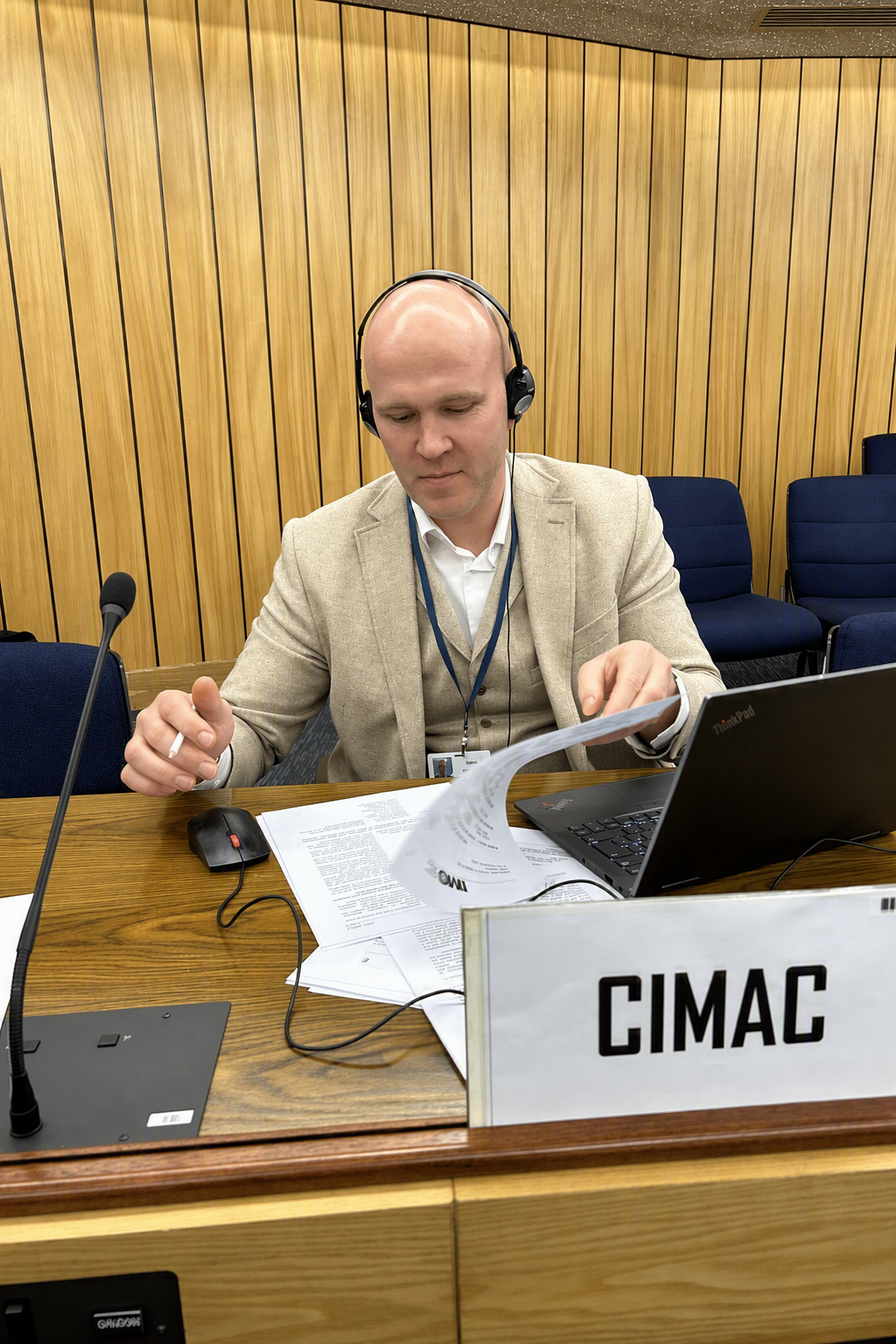
Daniel Erdmann, Deputy Secretary General CIMAC 
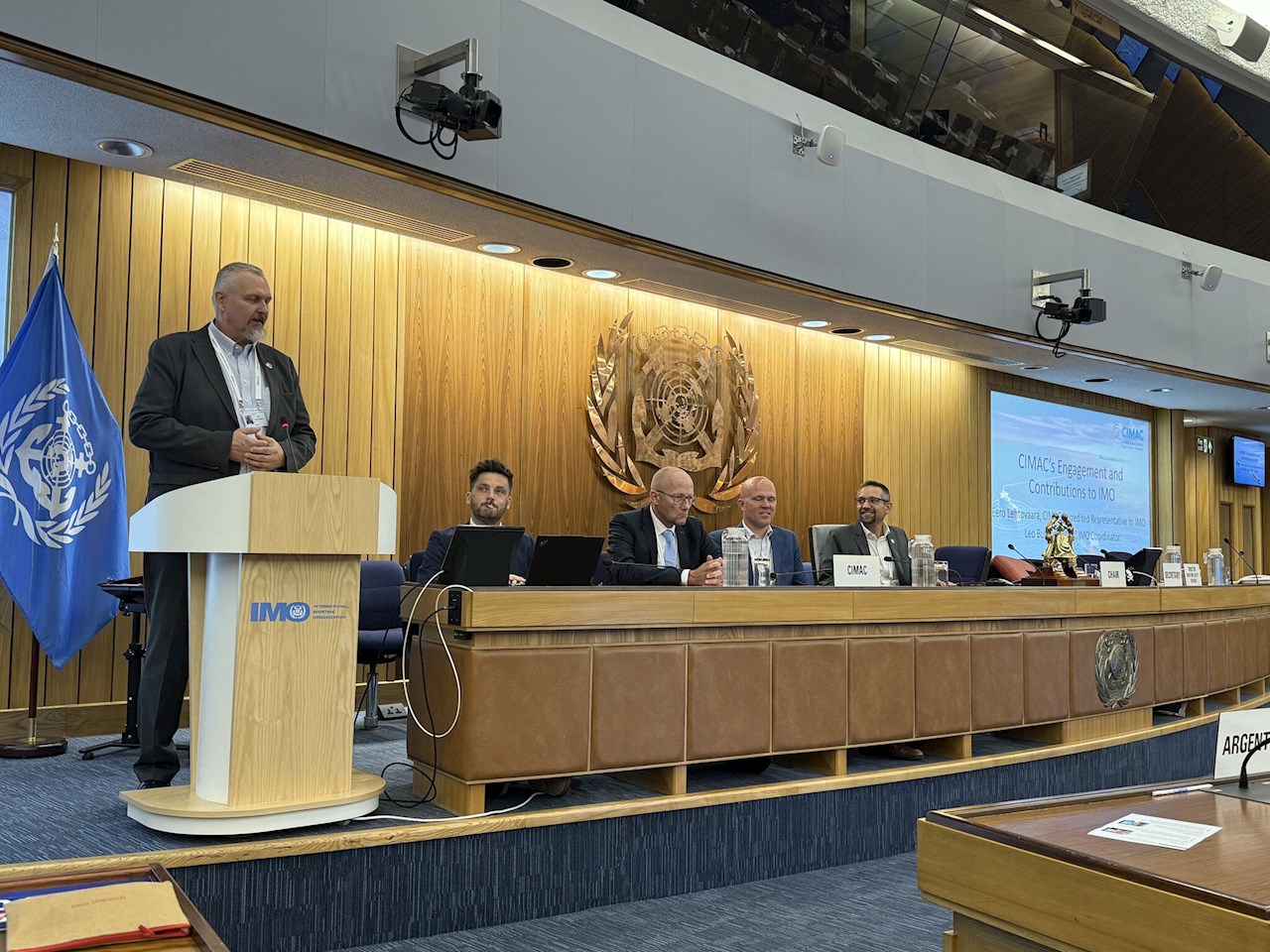
Eero Lehtovaara, Head of Regulatory and Public Affairs, ABB's Marine & Ports division and Leo Budicin, Leo Budicin, Regulatory Affairs Manager and Policy Coordinator, CIMAC
After securing NGO status in July 2024, CIMAC Secretary General Peter Müller-Baum emphasized: “Within IMO, CIMAC will concentrate on digitalization, non-shaftline propulsion, automation and system integration.”
Strategic priorities include digitalization, cybersecurity, and data harmonization, as well as alternative propulsion systems and underwater radiated noise. These are topics where regulatory frameworks and industry innovation intersect, and a consultative role allows CIMAC to contribute to developing robust legislation.
Eero Lehtovaara, Head of Regulatory and Public Affairs at ABB’s Marine & Ports division, also serves as Vice President, Digitalization at CIMAC. He has played a key role in shaping the Association’s strategy to share its expertise with the maritime industry’s global regulator.
From the operational point of view, more integration between systems introduces greater complexity. As systems interact, it becomes more difficult to model or predict the behavior of a ship as a whole in changing environmental conditions, Lehtovaara says. Making a rule change that targets a single function or task can have unintended consequences for operational performance, but also for the seafarers working with ship systems.
“Regulation must reflect growing interdependence in intelligent ship systems, and for the moment, there is no overarching maritime regulation on integrated systems. In an era when interactions between technology and humans touch all aspects of life, we need to nurture a two-way exchange, where system developers are fully transparent with industry and regulators are receptive to expert guidance on what is practical in technology terms.
“The ways we address lack of understanding of the ship as a system and accommodate the changing role of the human in the loop is not obvious in existing regulations. It’s essential that we help humans through the growing pains of AI, for example, at the same time as we identify areas that are potentially hype.”
Maintaining the relationship between maritime technology leaders and regulators is essential, Lehtovaara adds. Doing otherwise risks rules developing in ways that are incompatible - or even in conflict - with the integration that goes hand in hand with digitalization. “That would get complicated and expensive, and it would also have a negative impact on safety,” he says.
CIMAC in session at IMO
With strong experience of working in and around EU institutions for over a decade, Leo Budicin joined CIMAC in January 2025 to coordinate its activities at the IMO. He has since become a familiar face at meetings of the Maritime Environment Protection Committee (MEPC), Maritime Safety Committee (MSC) and Facilitation Committee (FAL), as well as at sub-committees on Ship Design and Construction (SDC) and Ship Systems & Equipment (SSE).
“It’s critical that CIMAC is part of the dialogue to raise awareness in every forum not only of the risks when systems do not communicate with each other, but also of the significant opportunities that integrated and connected systems offer for safety, efficiency, sustainability and operational performance,” Budicin observes. Participation in the Maritime Safety Committee Correspondence Group that is laying the groundwork to develop a new digitalization strategy for global regulation has been a priority, he adds.
Regulatory certainty is a key requirement investors look for, whether they are considering new ship designs, alternative fuels, autonomous ship technology or any other progressive transition.
CIMAC is part of a Joint Industry Working Group hosted by the International Association of Classification Societies (IACS)1 that is considering the impact of digitalization and increasingly complex systems on ships, and the introduction of advanced survey techniques. The high-level assessment is expected to bring forward a formal submission to IMO in 2027 that provides a basis to overhaul the International Convention for the Safety of Life at Sea (SOLAS) for the digital era by 20322.
Ongoing work also has consequences for topics within the IMO’s current four-year work program, which runs to 2028.
Areas of interest include IMO’s goal-based and non-mandatory Maritime Autonomous Surface Ships Code (MASS), which came into effect on July 1, 2026 as a framework to support the safe integration of AI-enabled and remotely operated commercial vessels3. The Code covers requirements for the design, approval and operation of autonomous ships, including navigation, connectivity, remote operations, fire safety, and search and rescue. It also underscores the importance of human oversight, with the master retaining responsibility for the ship at all times – even if not on board. The mandatory version of the MASS Code is expected to be ready for adoption by 2030 and to come into force by 2032.
The rules developed for integrated systems will have to align with the changing way humans interact with autonomous ship technologies as their use becomes a more common part of daily operations. Lehtovaara notes, for example, that while IMO has moved forward using agreed ‘levels’ of autonomy, regulations are not currently explicit on the point where autonomous technology would override human inaction in order to avoid an incident.
Contributing to rigor in maritime regulation
Regulatory certainty is a key requirement investors look for, whether they are considering new ship designs, alternative fuels, autonomous ship technology or any other progressive transition, Budicin observes.
CIMAC pointed this out at the IMO’s Marine Environment Protection Committee (MEPC) meeting, ending 1 May4, as delegations agreed to disagree on a way forward for the ‘Net Zero Framework’ on GHG emissions. “Our industry has already made substantial investments in technologies for new fuels, including engines, fuel systems, safety concepts, and testing capabilities… Prolonged uncertainty risks slowing innovation at a time when acceleration is essential… this requires a clear direction and regulatory certainty from the international community,” CIMAC stated.
Additional rigor will also be required for shipping’s rule-makers to get to grips with their integration challenge. Erdmann cites a recent IMO subcommittee discussion on developing new rules covering electrical motors that based its understanding on statements made in the 1980s and 1960s-era statistics. Using out-of-date assumptions about motor reliability could have resulted in rules that include unnecessary redundancy, he says.
“There is work to be done to update and share contemporary statistics, and this is a discussion that we will need to return to, but it’s an example of how consultation with industry can help NGOs, flag states and the IMO itself work towards making sound decisions.”
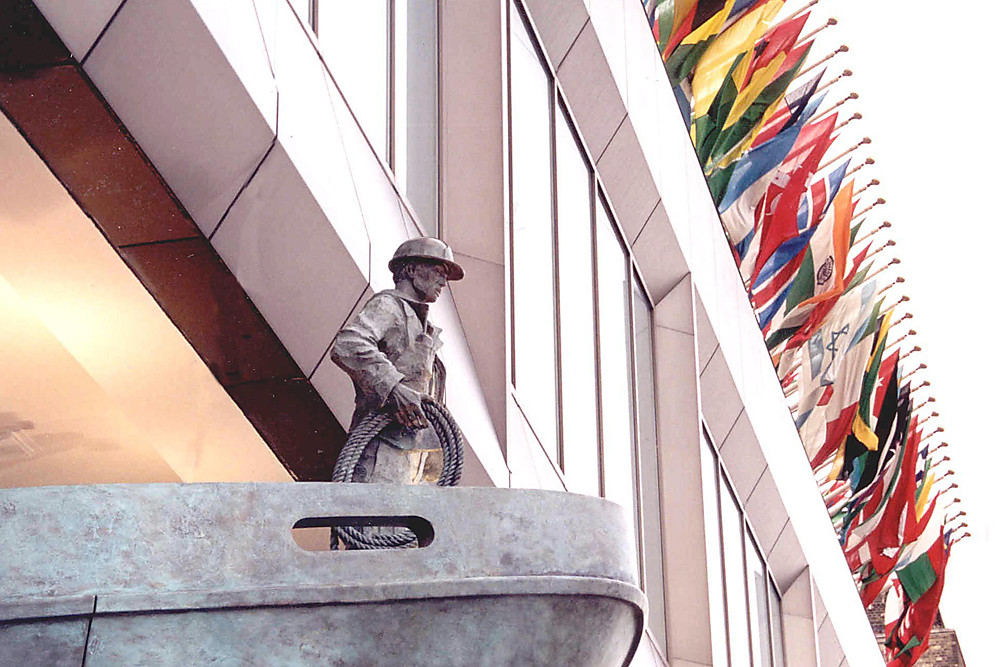
In another intervention at 11th session of the SSE in February 20255, CIMAC drew attention to the way the IMO subcommittee’s previous work on single electric propulsion had been limited to passenger ships, but that a new proposal introduced cargo ships into discussions, adds Budicin.
Less noise, more action underwater
Developing its role as a recognized expert on key topics, CIMAC has also prioritized work on Underwater Radiated Noise (URN). In May, the MEPC agreed to extend its ‘experience building phase’ for new guidelines on ship URN to 2028. Having already included URN in its ship efficiency work program relating to GHG emission reductions, MEPC also agreed in principle to commission a new study to gather evidence in support of future measures.
It’s critical that we establish precision on frequencies, limits and URN measurements on the seabed and on the ship, to show that efficiencies gained by better propeller design, hull optimization, vibration dampening are also verifiable as URN reduction.
CIMAC’s URN work pre-dates its consultative status at IMO, Budicin notes, and offers an example of its ability to “gather an expert group at the right time for the right place”. CIMAC aims to work with others to develop a substantive submission on the topic to IMO during 2026 and 2027. “Having ABB experts as part of the team ensures that we have some of the deepest knowledge on this topic at our disposal,” adds Budicin.
Following May’s MEPC meeting, Lehtovaara suggests that progress on URN may have been the biggest tangible outcome in terms of rule development. “We are on the right track and we look forward to making a full contribution to this vital work with CIMAC.”
“Measurement methodologies are going to be key,” he says. “This is not only about how measurements are taken or existing technology options using hydrodynamics on board or hydrophones over distance, but also about what exactly we seek to measure.”
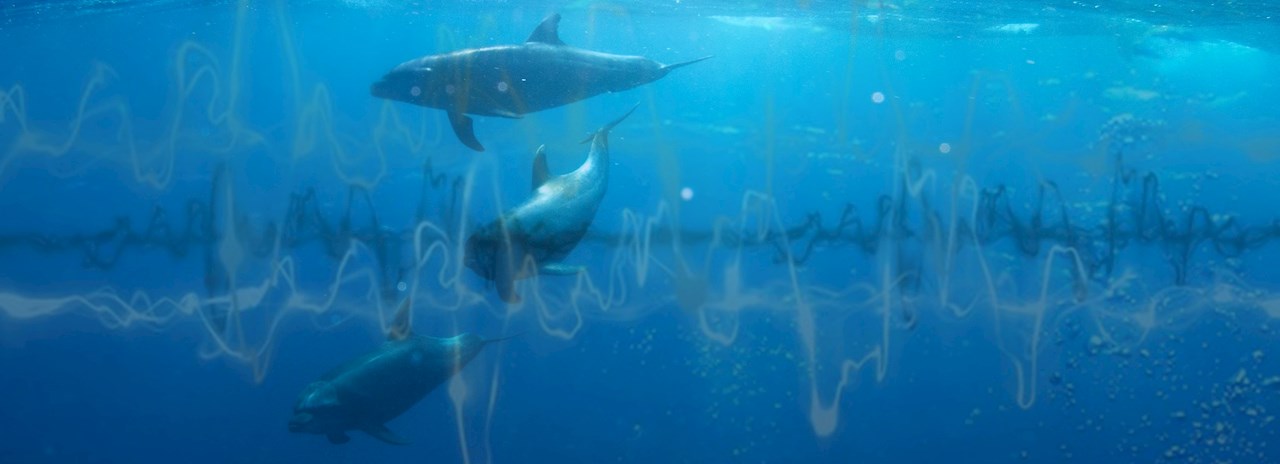
“It’s critical that we establish precision on frequencies, limits and URN measurements on the seabed and on the ship, to show that efficiencies gained by better propeller design, hull optimization, vibration dampening are also verifiable as URN reduction,” comments Budicin.
“By engaging with NGOs, flag states, and other stakeholders we’ll also identify what is missing from the discussion and where we can have the greatest impact. This is a fascinating topic and an example of how, by representing a global community with deep technical expertise, CIMAC’s knowledge can be transformed into a tangible contribution that will shape the future of the maritime industry.”
References:
[3] https://www.imo.org/en/mediacentre/pressbriefings/pages/imo-adopts-mass-code.aspx
[4] https://www.imo.org/en/mediacentre/meetingsummaries/pages/preview-mepc-84.aspx
[5] https://www.imo.org/en/mediacentre/meetingsummaries/pages/sse-11th-session.aspx


