When a storm knocks out power across a region, most of us notice only one thing: whether the lights stay on.
Many people have heard of microgrids—localized energy systems that can keep electricity flowing even when the main grid fails.
But how do they actually do it?
Behind every microgrid are thousands of decisions happening in fractions of a second. Solar panels suddenly producing less electricity as clouds roll in. Batteries deciding whether to charge or discharge. Backup generators starting. Every device responding to changing conditions while somehow staying perfectly synchronized.
This article explains three technical complexities that make microgrids one of modern electrification's biggest challenges.
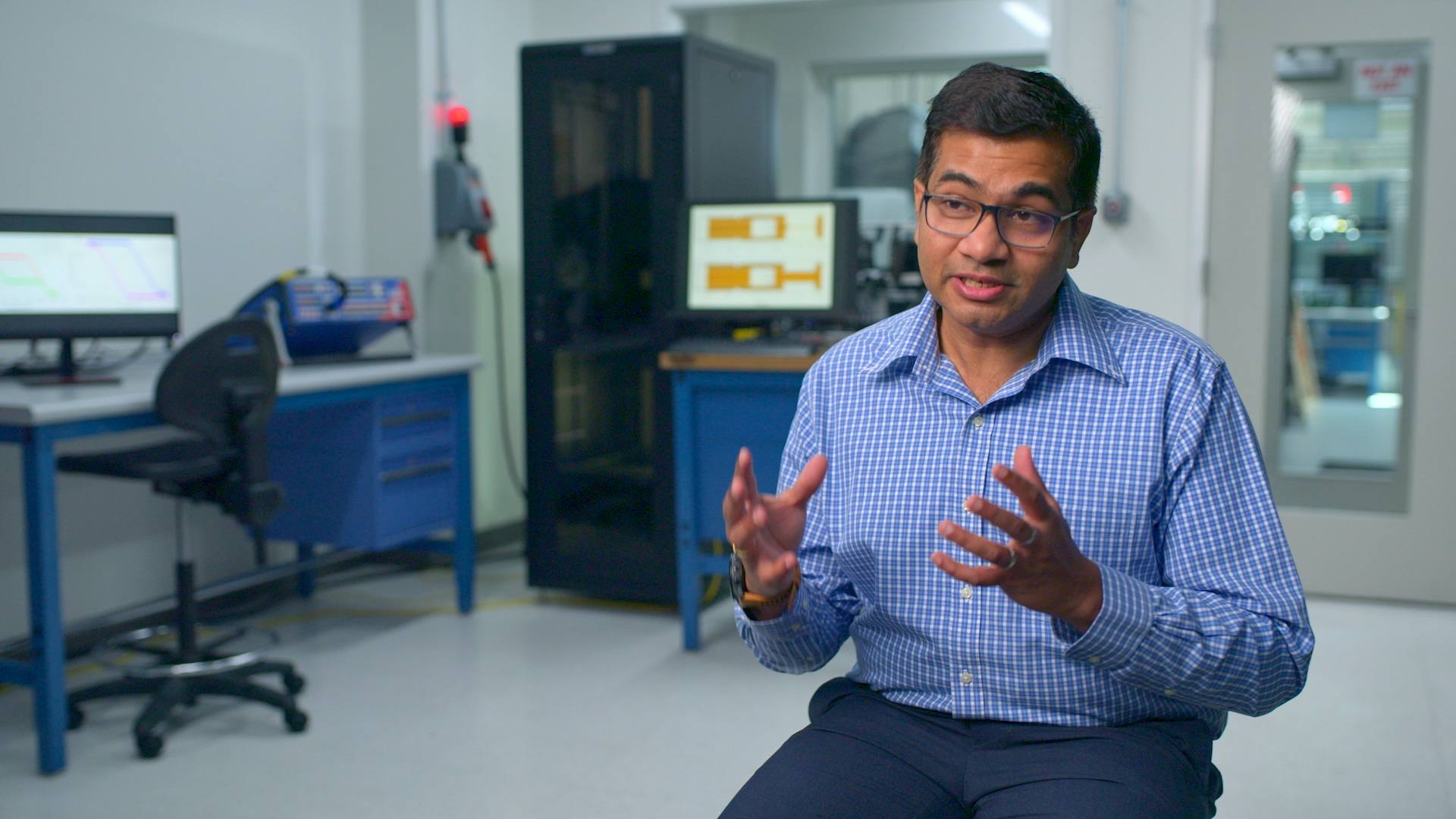
It's also what brings us to ABB's U.S. Corporate Research Center in Raleigh, North Carolina.
Inside the lab, scientists and engineers spend their days solving complex problems that most people never think about. Microgrids are far more complex than they first appear.
Here are three things that might surprise you.
1. Every microgrid has a unique configuration
If you've seen one microgrid, you've seen...one microgrid.
Every microgrid is built around a unique combination of energy sources, storage technologies, electrical equipment and customer needs.
A remote community integrating solar and batteries has very different requirements from a manufacturing plant that cannot afford even a second of downtime. A data center balancing massive electrical loads behaves differently from a university campus generating part of its own energy.
Local regulations, utility requirements, communication architectures and even cable layouts vary from one installation to another.
That means there is no universal configuration.
Before a single piece of equipment is installed, engineers create detailed digital models of each microgrid and simulate thousands of operating conditions—from sudden demand spikes to renewable energy fluctuations and grid disturbances—to understand how the system will behave.
2. Microgrids coordinate multiple energy sources in real time
Microgrids must integrate multiple energy sources (solar, batteries, generators, grid connection) to function reliably.
Designing the individual components is only half the job. The real challenge is making them behave as one.
Imagine an orchestra at the height of a performance. Every musician enters at precisely the right moment. Some play louder, others softer. Some stop while others begin. The audience doesn't notice the coordination—they simply hear beautiful music.
A microgrid works the same way.
Solar panels, batteries, generators and the utility grid are constantly exchanging energy. Production changes. Demand changes. Equipment switches on and off. Yet the entire system must remain perfectly balanced.
That coordination happens continuously, with control systems making decisions down to the hundredths of milliseconds level to keep electricity flowing reliably.
When everything works together, the complexity becomes invisible. And that's exactly how it should be.
3. Microgrids must respond to electrical faults in milliseconds
Most electrical faults develop incredibly fast.
When a tree falls on a power line or equipment unexpectedly fails, a microgrid must respond with speed and precision.
Protection systems must detect the problem, isolate only the affected part of the network and keep the rest of the system operating safely. Disconnect too much, and customers lose power unnecessarily. React too slowly, and equipment can be damaged or the entire microgrid can become unstable.
The challenge becomes even greater as modern microgrids combine conventional AC networks with DC (Direct Current) architectures, battery storage and renewable energy sources, all interacting in increasingly complex ways.
So how do you trust something this complex to work?
Designing a microgrid is one thing. Proving that it will perform reliably under thousands of different conditions is another.
That's exactly what ABB's research scientists in Raleigh, North Carolina spend their days doing, using a range of testing methods.
One of those methods is simulation. Our teams build detailed digital models of entire microgrids and expose them to countless operating scenarios—from changing weather and fluctuating renewable generation to sudden changes in demand or faults on the network. Simulations allow researchers to understand how a system will behave long before it's built.
Another is Hardware-in-the-Loop (HIL) testing, where real controllers and protection devices are connected to a real-time digital model of a power system. To the equipment, the simulated network behaves exactly like a real one, allowing engineers to validate new control strategies, uncover unexpected interactions and refine system performance without putting critical infrastructure at risk.
Researchers also carry out power protection testing, validating protection technologies under realistic electrical conditions, recreating disturbances and fault scenarios to verify that systems respond as intended.
Sometimes the simulations reveal problems.
Sometimes prototypes don't behave as expected.
Sometimes years of work lead to solutions that quietly become part of systems bringing reliable power to hospitals, factories or communities around the world.
For our customers, that confidence is essential. Organizations are striving to strengthen energy resilience and integrate more renewable energy into their operations, so they need to know these increasingly complex systems will perform.


