Andrea Estrada-Hein, VP Business Line Switchgear, ABB Distribution Solutions
Plenty of engineers have seen the difference between a technical improvement on paper and a practical one on site. Early Light Emitting Diode (LED) retrofits, for example, often promised efficiency gains but many did not deliver the light quality, reliability, or user experience that they should have. Much the same can be said of other digital upgrades, from software updates that bury everyday functions in new menus to touchscreen controls that look modern but make simple tasks slower.
In each case, the lesson is the same: changing the technology underneath only counts as progress when the result works better in practice, not just in theory.
That is the challenge facing Europe’s medium voltage market now. With the main phase of the EU’s revised F-gas regime now in effect, SF6-free switchgear is part of the live specification environment. Now, the focus is on which technologies genuinely improve the job rather than simply ticking the compliance checkbox.
Compliance, while essential, is only the beginning. Engineers still must think about service continuity, safe operation, footprint, ease of installation, room for project-specific configuration and the practical realities of maintenance in operation. A new design may satisfy the regulation, but if it makes those fundamentals harder or slower to manage, it will not feel like much of an upgrade.
Different sectors, shared challenges
The pressure looks slightly different across sectors, but the underlying demand is the same. Infrastructure projects, for example, need switchgear that can stay within a standard architecture while still accommodating highly specific requirements, whether that means the load profile of a port, the operational constraints of an airport or the layout demands of a hospital. Similarly, renewable projects often favor standardization and delivery speed, but with flexibility for local adaptation.
An update can only be considered an upgrade when the outcome is better for the people using it.
In each case, the challenge is to remove SF6 from the equation without introducing fresh compromises elsewhere in the system. That means taking a harder look at how switchgear behaves in the field:
- How well it supports operators,
- how much visibility it gives facility teams,
- how it handles abnormal conditions, and
- how easily it can be adapted to real applications rather than idealized ones.
It’s this test that separates a switchgear offering upgraded performance from one that simply updates to comply with legislation. And, in the case of SF6-free technologies, the upgrade doesn’t come from introducing new functionality and features. In fact, quite the opposite is true.
Balancing innovation with familiarity
From ABB’s experience, one of the most important decisions in SF6-free switchgear design was not to treat the move to SF6-free technology as a reason to force users into a completely unfamiliar operating concept.
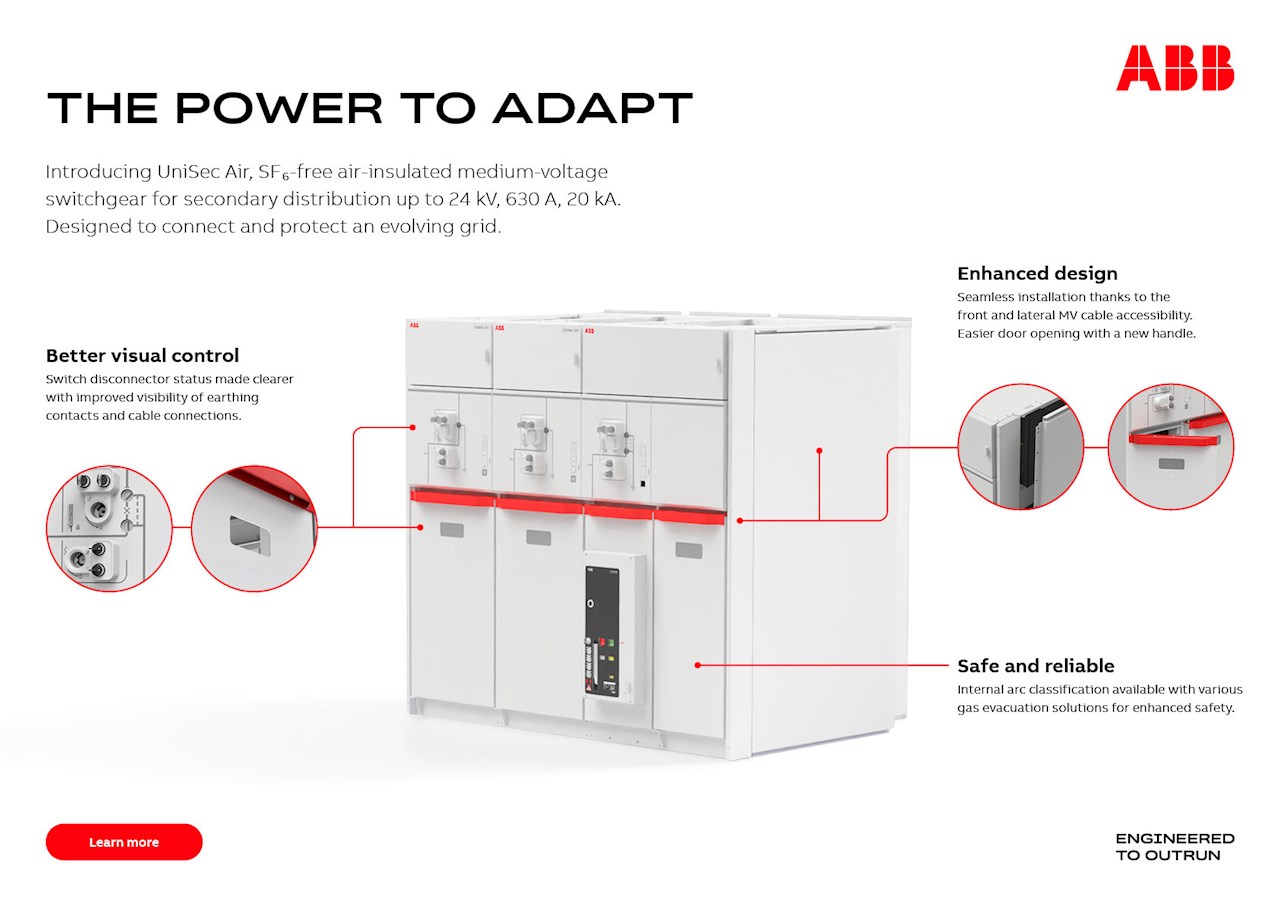
ABB’s UniSec Air air-insulated switchgear, for example, keeps the same footprint and operating philosophy as classic UniSec, which means the transition is easier to manage for customers expanding an existing installed base or working within the constraints of an existing room layout. In medium voltage, familiarity is about reducing retraining, lowering the scope for operator error, and making integration into existing systems more straightforward.
However, that does not mean an SF6-free switchgear should be free of innovation. For us, we worked closely with end users and installers to identify the key challenges they experience in day-to-day work.
Several of the changes in UniSec Air came directly from that feedback. The switchgear offers easier frontal and lateral access to medium voltage cable connections, a redesigned handle to simplify door opening, clearer synoptics and status indication and better visibility through the inspection window for earthing contacts and cable connection status.
None of those details are regulation mandated. Rather, all of them came from an ambition to make operation and maintenance safer, faster, and less dependent on specialist familiarity.
And that is where the lesson from the early days of LEDs and software updates comes into play again. Done right, the SF6-free transition provides the opportunity for the new generation of equipment to improve the whole operating experience around it — continuity, maintainability, visibility, safety, and flexibility — rather than merely meeting the new baseline.
An update can only be considered an upgrade when the outcome is better for the people using it. The smart switch is the one that changes what needs to change without making the rest of the job harder.


