By Andrea Menti, Business Line Leader, Energy Distribution, ABB Electrification’s Smart Buildings Division
“Build it Ready” sums up the importance of preparing buildings for change. As the theme for this year’s World Green Building Week, supported by three pillars: “Built Resilient”, “Built Efficient” and “Built for Opportunity”, it is a reminder of the need to create buildings that are ready for an unpredictable future. Electrification is a key part of this journey.
The world is electrifying faster than its buildings are changing. The IEA anticipates that the buildings sector will account for 49% of the increase in global electricity demand between 2025 and 2030. Technologies such as EV charging, heat pumps, renewable generation, storage and digital systems present important steps forward, but also increase the demands placed on a building’s electrical infrastructure.
Buildings are already under pressure to adapt to changing energy and user priorities. This will only grow in the next decade and beyond. At the same time, buildings are evolving from passive energy consumers into more active participants, capable of generating and storing energy. This shift means there will be a greater need to coordinate exactly when and how energy is used. Panels, plant rooms and other infrastructure spaces cannot keep expanding to accommodate every new requirement.
The challenge is complex. However, buildings can accommodate more power and functionality while using less energy and fewer resources, helping owners and facilities managers control costs while minimizing the additional space requirements, complexity and disruption involved. Rather than being an additional burden for buildings, intelligent, modular and installation-friendly electrical infrastructure can actively improve performance and reduce operating costs and future upgrade risks. These types of manageable steps forward can help buildings become better prepared for an uncertain energy future.
Efficiency beyond energy consumption
Reducing consumption and controlling energy costs are central to building efficiency. But being truly “Built Efficient” is about much more than lowering consumption. It means using space, electrical capacity, materials, installation time and operational insight more effectively across the building lifecycle, while also safely and efficiently managing increasingly diverse energy sources. This can be achieved by making strategic infrastructure changes that deliver measurable improvements - and by moving from fixed energy systems to solutions that enable real-time monitoring and control through digitalization and automation. Doing so has the potential to transform raw energy data into useful operational insight.
As I often say, you can’t optimize what you cannot see. To be fully future-ready, buildings must have comprehensive visibility of systems and resources. This is achieved through solutions such as electrical infrastructure capable of delivering real-time insight, right down to the power meter, sub-distribution board and circuit-breaker level. Facilities teams can then progress from reacting to consumption trends to proactively identifying inefficiencies, managing peak demand, detecting faults and ultimately, making more informed decisions. It’s a breadth of visibility that ensures facilities teams can trust they’ll be able to identify waste, manage demand and make more strategic steps forward - however their electrical infrastructure evolves in the future.
Optimized performance, reduced resources
Space - or a lack of it - can seem a significant obstacle in the drive towards future-ready buildings. While energy requirements continue to evolve, it is not usually possible to expand the footprint of an existing building to any meaningful degree. Most of today’s buildings cannot increase in scale, especially those in urban settings. To become future-ready, buildings must adapt beyond these limitations. Achieving this requires infrastructure that integrates characteristics sometimes viewed as competing priorities: compactness and performance; intelligence and simplicity; reliability and flexibility.

Infrastructure designed to evolve
So how can buildings address the conflict between spatial and structural constraints - and the need to evolve? One important answer is the use of compact, higher-performing electrical infrastructure, particularly in existing buildings where panels and plant rooms offer limited room for expansion. Intelligent systems and simpler installation make increasing electrical complexity easier to manage, while reducing project time, resource use, disruption and the risk of human error. These solutions make not only energy management but entire buildings more intelligent, flexible and ready for changing user needs. Rather than addressing electrification as a linear, limited system, they prepare buildings for a world that is increasingly dynamic, digital and multi-directional. Improved performance matched with a reduction in the use of space and resources will ensure buildings are ready for tomorrow, as well as today.
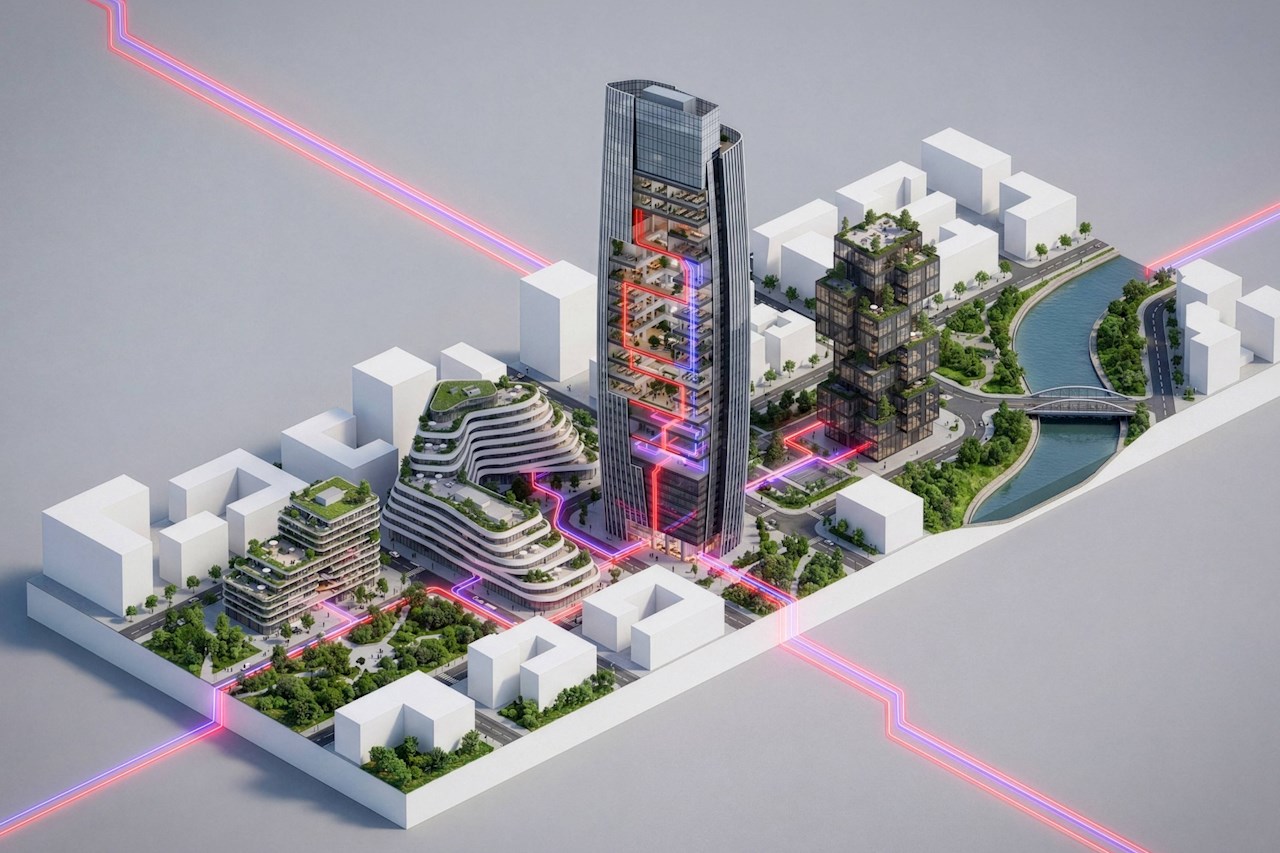
Being future-ready means being able to adapt. Traditional building grids are built for fixed maximum loads, making retrofits complex and costly. High-density power demands from green technologies, such as those from commercial heat pumps and EV charging networks, mean buildings will increasingly need to scale dynamically. Modular electrical infrastructure allows buildings to add capacity and integrate new technologies and energy sources as demand grows, without the risk of upfront overinvestment. Instead of static, constrained systems, these solutions create an integrated, dynamic ecosystem that gives buildings the flexibility to scale up or down as required.
The advantage of this long-term adaptability goes beyond ensuring buildings keep up with the needs of their users. It can also lead to lower operating costs and more efficient use of existing infrastructure. By combining modular electrical infrastructure with real-time digital monitoring and load management tools, electrical systems can dynamically scale, reconfigure and handle fluctuating demand without requiring complete infrastructure overhauls.
Build for change
As the theme for this year’s World Green Building Week reminds us, it is critical that buildings become better prepared for the changing priorities and needs that lie ahead. We cannot anticipate the exact demands that will be placed on buildings in 2036, let alone 2086. The most future-ready buildings will be those that help owners and operators use less energy and fewer resources, but also enable them to control costs and prepare for changing demands.
Evolution has always been critical to adapting to the unknown. Being ready for an unpredictable future means looking beyond the limitations of traditional electrical infrastructure. Rather than being a burden, the energy transition presents an opportunity to shape a better future for buildings - and the people who live and work in them. Achieving that starts today.
About the author
Andrea Menti

Andrea Menti is the Business Line Leader for Energy Distribution within ABB Electrification’s Smart Buildings. In this role, he oversees global operations, driving innovation and efficiency in energy distribution solutions that enhance safety, reliability, and sustainability.
With nearly three decades at ABB, Andrea has held multiple leadership positions across operations, supply chain, and general management, gaining deep expertise in complex, global environments. Before his current role, he served as Head of Operations for ABB’s Electrification Business Area, where he led strategic transformation initiatives and optimized business processes across multiple regions. He has also held key leadership roles within ABB’s Smart Power and Motors & Generators divisions, managing large-scale businesses from innovation, sales and development to manufacturing, logistics, and supply chain operations.
Andrea is passionate about innovation, change management, and people development. He believes that empowerment, collaboration, agility, and customer-centricity are the cornerstones of a successful business. His leadership is defined by a forward-looking approach, turning challenges into opportunities to drive continuous growth and progress. Andrea is based in Italy and holds a Master’s degree in Mechanical Engineering from Politecnico di Milano.


