A revolution in the power architecture
The electricity flowing through modern facilities contradicts the architecture carrying it.
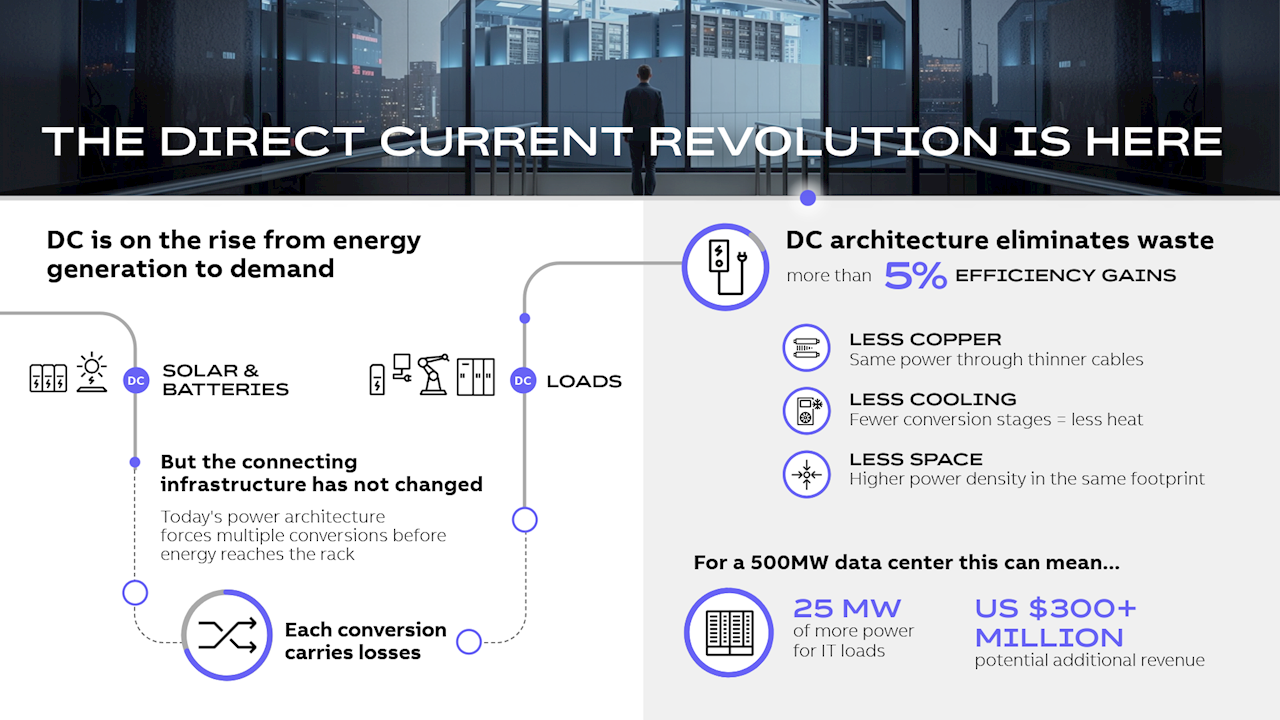
Solar panels, battery storage systems, electric vehicles, LED lighting, industrial motor drives, and climate control systems all run natively on direct current. Yet most facilities still distribute power through alternating current: a system designed in the 1890s, when electricity was new, and long-distance transmission was the only engineering challenge that mattered.
This mismatch isn't trivial. Every DC-native device—from a server rack to a factory robot to an office EV charger—must convert incoming AC power to DC internally, then often convert it again before use. Each conversion stage wastes energy. Each requires redundant equipment, floor space, and copper.
The cumulative result: wasted capacity, higher operating costs, and constraints on how much compute, automation, or power density a facility can support behind a single grid connection. This is where hybrid AC/DC architecture enters. Instead of forcing every watt through multiple conversions, a hybrid system keeps traditional AC distribution for standard building loads while routing DC-native systems onto a shared direct current backbone. This means fewer conversions, less waste, more usable capacity from the same infrastructure investment.
Why is this shift happening now? Three factors are converging simultaneously. First, the density of DC-native devices in facilities—from servers to solar arrays—has reached a tipping point. Second, the economics of consolidating them are now positive in new construction. Third, the supply chain and industry standards required to scale deployment are finally maturing.
Data center demand is fasttracking the transition
The IEA projects global data center electricity demand to more than double—from 415 TWh in 2024 to 945 TWh by 2030. Behind this growth sits an acute infrastructure challenge: grid interconnection queues in major markets now stretch 7 to 10 years, and power density constraints are compromising the economics of conventional AC distribution. For hyperscalers deploying next-generation AI compute, the problem is real. Today's chips already approach 200 kilowatts per rack—and next-generation AI chips are expected to draw 1 MW per rack and beyond. At those densities, conventional AC architecture becomes impractical: the racks generate too much heat, occupy too much space for power conversion equipment, and strain grid connections beyond what utilities can approve. Hybrid 800V DC architecture can solve this. It removes the power density ceiling and delivers energy efficiency gains of more than 5%. To contextualize: a 5% efficiency gain across a 500MW data center campus could unlock 25MW of additional capacity, equivalent to more than $300 million in potential additional revenue per year.
The economics and engineering that make direct current essential for data centers are the same fundamentals that will make it efficient for different industries as well. The supply chains, equipment standards, and installation expertise being justified today by data center demand will benefit industrial plants and commercial buildings downstream.
Industrial plants and commercial buildings: same logic, different timeline
The direct current transition extends far beyond AI compute. The same underlying problem—DC-native loads forced through AC conversion—exists in factories, office buildings, hospitals, and logistics hubs around the world.
What changes is the timeline.
Modern factories are already partly DC: industrial motor drives controlling conveyors, robots, and automated handling equipment operate natively on direct current, converting AC to DC internally on arrival. Plant-wide DC consolidation simply moves that conversion upstream—onto shared infrastructure—eliminating redundant stages across every drive. Capital savings come from freed floor space, eliminated power distribution units, and reduced copper requirements. Annual operating savings range from lower conversion losses to reduced peak-demand charges. The economics are strongest in automation-heavy sectors: automotive body shops, paper and metal manufacturing, high-bay logistics. Regional adoption benefits vary—Europe leads on energy costs, the US on grid reliability, Asia-Pacific on industrial robot density.
Commercial buildings present a medium-term opportunity following a similar logic. Their solar panels, battery storage systems, EV charging infrastructure, LED lighting, and climate control are all DC-native—yet conventional AC architecture forces each through its own separate conversion stage. Hybrid 350V DC consolidates the major loads onto a shared backbone while traditional office systems remain on AC. A shared DC backbone can capture roughly 7% of a building's annual electricity bill. The business case strengthens as EV charging density grows and battery costs continue falling.
Across all three sectors, timing is the strategic variable. The standards, supply chains, and installation expertise being built to serve data centers from 2025 to 2027 will directly reduce the cost and complexity of industrial and commercial adoption from 2027 onwards.
One transition, many starting points
The direct current transition doesn't look the same for everyone. A hyperscaler building a new campus, an automotive manufacturer midway through an infrastructure cycle, and a hospital developer planning a new building all face different constraints, different economics, and different starting points.
The question isn't whether to move toward DC—it's when, where, and how it makes sense for a specific facility.
That's where ABB can help. With more than 25 years of DC experience, over 700 patents, and expertise spanning the full grid-to-rack scope—from medium voltage infrastructure to DC safety systems and system-led design —ABB works with operators and technology partners to evaluate what hybrid architecture makes the most sense.


