Presents strategic vision for future
ABB CEO Ulrich Spiesshofer presented his vision of the future as he participated today in panel discussions and an on-stage interview at a major global business conference in in the capital of Saudi Arabia.
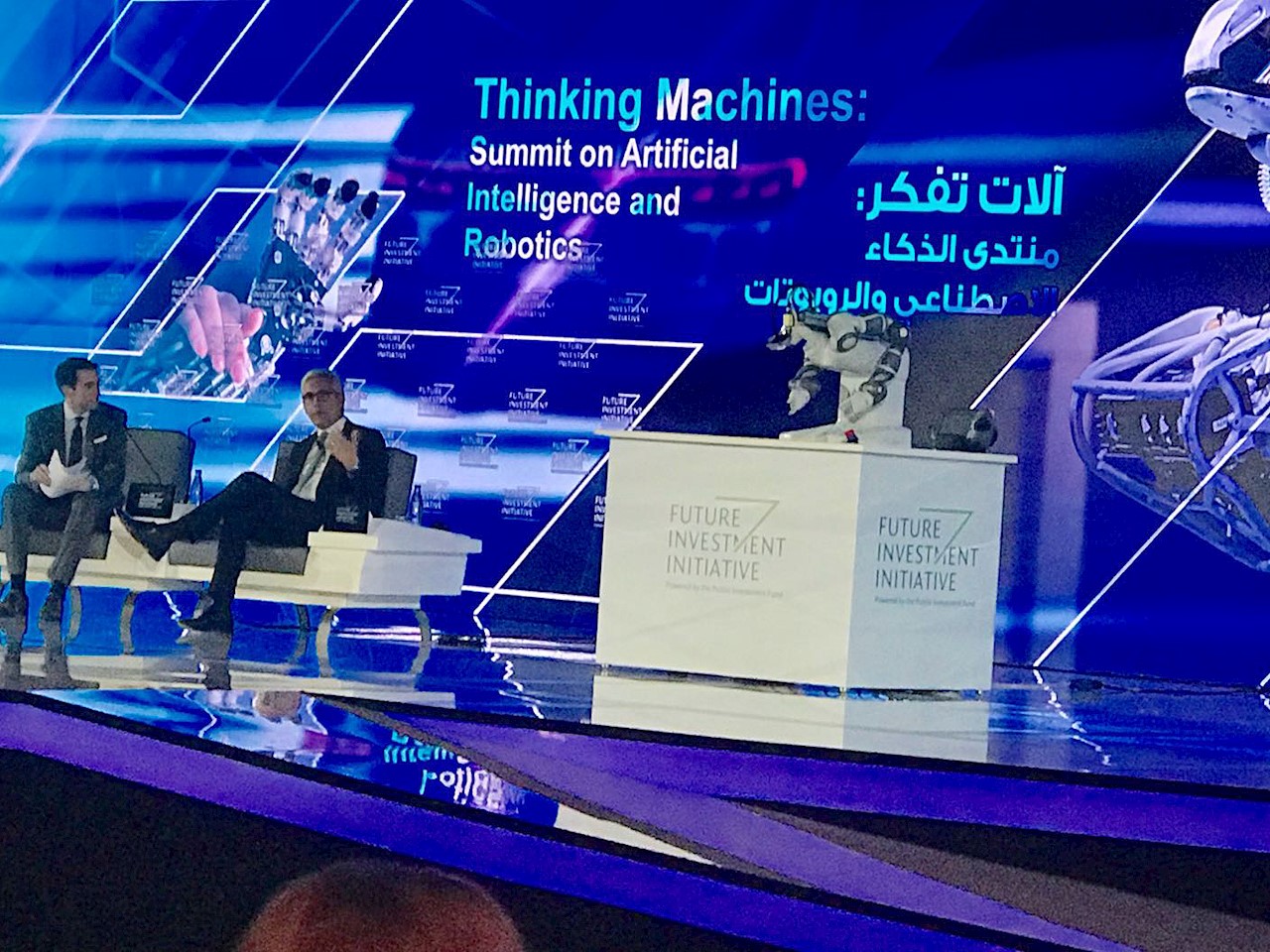
The new technologies of the Energy Revolution, coupled with the digital technologies associated with the Fourth Industrial Revolution, now present us with a tremendous opportunity to raise productivity, stimulate private enterprise and reduce unemployment, Spiesshofer told the high-level audience at the Future Investment Initiative (FII) in Riyadh. “As a major player in the energy sector as a whole, Saudi Arabia is ideally positioned to embrace and lead the Energy Revolution,” he said. “Now is the ideal moment for government and business to work together to seize this opportunity.”
The FII was organized as part of Saudi Arabia’s Vision 2030, the nation’s ambitious blueprint to harness its strong investment capabilities and use its unique strategic location to become a global investment hub. To kick off the conference, on Tuesday Saudi Arabia’s Crown Prince Mohammad bin Salman announced plans to build a new city of the future on the nation’s Red Sea coast – a massive and ambitious project that will incorporate a wide range of cutting-edge technologies.
Spiesshofer participated in the conference’s taskforce panel on power and renewables as well as in a Q&A session with industry leaders, moderated by New York Times journalist Andrew Ross Sorkin, as part of the event’s summit on artificial intelligence and robotics.

In both sessions, he discussed how innovations can be harnessed to achieve sustainable, positive and growth-oriented results. Over the course of the day, he advised how Saudi Arabia can take advantage of the transformation of the power sector as well as how robotics and artificial intelligence – along with parallel developments in cloud computing, machine learning and electronic sensors – are converging to create a new generation of customized products and services and unleash new levels of productivity.
To prepare for the future, Spiesshofer said, the public needs to be informed of the benefits of this revolution to allay fears about technology depriving them of work. Yet people also must be prepared for how the revolution will change the nature of their work.
“In the Fourth Industrial Revolution, people will need new skills and skill sets, and education will become an integral part of working life as the pace of change, which used to be inter-generational, becomes intra-generational,” he said, and went on to call for new partnerships between government, industry and universities to adapt curricula accordingly.
Spiesshofer emphasized that, in the Energy Revolution, the technical challenges associated with integrating renewables into the energy mix have largely been addressed – with technologies like high-voltage direct current, microgrids and modern, digital substations.
“The real challenge we all face is to generate the political will to execute the transition … and to find the funding necessary to pay for it,” he said.
In that context, he welcomed the announcement at the conference by the Saudi Crown Prince that the country would channel $500 billion of investment into building a new city of the future, designated “NEOM,” on the coast of the Red Sea. The new city is expected to attract foreign investment, promote industrial development and economic diversification, and facilitate trade with Egypt and the rest of Africa.
More than 3.7 billion people are now living in cities, and projections show that some 7.4 billion people will reside in cities by 2050, Spiesshofer noted.
“Saudi Arabia is ready to seize an incredible opportunity to show the world how we can accommodate all that urban development in a fully sustainable way that does nothing to hinder the progress of economic development,” he said.


