ABB control systems help capture 12 million tons of carbon dioxide
ABB process control systems have successfully managed the world's first large-scale carbon capture and storage (CCS) facility since 1996. To date nearly 12 million tons of carbon dioxide have been captured and safely stored 1,000 meters below the seafloor. More than half of the world's large-scale CCS facilities are now controlled by ABB technology.
Although there are several small-scale CCS projects in the world today, often using different proprietary technologies and operating on a pilot basis, there are only four facilities that capture and store carbon dioxide on a large, commercial scale for climate change reasons.
Three of those four facilities are operated by Statoil, the Norwegian-based oil and gas company. And ABB, the world's leading supplier of distributed control systems for energy-intensive industries like oil and gas, is helping Statoil monitor and control the complex process of capturing and safely storing the carbon dioxide at these facilities.

It was Statoil who developed the world's first large-scale CCS process in 1996 at the Sleipner oil and gas field in the North Sea. The gas recovered at Sleipner contains 9 percent carbon dioxide, which exceeds the market requirement of 2.5 percent. If emitted the captured carbon dioxide would have given rise to a cost of nearly $60 per ton in carbon taxes and emission quota purchases.
By stripping the carbon dioxide from the natural gas, compressing it and injecting it into a storage reservoir 1,000 meters beneath the seafloor, Statoil is able to meet the market specifications, significantly reduce its greenhouse gas emissions and avoid a considerable cost.
About one million tons of carbon dioxide are captured and stored at Sleipner each year. This amounts to around 12 million tons in all since 1996 - a huge benefit for the environment and a pointer to how global carbon dioxide emissions can be reduced and managed in the coming years.
Following the success of its CCS project at Sleipner and a second facility in Algeria, Statoil opened a third large-scale CCS process at the Snøhvit gas field in the Barents Sea in 2008. There, natural gas with a carbon dioxide content of between five and eight percent is piped 143 kilometers to an onshore liquefied natural gas (LNG) plant on the island of Melkøya.
The excess carbon dioxide is stripped at Melkøya and piped 153 km offshore, where it is injected into a saline aquifer 2,800 meters below the seafloor. The process was started in 2008. It captures and stores up to 700,000 tons of carbon dioxide a year.
Statoil's latest CCS project is the European carbon dioxide Technology Centre at Mongstad in Norway, which is under construction and which Statoil owns along with Shell and Gassnova. The intention is to develop carbon capture technologies and further reduce the cost and risks associated with large-scale capture and storage. The Technology Centre at Mongstad is the largest planned pilot project of its kind, with an annual capacity for handling up to 100,000 tons of carbon dioxide. The centre is scheduled to start operation in late 2011/early 2012.
ABB's involvement in all three projects - Sleipner, Snøhvit-Melkøya and Mongstad - is comprehensive. ABB automation systems monitor and control all three sites, using their uniquely integrative capability to control not only the complex carbon capture process but the entire production processes as well.
At Sleipner, an ABB integrated distributed control solution manages all subsea and topside operations including the subsea and wellhead control systems, the safety, shutdown and fire and gas protection systems, and the carbon capture and storage process.
At Snøhvit-Melkøya, ABB automation systems control the offshore gas field, pipelines, LNG plant and carbon capture plant, as well as the safety, electrical control and power management systems for the onshore facilities.
And at Mongstad ABB is supplying the complete electrical and automation scope for the entire carbon dioxide technology center.
ABB has a long and close working relationship with Statoil and has developed numerous leading-edge power and automation solutions for Statoil's operations. They include the world's first offshore platform to be powered by electricity transported from the onshore grid.
ABB expands its solar inverter offering
New ABB solar inverters* for residential and commercial buildings as well as a megawatt station for photovoltaic power plants are being introduced to the market for the first time at the Intersolar fair in Munich, Germany - the world's largest exhibition for the solar industry.
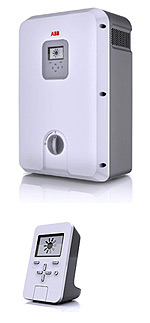
ABB string inverters (PVS300) target solar installations in residential buildings as well as small and medium-sized commercial and industrial buildings. The new transformerless single-phase inverter series has a power range from 3.3 to 8 kilowatts (kW).
It converts energy generated by solar panels into electricity that can be fed into the power network.The string inverter's all-in-one design includes built-in protection functions which reduce the need for costly and space-consuming external protection devices and larger enclosures.
Compact, reliable, safe
The result is a more compact, reliable, safer and cost-effective solution, especially for installations using multiple inverters.
The heart of the inverter is an intuitive and versatile control unit equipped with a graphical display. It offers a comprehensive range of key functionalities that are easy to use with the built-in assistants and help menu.
The control unit has three different mounting options covering all user requirements. It can be integrated with the inverter housing, or mounted separately on a wall to monitor inverter performance from outside the installation room.
It can also be wirelessly connected so the inverter can be installed in a remote part of the site, and monitored wirelessly from inside the home or main building.
A turnkey solar solution
The ABB megawatt station is a container housing all electrical equipment needed to rapidly connect a photovoltaic power plant to a medium-voltage electricity grid.
The station is a turnkey solution, complementing the recently launched ABB central inverter offering. It houses two 500 kW ABB central inverters, an optimized transformer, medium voltage switchgear, monitoring system and solar generator terminal boxes.
The steel-framed insulated container comes complete with a concrete foundation, also designed and produced by ABB.
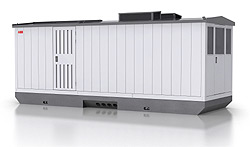
The station's thermal insulation lets it operate in harsh temperatures and humid environments. The station is designed for at least 25 years of operation.
The total package weighs only 20 tons, which is less than half the weight of conventional concrete stations.
At 50 square meters, the Megawatt station is about 15 percent smaller than other standard container solutions on the market.
It is easier and less expensive to transport, because registered heavy goods vehicles or large cranes are not necessary to move it.
Depending on the size of the PV power plant, several ABB megawatt stations can be combined to meet the demand capacity.
ABB solution boosts power plant energy efficiency
ABB medium-voltage drives have slashed the energy consumption of two boiler feed pumps at a coal-fired power plant in Germany by 25 percent. The solution increases plant revenues by $800,000 a year and reduces annual CO2 emissions by 10,200 tons.
The two ABB high-efficiency ACS 1000 medium-voltage drives control two boiler feed pumps at unit 6 of the 1,675 megawatt GKM coal-fired power plant at Mannheim, Germany.
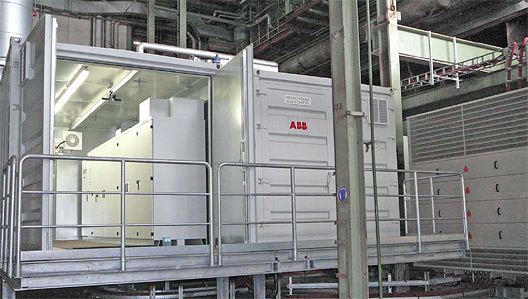
The pumps each have a rated output of 5.8 megawatts and were installed in the mid-1970s when unit 6 was constructed. Prior to the ABB solution the pumps were controlled by hydraulic clutches, which were operating with an efficiency of only 72 percent and were losing more than 1 megawatt of energy per pump.
When unit 6 was revamped in 2006, GKM concluded that the poor efficiency and high energy losses of the pumps and clutches were no longer sustainable. GKM turned to ABB for a solution.
ABB proposed a modernization package for each pump comprising an ACS 1000 medium-voltage variable speed drive, an ABB RESIBLOC® dry-type transformer and a complete overhaul of the pumps.
After two years of trouble-free operation GKM could confirm a reduction in pump energy consumption of 25 percent, energy that the plant can sell instead of consuming and which is worth $400,000 per pump per year in revenues.
The improvement in energy efficiency has had a corresponding impact on the plant's carbon footprint, lowering its carbon dioxide emissions by 10,200 metric tons a year - a significant reduction for a fossil-fuel power plant.
And the overall efficiency of the new pump drive system is a near-perfect 98.5 percent, compared to the inefficient 72 percent of the previous system.
The installation has been so successful that GKM subsequently awarded ABB an additional two contracts to install medium-voltage drive systems for the feeder pumps and water circulation pumps at two of the plant's other generating and district heating units.
Coal-fired power plants typically consume between 7 and 15 percent of the energy they generate, with motor-powered applications like pumps accounting for 80 percent of this parasitic consumption.
ABB helps harness urban wind power
ABB has helped a European renewable energy company develop an award-winning wind turbine for urban environments that helps make towns and cities more sustainable and consumers more energy efficient.
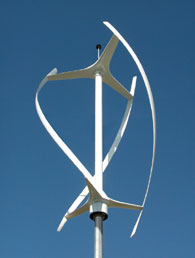
Designed and manufactured by quietrevolution of the U.K., the QR5 wind turbine has already won eight awards and nominations as well as the attention of the world media, including the BBC, CNN, Financial Times and MSNBC.
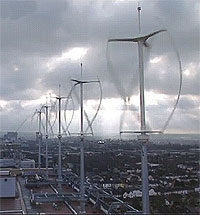
The QR5 is a vertical axis wind turbine designed specifically to harness wind energy in environments near people and buildings, where changes in wind speed and direction can be rapid and unpredictable.
The helical (twisted) design is highly compact and, unlike conventional wind turbines, suitable for installation on rooftops or in open space alongside buildings.
It is virtually silent and vibration-free, and with minimal moving parts requires little maintenance.
A typical installation can produce up to 7,500 kilowatt-hours of electric power a year, which is enough to meet the electricity requirements of a small office of 10 people.
To date around 100 QR5 turbines have been sold to retailers, real estate developers, public authorities, schools, universities and colleges in the U.K. and Europe.
quietrevolution approached ABB at an early stage of product development for advice and guidance on an electrical solution for this potentially revolutionary wind turbine.
ABB conducted extensive tests in the U.K. and Finland, helped ensure that the turbines comply with the requirements of grid operators and government legislation, and proposed an appropriate permanent magnet generator.
A standard ABB industrial regenerative drive enables the turbine to generate the maximum amount of energy at all times and in rapidly changing wind speeds.
"The drive allows us to switch seamlessly from regeneration to drawing power, as well as giving accurate speed control," says Richard Cochrane, quietrevolutions's founder and chief technology officer. "This produces the maximum amount of energy from gusty and turbulent winds, which are prevalent in built-up environments."
"Another useful feature of the ABB drive are the simple communications protocols, which are a cost-effective way to control and report on the performance of the system via our web interface," says Cochrane.
ABB is the world's leading supplier of power and automation equipment and solutions for the wind power industry, and is the market and technology leader in low- and medium-voltage AC and DC drives.
ABB (www.abb.com) is a leader in power and automation technologies that enable utility and industry customers to improve their performance while lowering environmental impact. The ABB Group of companies operates in around 100 countries and employs about 117,000 people. ABB has a full range of business activities in China, including R&D, manufacturing, sales and services, with 15,300 employees, 30 joint ventures and wholly owned companies, and an extensive sales and service network across 60 cities.


