In the run-up to Davos, the media actively sought out ABB's views on this year's theme. Swiss television network SRF broadcast a panel discussion in which Chairman Voser, along with his counterparts from Roche and Credit Suisse, addressed the economic outlook and the challenges and opportunities of a digital future. In an op-ed for the Handelsblatt WEF supplement, Spiesshofer shared his thoughts on the potential productivity gains associated with the new revolution. The piece subsequently appeared in other major publications around the world.
ABB's intensive participation in the Davos forum underscores the group's leading role in providing power and automation solutions that serve the complex and constantly changing needs of today's cities, transportation networks, enterprises and governments. Technologies developed by ABB enable communities and businesses to meet increasingly stringent environmental targets and regulations, and implement process and design efficiencies that reduce costs over the long term.
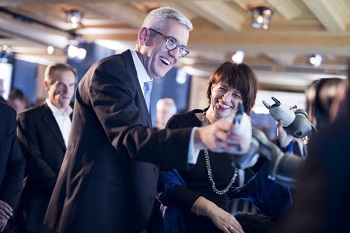
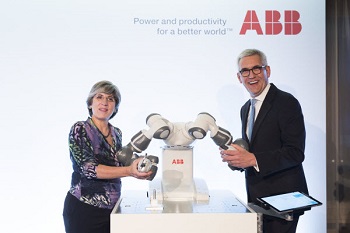
On Thursday evening in Davos, ABB's highly anticipated annual event was well-attended and received by an attentive throng of VIPs, including Swiss Federal Councilor Doris Leuthard. The topic was the current state of artificial intelligence and machine learning, and Spiesshofer outlined some of the ways in which ABB is contributing to the fourth industrial revolution with a variety of advanced digital solutions. The keynote panelist was Professor Manuela Veloso of Carnegie Mellon University, a past president of the Association for the Advancement of Artificial Intelligence and one of the world's greatest experts on mobile robots functioning in unpredictable environments. A memorable guest appearance was made by YuMi, ABB's groundbreaking parts assembly robot, designed to work safely alongside humans. The occasion was moderated by Professor Anya Schiffrin of Columbia University, an expert in international media and the wife of economist and Nobel laureate Joseph Stiglitz. The previous year, ABB hosted a similarly provocative panel on the topics of industrial efficiency and the Solar Impulse experimental aircraft project.
On Friday, the CEO spoke at three different events, starting with a breakfast discussion held by the Boston Consulting Group on the topic of artificial intelligence and the next wave of productivity growth. Fellow panelists included Microsoft CEO Satya Nadella and Professor Andrew McAfee of MIT's Sloan School of Management. Spiesshofer made the point that, although digitalization and increased automation represent unstoppable trends, there is no need to fear them, rather we need to embrace the change - the automotive industry in the 1960s is a classic example of how past waves of automation have always resulted in more jobs and rapid economic development.
Later in the day, Spiesshofer took part in a debate with Swiss President Johann Schneider-Ammann, UBS CEO Sergio Ermotti, Adecco Chairman Rolf Doerig, and Professor Lino Guzzella, president of the Swiss Federal Institute of Technology in Zurich. Swiss competitiveness was the subject of what proved to be a lively discussion. Spiesshofer argued that for Switzerland to retain its leadership in economic competitiveness, it must take steps to cut red tape and give enterprise the freedom they need to grow.
To round out Spiesshofer's busy schedule, he also participated in an afternoon panel on the future of energy. Fellow panelists included Carl-Henric Svanberg, chairman of BP and Volvo, and John Carrington, CEO of Stem Inc., an innovative energy storage company.
The discussions in Davos were also actively attended by ABB Chairman Voser and two members of the group's Executive Committee, Tarak Mehta, president of the Electrification Products division, and Frank Duggan, president of the Asia, Middle East and Africa region. In company with Ulla Jonsson, head of human resources in the Power Grids division, the group's senior managers met with executives from a number of leading companies, including ABB's customers, suppliers and partners. Topics of discussion ranged from ABB's contributions to the transformation of industry to the comprehensive redesign of the world's electrical system - which will be necessary as renewable energy becomes increasingly central to the global energy mix.


