Georg Gutermuth, Felix Lenders, Bernhard Primas ABB Corporate Research Ladenburg, Germany, georg.gutermuth@de.abb.com, felix.lenders@de.abb.com, bernhard.j.primas@de.abb.com; Sleman Saliba ABB AG Mannheim, Germany, sleman.saliba@de.abb.com
The world is undergoing rapid change. For example, the three megatrends of urbanization, decarbonization and digitalization have combined with climate change concerns and calls for a sustainable society to produce seismic shifts that are transforming everyday life.
These global developments are disrupting the energy landscape, resulting in huge pressure for change on utilities, power providers, municipalities and energy users in industrial, commercial and domestic settings. Optimization of energy resources and consumers is a key aspect of accommodating this change.
Due to the increasing complexity of energy systems, this optimization task can only be dealt with by automation and tools that determine the best setpoints for each situation, the optimal mix of energy generation and consumers, and the best way to exploit ancillary systems, such as a battery energy storage system (BESS) →06. This requirement for automation and tools encourages creative thinking and presents opportunities to develop new solutions. One such new solution is the “ABB Energy Management Rapid Site Assessment Value Calculator” (EMS site assessment calculator, for short), which allows ABB, together with an energy manager or site manager, to calculate quickly what financial benefit an EMS would bring through optimized site operation. Additionally, investment decisions leading to further reduced consumption and minimized CO₂ emissions can be supported by scenario calculations.
Industries can contribute to sustainability – and profit from it
Industrial and commercial sites account for about half of all global electricity consumption [1] and 30 to 40 percent of greenhouse gas emissions. The desire to reduce these figures – and lower environmental impact – is driving ever more investment in technologies such as photovoltaic (PV) energy generation, electric vehicle (EV) charging, BESS technology and energy capture from combined heat and power (CHP) plants. But the decisions to invest in these technologies must be made wisely as they do not automatically pay off financially and may even have unexpected adverse effects such as an overloading of a site’s grid connection.

ABB Ability™ Energy Management – OPTIMAX
An EMS, such as ABB Ability™ Energy Management – OPTIMAX® (OPTIMAX EMS), is usually an investment that pays off quickly. An EMS collects and reports consumption information, reducing the time needed for regulatory reporting – as required, for example, by ISO 50001 – by up to 50 percent. Additionally, an EMS comes with visualization tools and dashboards that enable energy managers to identify the hidden energy saving potential of the site. By taking adequate measures (eg, thermal insulation, sensorization of energy consumers, or replacement of old equipment), energy savings of up to 40 percent are achievable, as proven in projects.
On top of those benefits, ABB’s OPTIMAX EMS unlocks the full cost savings potential of industrial sites by optimally coordinating all assets in real-time. This is done by continuously optimizing different energy resource options, load and market dynamics, and flexible assets, such as EV charging or storage hardware, for the benefit of the site owner and the environment. If required, OPTIMAX EMS’s accuracy can be enhanced by AI-based weather and market development forecasting.
To demonstrate how ABB’s vision of a zero-emission tomorrow can be realized today, OPTIMAX EMS was implemented at some ABB sites – for example, at the ABB Busch-Jaeger site in Germany, where OPTIMAX EMS balances flexible loads, solar infeed, a CHP plant and a BESS →02. OPTIMAX EMS helps the site become CO₂-neutral, making a big step toward ABB’s “mission to zero.”
![02 The ABB Busch-Jaeger site in Germany runs OPTIMAX EMS [3].](https://resources.news.e.abb.com/images/2022/1/20/0/energy_savings_at_fingerprints_m1056-02.jpg)
Quick calculation of the value proposition
To estimate the savings potential achievable through optimized operations, online tools such as ABB’s Energy Management Calculator [4] can be used. For a detailed individual – and thus more accurate – assessment, the ABB Energy Management Rapid Site Assessment Value Calculator delivers a quick and reliable optimization calculation. The tool guides the ABB specialists – together with the interested partner – through the process of collecting relevant data and runs a live calculation over a given time frame to compare optimized operation with OPTIMAX EMS versus a non-optimized operation to quickly quantify the specific savings potential. The guiding principles of the tool are:
• Obtain good accuracy with little data.
• Propose reasonable default values when actual site data is not available.
• Perform an online optimization on historic measurement data (typically one year’s worth) in under 10 min.
• Show meaningful results that are useful for taking an informed next step.
The customizable model in the EMS site assessment calculator is identical to the one in the operations tool (OPTIMAX EMS) →03.
Data entry
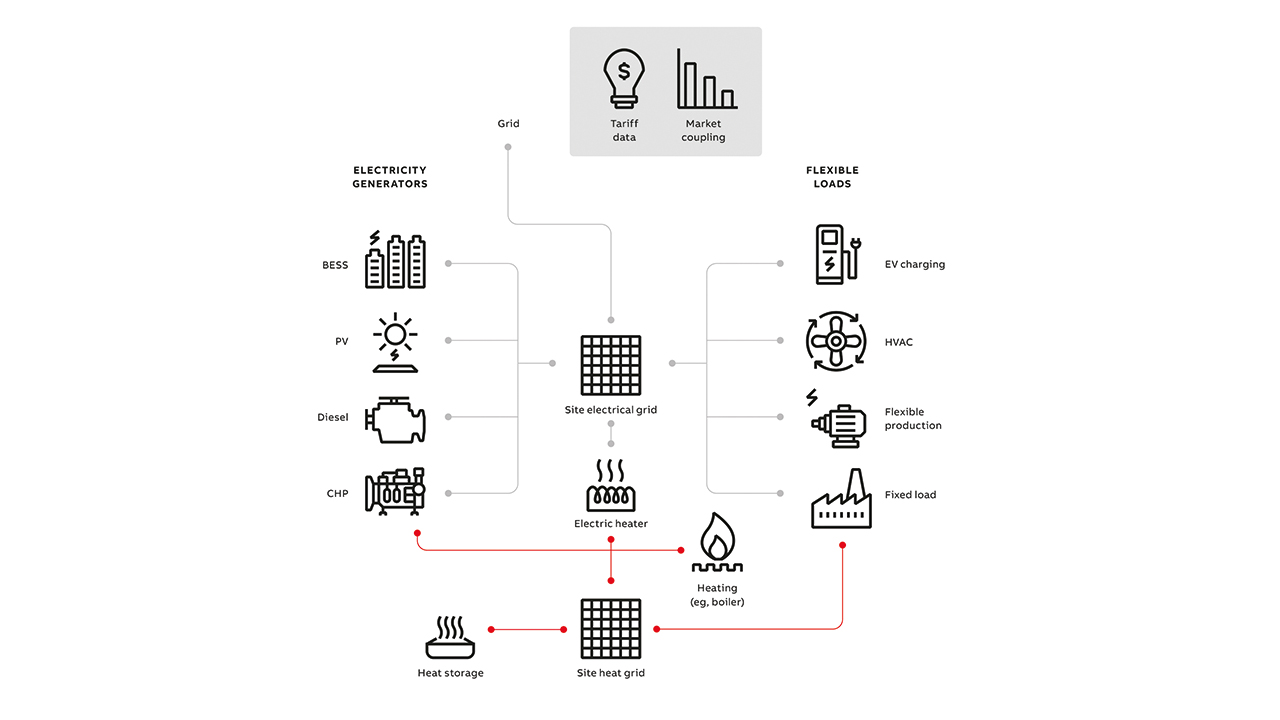
In a first step, all relevant site assets are identified. →04 shows an example site configuration. The elements identified determine the data needed – for example, time series, size and cost parameters of (flexible) loads, on-site generation, storage and grid-connection data. With this information, the optimization calculation can be started.

To achieve the accuracy goal, it is necessary to base the calculation on actual historic time-series data from the site under investigation. This precaution ensures that real values with realistic time correlations are evaluated. If some data is not easily available, realistic defaults can be generated by the tool. For time-series data, the following default alternatives have been implemented:
• The real grid intake (the residual load at the point of common coupling, ie, where the facility’s local electric system connects to the utility’s) can be approximated by specifying the fixed loads and adding them to the time series of flexible load and generation.
• If heat-load curves are not available, they are automatically calculated from a few building parameters and ambient temperature curves for the location in question.
• PV generation curves can be calculated from the installed capacity and solar radiation information based on location-specific historic data.
• EV-charging time series can be simulated based on the number of chargers, vehicles and schedule of site operations →05.

Tariff information is important
Parameters relating to asset sizes (eg, energy or power) must also be accounted for in the calculation. For most other required values (eg, efficiency), typical defaults are proposed.
Besides generation, consumption and technical asset parameters, the calculation requires realistic cost information. The grid tariff information on energy and power prices can be entered in the most common forms, for example:
• Energy: fixed price, time-of-use models or flexible spot market tariff
• Power: peak-demand charge and energy excess model
Additional information such as feed-in tariffs or heating fuel costs will be asked for when applicable.
After data entry completion and automatic validation of data consistency, the optimization calculation can be started with a simple press of a button.
Optimization results
After an average calculation time of under 5 min, the assessment of the energy costs, with and without optimization, is displayed →06.

06a Result overview. 
06b Detailed output.
06 Example energy assessments from the tool.
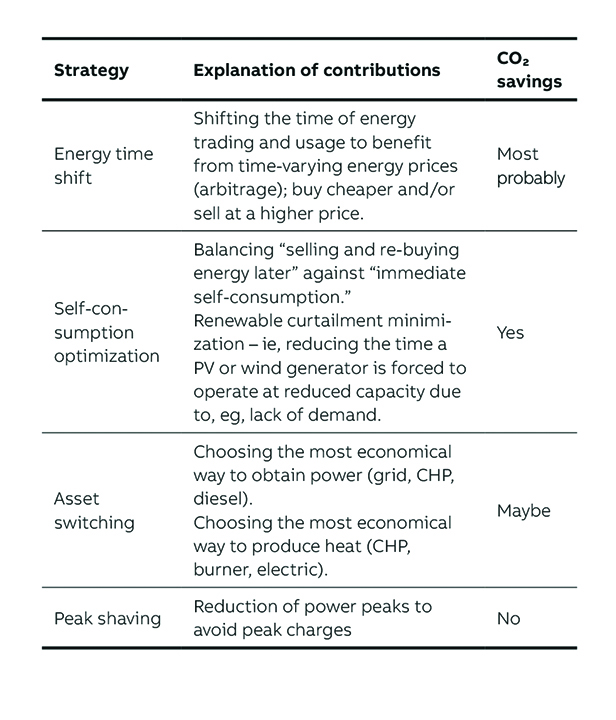
First applications of the tool to real site data confirmed an average annual electricity cost savings potential of 8 percent. The method’s accuracy implies that the specific result for similar sites can vary due to differing assets, tariffs, time series and equipment flexibility. Depending on the details, the chosen optimization strategy will vary. The effect of different strategies is given in →07.
Scenario calculation – total site assessment
Once site data is entered, scenarios can be modeled – for example, the effect of adding PV and/or a BESS, increasing EV charging activities, changing the utility tariff, or switching to spot market trading. By running a series of scenarios, even the optimal sizing of added battery capacity or the upper limit of additional EV chargers can be ascertained, thus massively reducing, for example, CAPEX investment in excessive grid extension.
Lessons from the optimization calculations
Initial runs of the tool on real industrial cases not only confirmed its benefit but gave interesting insights into savings potentials →08.
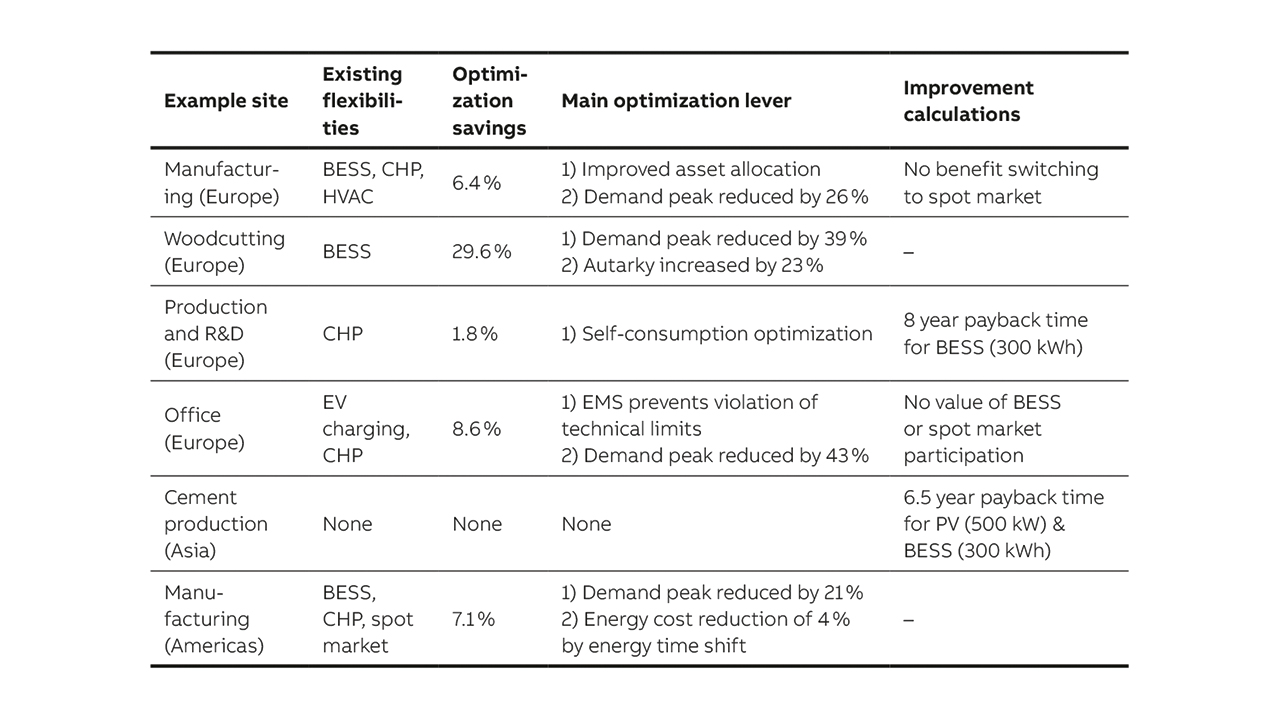
Lessons were learned from site calculations:
• A typical site has an electricity cost savings potential of 6 to 9 percent when using an EMS to optimize its operations.
• Among the four contributing strategies, peak shaving is often the most valuable, with an average peak demand reduction of 20 to 40 percent.
• Higher equipment flexibility results in higher savings. The highest savings can typically be achieved through smart EV charging, intelligent battery operation, load shifting, and optimized CHP and heat storage.
• An EMS can provide non-tangible benefits, eg, when it prevents violation of technical grid limits that could otherwise damage equipment or when it enables larger on-site loads (eg, EV charging) without the need to upgrade the grid connection.
• Important factors for the calculation accuracy are actual time series, correct tariff information and the extent of flexible equipment available. On the other hand, the method is quite robust when analyzing short, data-lean timespans (under one year).
An EMS can pinpoint unnecessary energy losses of up to 40 percent that can be reduced by static measures. On top of that, OPTIMAX EMS provides, on average, an additional energy cost reduction of 8 percent. The actual value, however, depends on the specific customer conditions and can vary greatly. Here, the new ABB Energy Management Rapid Site Assessment Value Calculator comes to the rescue. The tool can be filled out by ABB together with the energy manager to calculate accurately – in about ten minutes – the potential to further minimize the site’s energy bill. By doing this, the tool helps industrial energy managers to gauge the benefits an EMS such as OPTIMAX EMS and additional assets could deliver.
ABB believes this rapid, yet detailed, service supports commercial, business and industrial customers in making the right decision on their way to becoming a sustainable and cost-efficient enterprise.
References
[1] R. Carli et al., “Sustainable Scheduling of Material Handling Activities in Labor-Intensive Warehouses: A Decision and Control Model,” Sustainability 2020. Available: https://doi.org/10.3390/su12083111. [Accessed April 28, 2021].
[2] ABB, “We make complex tasks scalable and highly flexible – ABB Ability™ OPTIMAX® for industrial and commercial facilities.” Available: https://new.abb.com/mission-to-zero/optimax. [Accessed April 28, 2021].
[3] ABB, “ABB presents state of the art solution for CO₂-neutral and energy self-sufficient factory of the future at its site in Lüdenscheid.” Available: https://new.abb.com/news/detail/23200/abb-presents-state-of-the-art-solution-for-co2-neutral-and-energy-self-sufficient-factory-of-the-future-at-its-site-in-ludenscheid. [Accessed April 28, 2021].
[4] ABB, “Unlock the value of energy management.” Available: https://energymanagement-calculator.abb.com/. [Accessed April 28, 2021].
Photo: ©一飞 黄/stock.adobe.com


