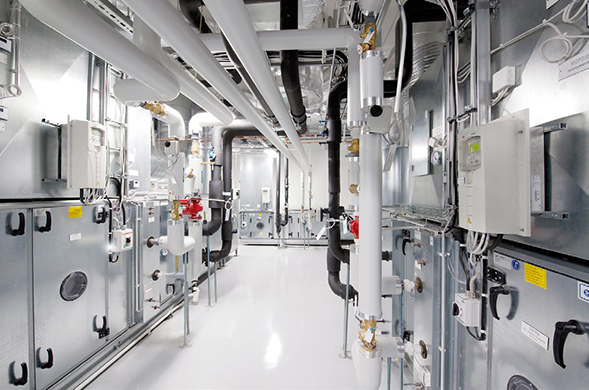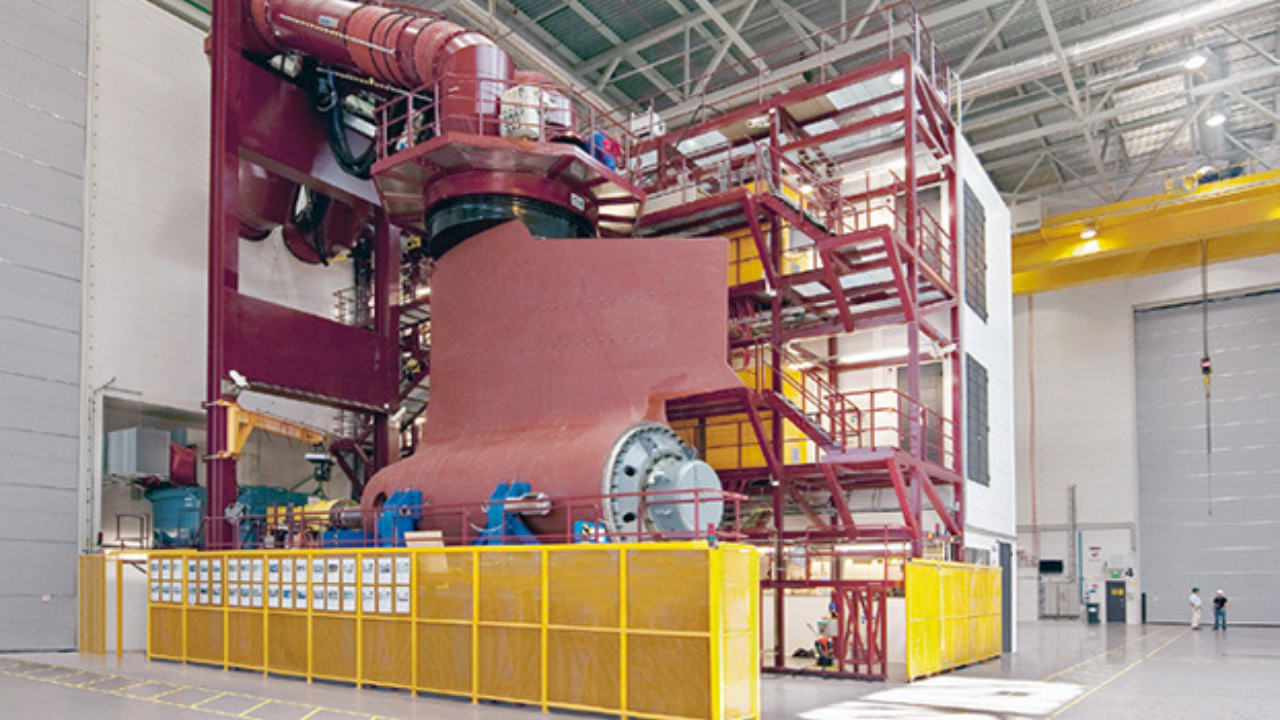
From the opening of the factory in 2007, the heating, ventilating and air conditioning (HVAC) system was set up to help monitor the testing while also performing its normal heating and air conditioning, throughout the site.
Integrated automation system simplifies monitoring
At the heart of the HVAC system is BACnet, which plays a critical role in monitoring the temperature of propulsion units under test. Pumps and fans are controlled via 30 ABB standard drives for HVAC. Drives are integrated without gateways, having native BACnet, and are fully visible throughout the system. BACnet enabled drives are connected to the building management system (BMS) using BACnet/IP to MS/TP (Master-Slave/Token Password) routers.
Thus all drives can be accessed from the BACnet operator workstation independently. All data is visible throughout the network, without having to be mapped between different protocols. Patented swinging choke cuts harmonics.
The BMS monitors the flow and temperature of air used by the Azipods being tested, as well as the heating and air conditioning throughout the site. It enables the same operator workstations and operator interfaces to be used for the air conditioning of the factory and the acceptance testing.
The BACnet system is divided into three sub networks: one for the office block with five air handling units; one for the factory unit with three air handling units; and one air handling unit dedicated to supply cooling air for the product testing.
Easy remote access and future proof network
BACnet integration allows remote access to the system over local intranet and also to each individual drive. Even the inputs and outputs (I/Os) of the ABB standard drives for HVAC can be freely controlled from the BMS.
A benefit of BACnet is that functions not anticipated when the system was originally installed can be easily added. With BACnet, all the data is available all of the time. Instead of data being updated automatically, each device sends a request when an update of the value is needed. This eliminates the need for unnecessary updates of infrequently used data. For example, it makes more sense to track the running hours of the fans once a month while energy consumption ideally is monitored in real time.
This allows a workstation to be simply re-configured to add new functionality, eliminating the need to re-program any devices or install any new wiring. Had the installation used a traditional data bus or gateways to connect the drives, this modification would not have been possible. A new range of smaller, Azipod units has entered production. Here, water cooling will be used during testing, so the HVAC system has been modified to monitor cooling water temperature, without disturbing the existing automation.