Historically, the spinning turbines in large, centralized generation plant, such as gas-fired or nuclear power stations, have been a source of the vital inertia that help keep power grids stable. Inertia acts something like a car’s shock absorbers, helping to smooth the way over bumps in the road. It enables the grid to react to sudden changes in frequency, such as when a generator trips offline, by providing time to respond. This keeps the system frequency within tightly controlled limits. A stable grid is robust enough to withstand any sudden loss of load or generation, while lack of stability has been a contributory factor to some of the major grid outages that have occurred in recent years.
But the nature of the global energy mix is changing fast as it turns to renewable resources such as wind or solar. And that presents a challenge as they cannot contribute with inertia, while the large generators that can contribute with inertia are being decommissioned. The resulting decline in inertia can leave grids vulnerable to frequency fluctuations and voltage dips that increase the risk of disruptions or even blackouts
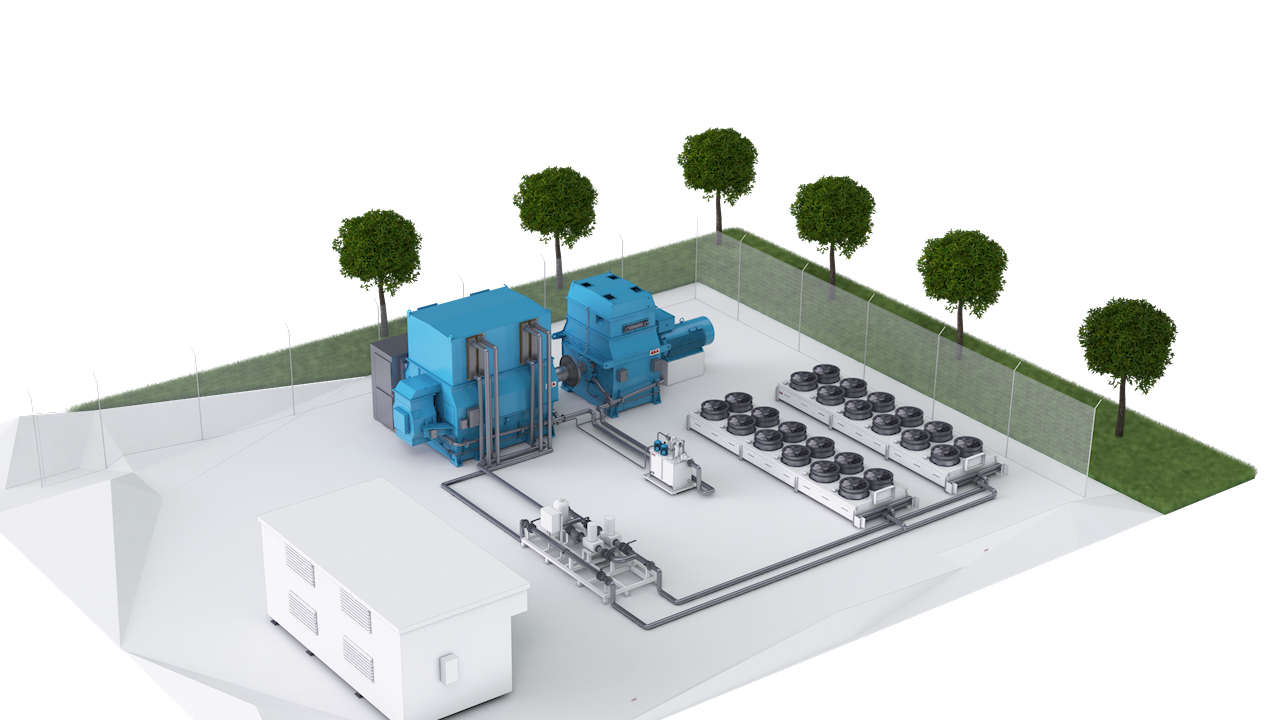
Fortunately, there is a very cost-effective and reliable solution readily available in the form of synchronous condensers (SCs). These are large rotating electric machines that look very much like motors, but they do not drive anything. Equally, they are like generators, but they do not generate electricity. What SCs do is to mimic the operation of large generating plant by providing an alternative source of spinning inertia. Transmission planners, grid operators, and renewable developers can strategically position SCs at weak nodes, at grid edges, or directly adjacent to large wind or solar farms.
ABB has developed a comprehensive service to deliver full synchronous condenser solutions for utilities and industrial operators, tested and ready to meet local grid requirements. This includes the initial modelling of the grid to decide on the optimal size of SC. A good example is the 2023 commissioning of ABB’s turnkey project for Statkraft, Europe’s largest renewable power generator, to help restore the missing system inertia and stabilize the UK power grid. The project features two ABB high-inertia synchronous condenser systems installed at the Lister Drive Greener Grid Park in Liverpool.
Another example is The Faroe Islands in the North Atlantic, which are relying on synchronous condensers to reach an ambitious 100 percent renewable energy target by 2030. ABB has already installed two SC units for the island group’s power utility, SEV, with a third on the way.
Most recently, Red Eléctrica, the company responsible for the transmission and operation of the Spanish electricity system (TSO), has awarded ABB with orders for five SCs to strengthen the electricity grid, increase the quality of supply and boost the energy transition of the Canary and Balearic Islands.
The key to ABB’s success is our commitment to engineering excellence combined with an extensive track record and the capability to customize the SC solution to suit the exact project needs.
By providing an effective way to compensate for the reduction in inertia as the energy transition gains momentum, ABB synchronous condensers are helping our grid and industrial customers stabilize their power networks so they can move confidently into a world powered by renewables.
For further information, visit https://new.abb.com/motors-generators/synchronous-condensers
This is the third in Kristina’s series of articles on grid stability. You might be interested in reading the other two articles that go further into the subjects of What happens when we add renewables to the grid and What is grid stability – and why should you care?


