Earlier this year, the International Maritime Organization brought URN into its plan for regulatory work to advance maritime decarbonization. IMO administrations thereby accepted the principle that efforts to cut ship emissions could be harnessed to overcome another cause of harm to the environment. This is a new regulatory pathway towards limiting URN, which has previously remained a matter for non-mandatory IMO guidelines (agreed in 2014 and updated in 20231).
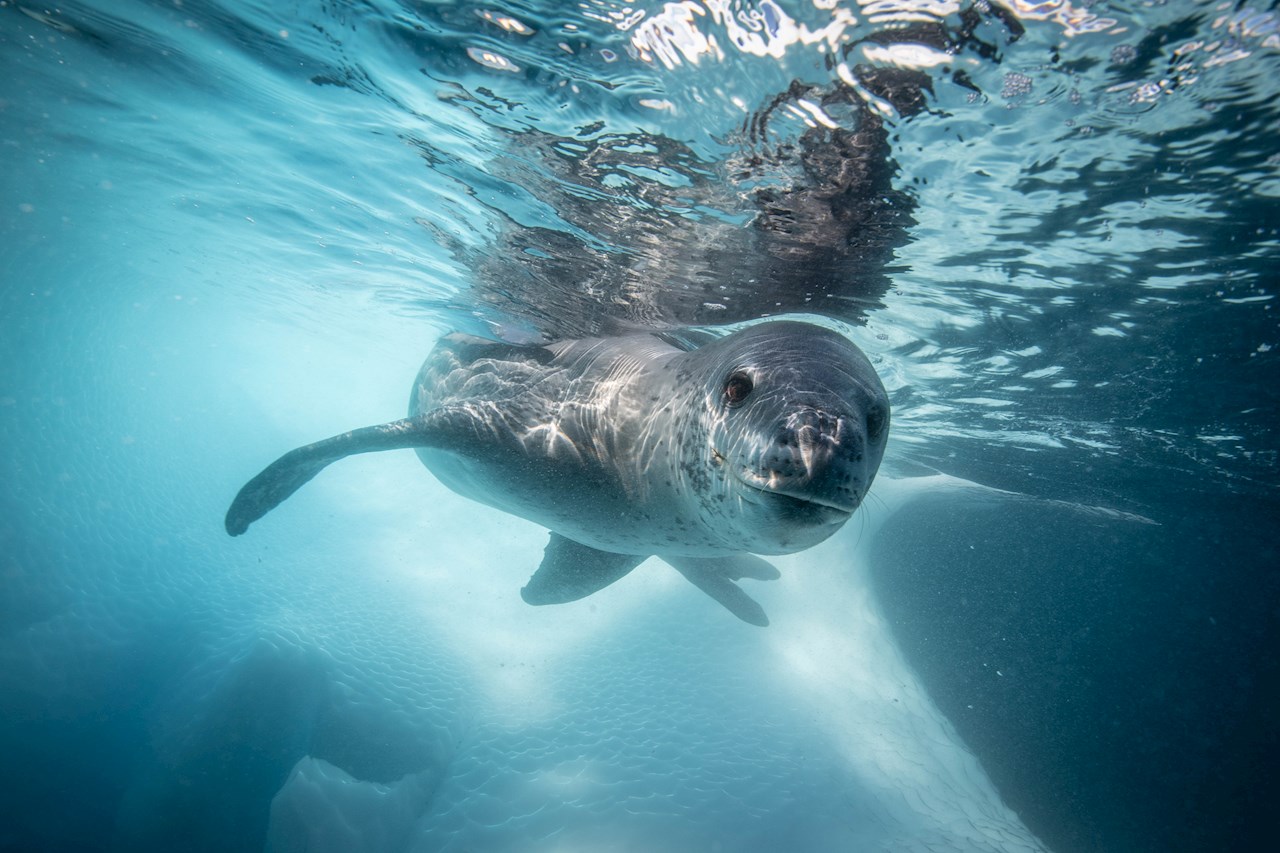
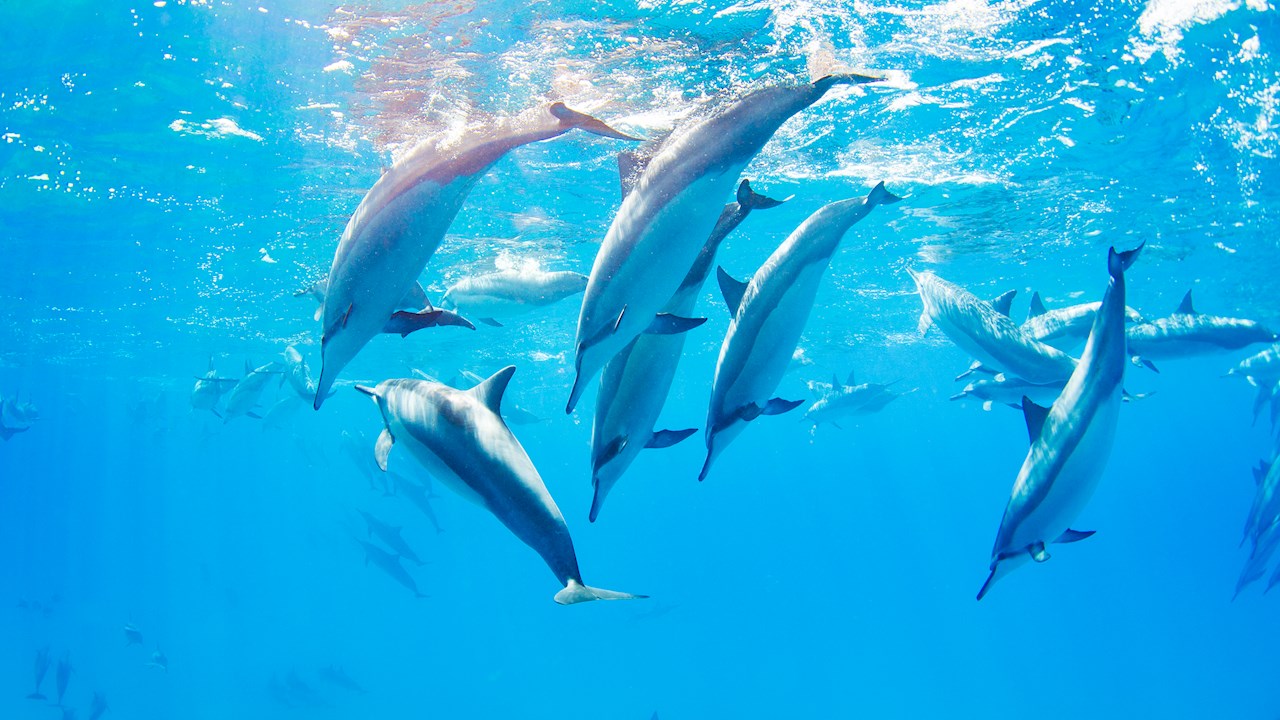
Whether produced by propulsion systems, hulls moving through water, machinery or other onboard activities, URN from ships falls into frequency ranges from about 10 Hz to several kHz. Global ship noise cuts across frequencies whales use to communicate over long distances, as well as the biosonar sound pulses smaller marine mammals such as dolphins and seals rely on not only for navigation, but also for hunting, social interaction, and sensing their environment.
As well as disrupting communication, causing stress and even leading to hearing loss, URN can affect the ability of marine life to forage, find a mate or follow a migration route.
Are you listening?
Underwater noise has been a longstanding focus for ABB Marine & Ports, where URN mitigation for its Azipod® propulsion system takes account of hydrodynamic noise caused by propellers (PURN) and the magnetic noise (MURN) generated in drive motors. For Azipod® propulsion, mitigating MURN is especially important because the electric motor is in a pod outside the ship hull which radiates acoustic energy.
Where PURN is concerned, the main source of hydrodynamic noise is propeller sheet and tip vortex cavitation, where volume fluctuations of cavitation cause broadband noise into water. Steps to mitigate the effect work to delay or weaken cavitation during operation.
ABB’s success in mitigating both noise sources is demonstrated by the selection of Azipod® propulsion for research vessels, where acoustic emissions are restricted and ‘silent’ notation from class defines strict URN limits. For example, Azipod® propulsors feature on Tan Suo San Hao and Ji Di - two icebreakers delivered to the Institute of Deep-sea Science and Engineering Research Institute in 20252. These ‘acoustically sensitive’ DNV SILENT-A vessels feature a sine filtering solution to reduce converter noise.
Global ship noise cuts across frequencies whales use to communicate over long distances, as well as the biosonar sound pulses smaller marine mammals such as dolphins and seals rely on not only for navigation, but also for hunting and social interaction.
Leading the work on URN at ABB’s Marine & Ports division are Janne Roivainen, Senior Principal Engineer, and Tuomas Sipilä, Senior R&D Engineer, Hydrodynamics. With 31 years at ABB and a PhD in magnetic noise calculation methods, Roivainen says he transferred into the marine business three years ago “mainly because of URN”. Sipilä holds a Lic. Sc. in Naval Architecture and joined ABB five years ago, after 18 years of researching hydrodynamics at VTT Technical Research Centre of Finland Ltd, the leading research and technology company in the Nordic countries.

Tuomas Sipilä, Senior R&D Engineer, Hydrodynamics, ABB's Marine and Ports division 
Janne Roivainen, Senior Principal Engineer, ABB's Marine & Ports division
According to Sipilä, the last five years have seen an increasing appetite from ship owners to include PURN early in project discussions, based on guidance from class but also drilling down into the detail of ABB’s work on Computational Fluid Dynamics (CFD) and high-fidelity propeller optimization including tip vortex noise modelling.
Quiet optimization
“Optimizing performance and excitation levels has to pay attention to a range of parameters, including the propeller diameter, blade area ratio, section profile geometry, thickness, camber, chord, skew, rake distributions, and pitch”, says Sipilä. “We draw on optimization algorithms which compare goals and constraints for individual propeller designs and develop the pareto front for trade-offs between conflicting objectives. Also ship-specific adjustments may be needed.”
In recent times, attention has focused on propeller characteristics, with effective fine tuning to reduce PURN that does not sacrifice efficiency achieved by adjusting blade geometry details. This has brought “a good compromise between noise and efficiency”, Sipilä adds.
Owners are also increasingly inquisitive about the ABB’s use of digital twins to optimize MURN and PURN reduction, according to Roivainen, and the simulations, structure-water models and magnetic field solvers it has developed to mitigate MURN. Full-scale validation is crucial for model development.
Roivainen explains that MURN is a consequence of either motor ‘self-noise’ or is traced to the converter driving the motor. Mitigating MURN can therefore involve optimizing motor designs or using a different converter setup. Other strategies include introducing a sine filter, modifying the switching frequency or modulation control, or using DC-level reduction at lower speeds.
In the future, Roivainen predicts that the active control technologies will be adapted for use in propulsors to reduce self-noise. ABB’s Marine & Ports division is also plugging into wider work on modeling ‘silent drive’ pulse patterns for medium-voltage converters.
Noise and communication
In addition to strategies for mitigation, standards for measuring URN must also move forward, so that any efforts by world shipping to turn down the volume are truly effective. Standard prediction methods for PURN still largely rely on semi-empirical methods, for example, or model tests that can be compromised by background noise or influenced by the measurement system itself.
Furthermore, if measuring MURN onboard ship can seem straightforward, standard methodologies are not comprehensive, while the far-field tests using stationary hydrophones that verify URN in the environment are costly.
“It’s like a ‘drive-by’ noise test in deep water, with verification measurements usually based on fixed operating conditions, for example 11 knots and 80 percent of Maximum Continuous Rating (MCR), the maximum power output a ship's engine is designed to safely sustain for continuous operation” Roivainen explains. “This can take several hours. Imagine what that means for an owner seeking to evaluate URN fleet-wide.”
Earlier in 2025, the International Standards Organization published ISO 17208-3, which aims to facilitate the precise measurement of ship URN in shallow water (under 150-meter depth)3.
Roivainen welcomes the move, and highlights ABB’s work to develop an onboard measurement methodology designed to align URN test procedures with the consistency required by such a standard.
One of the key areas of focus has been the CLUE project - ‘Continuous Logging of Underwater noise Emissions’ – where ABB and DNV collaborated in a two-year study to develop a new methodology for measuring URN 4 .
Funded by Transport Canada through the Quiet Vessel Initiative, the Clearseas study drew on data captured by instrumentation installed in the Azipod® propulsion onboard a Royal Caribbean Cruise Lines ship. Its objective has been to create a prototype continuous measurement system for ‘apparent far field URN’ – in an approach which seeks to infer PURN and MURN in the environment based on a ‘transfer function’ and vibro-acoustic computations to self-correct internal readings.
Part of the project saw DNV augment its existing near-field method by mounting accelerometer sensors to measure vibrations from the motor inside the Azipod® unit. To enable self-correcting functionality, consolidated data from the instrumentation installed was compared to readings simultaneously taken by hydrophones in the water column.
“The project achieved what it set out to do, and the data captured certainly increased understanding of the correlation between near- and far-field measurements to improve estimates of the Azipod® propulsor URN,” says Roivainen. “It delivered new insights, especially where ships are involved in off-design conditions such as during maneuvering in ports.”
“We saw quite accurate far-field URN predictions, based on near-field measurements,” comments Sipilä. “Increasingly, we think the statistical data we are gathering will offer a robust foundation for an URN correlation algorithm.”
The sound of sharing
Repeatedly, Roivainen and Sipilä emphasize ABB’s efforts to share its accumulated knowledge. In addition to internal development, it has participated in several international research projects such asEnergy and Lifecycle Efficient Machines (EFFIMA) 5 , Propeller induced low and high frequency noise (PropNoise)6, Cooperative Research Ships (CRS) 7, Underwater Radiated Noise management for ECO-efficient shipping (URNECO) 8 . ABB is also a founding member of CIMAC’s WG 22 group “Radiated Noise”, which was established in April 2025 to enhance compliance by ensuring industry adherence to IMO guidelines on URN reduction 9.
“It’s critical that we get a baseline, especially given that the IMO has put this topic together with decarbonization,” says Sipilä. “Yes, you can make improvements on propeller performance for efficiency and URN but you need to establish how one parameter affects the other.”
“CIMAC WG 22 is working on a position paper for IMO that will focus on the practicalities of measuring URN, and we think establishing the right baseline will be key for a regulation that is effective and practical,” adds Roivainen. “That will require more cooperation, with ship owners, regulators and yards, so that we have better data on noise.
“We know a lot about URN sources, the effects and how to mitigate them. We also know that there is more work to be done and that effective URN mitigation demands a combination of technical innovation, operational change and global cooperation. That is why we’re always ready to talk about noise.”
References:
[1] Revised guidelines for the reduction of underwater radiated noise from shipping to address adverse impacts on marine life
[2] https://new.abb.com/news/detail/106591/abb-to-supply-ice-classed-azipodr-propulsion-for-new-polar-research-vessel
[3] https://www.iso.org/standard/81321.html
[4] https://clearseas.org/wp-content/uploads/TN24-10-CLUE-Final-Report.pdf
[5] https://cris.vtt.fi/en/publications/effima-ohjelma-p%C3%A4%C3%A4t%C3%B6kseen-menetystarina-fimecc
[6] https://cris.vtt.fi/en/projects/propeller-induced-low-and-high-frequency-noise/
[8] Underwater Radiated Noise management for ECO-efficient shipping - VTT's Research Information Portal
[9] https://www.cimac.com/working-groups/wg22-radiated-noise/index.html


