A panelboard is an electrical distribution component that takes an incoming power supply and divides it into individual branch circuits, each protected by its own breaker. Rated up to 600V and 1,200A under CSA C22.2 No. 29, panelboards are wall-mounted, front-access enclosures used across Canadian commercial and industrial buildings.
Lighting panelboards are typically used for higher-density, lower-amperage circuits, while power panelboards are designed for larger three-phase loads such as motors, HVAC systems, and downstream distribution.
Panelboards are among the most common pieces of electrical distribution equipment in commercial and industrial buildings, but the distinction between a lighting panelboard and a power panelboard is not always well understood.
This article explains what a panelboard is, how its key components work together, the practical distinction between lighting and power panelboards, and what to consider when specifying or upgrading one.
What Is a Panelboard?
Panelboard definition and basic function
Panelboards are everywhere. They are crucial components of an electrical system that divide an incoming electrical supply into multiple protected branch circuits.
Power reaches a panelboard from an upstream source, typically a switchboard, switchgear, or transformer. From there, it distributes that power through individual branch circuits, each safeguarded by its own circuit breaker for overcurrent protection.
Unlike switchboards, which are floor-standing and accessible from both the front and the rear, panelboards are surface- or flush-mounted to walls and designed for front access only. This makes them suited to installation in electrical rooms, corridors, or service spaces where access can be limited.
Under CSA C22.2 No. 29 standards (aligned with UL 67), Canadian panelboards are rated for voltages up to 600V and currents up to 1,200A. They are available in both single-phase and three-phase configurations, covering everything from small retail outlets to large industrial facilities.
Where panelboards sit in the distribution hierarchy
In a typical commercial setup, power enters through a utility service entrance, passes through a main switchboard, and then fans out to panelboards located throughout the facility – one per floor, one per tenant, or one per mechanical zone. Each panelboard is the final distribution point before power reaches end-use loads.
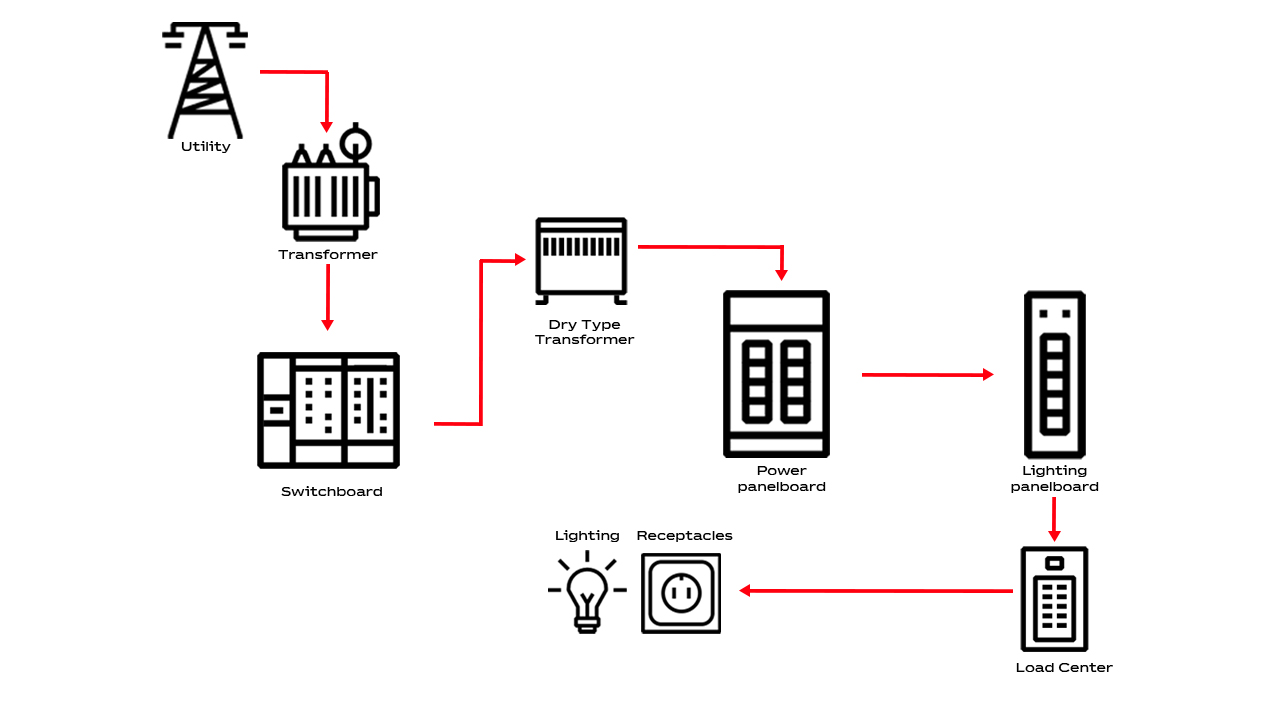
This matters more than it might seem. Because a panelboard serves a defined zone or function, a fault or maintenance shutdown at the panel level affects only that zone, not the whole building. For that reason, larger buildings may have dozens of panelboards carefully distributed and sized throughout them.
Less demanding residential or light-commercial applications can use panelboards as their main power distribution unit in combination with a service entrance, provided they operate below 1200A. In these setups, panelboards often feed load centers, which serve as the final power distribution point.
Key Panelboard Components
Inside a Panelboard
Regardless of size or voltage rating, every panelboard is built around the same set of core components:
Enclosure / Cabinet: Metal housing that mounts to the wall. It is available in various protection ratings, including NEMA 1 (indoor), NEMA 2 (indoor + light water resistance, commonly used across Canada), NEMA 3R (outdoor/weather-resistant), as well as NEMA 4/4X and NEMA12 (for varying levels of environmental hazard protection).
Main Breaker or Main Lugs: A main breaker panelboard includes a built-in circuit breaker that feeds the bus bars, required when no upstream disconnect exists or when the panel serves as service entrance equipment. A main lug panelboard relies on upstream equipment for protection, making it the standard choice for subpanel applications.
Bus Bars: Copper or aluminium conductors that carry current from the main connection point to each branch circuit position. The material is selected according to its application and should comply with the code requirements.
Branch Circuit Breakers: Individual overcurrent protection devices for each outgoing circuit. A wide range of size options is available, from 15A to 1,200A, with interrupting ratings up to 200kA. Can be single-pole (120V), double-pole (240V), or three-pole (three-phase), depending on the load.
Neutral Bus Bar: The connection point for neutral conductors from each branch circuit.
Ground Bus Bar: The connection point for equipment grounding conductors, providing a safe fault current path
Dead Front: A protective cover that prevents accidental contact with live parts when the panel door is open. Required by the CSA for all panelboards.
Lighting Panelboard vs Power Panelboard
A brief history of the distinction
For most of the twentieth century, both the NEC and CEC formally distinguished two panelboard types: lighting and appliance panelboards, and power panelboards. The distinction was based on how many circuits served lighting and small appliance loads, defined as circuits with a neutral connection and overcurrent protection of 30A or less.
If more than 10% of circuits fell into that category, the panel was classified as a lighting panelboard. A hard limit of 42 overcurrent devices also applied.
In 2008, these formal definitions were removed from both codes, along with the 42-circuit limitation. Today, both types are built to the same standards, with no code-based distinction between them. Despite this, the terminology does still persist, and for good reason, helping to differentiate between product portfolios and intended uses.
Lighting Panelboards in practice
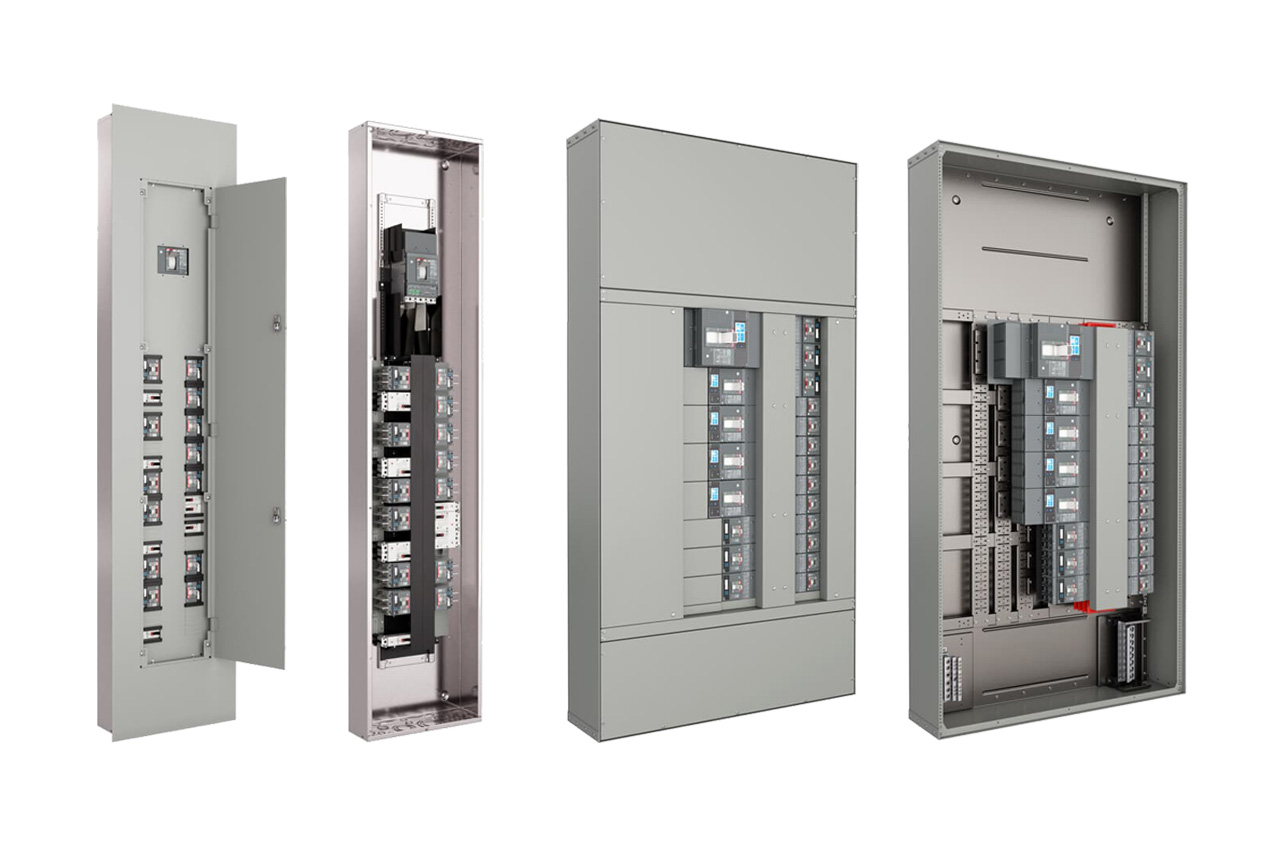
Modern lighting panelboards are far more versatile than their name suggests. They are a standard choice for offices, schools, healthcare facilities, and retail spaces, as well as any application that requires a high number of smaller circuits.
Many applications, such as commercial kitchens or small HVAC systems, can also be served by lighting panelboards, provided the breaker ratings align with the load requirements.
They are available in single-phase and three-phase configurations, with voltage ratings up to 600/347V and main ratings reaching 800A. Branch breakers typically range from 15A to 125A, making them the perfect match for circuits serving lighting and small loads.
Circuit density can be a challenge in space-constrained installations, physically limiting the maximum size of an enclosure and the number of circuits that can fit within.
ABB’s ReliaGear Lighting Panelboards address this directly, featuring specialised SACE FORMULA A2 and SACE Tmax XT circuit breakers. These breakers allow for more branch circuits to fit within configurations, making them particularly useful in projects where space is limited but circuit count is high.
Power Panelboards in practice
Power panelboards are designed for larger, more demanding loads. Mechanical rooms, industrial process areas, data centres, and large HVAC installations regularly use them as they’re suited to supporting more substantial equipment.
In many cases, power panelboards are also used as an intermediary between the main switchboard and lighting panelboards, distributing power in bulk to smaller sections of the facility.
They are typically configured for three-phase systems at 240V, 480V, or 600V and can accommodate two- and three-pole breakers ranging from 15A up to 1,200A, with interruption ratings as high as 200kA. ABB’s ReliaGear neXT Power Panelboards are built to handle these higher-capacity applications, supporting higher power densities with compact circuit breakers.
Lighting vs Power Panelboard Comparison Table
Lighting Panelboard | Power Panelboard | |
Main application | Residential buildings, and light commercial | Commercial & industrial |
Physical size | Small-medium | Medium |
Breakers | Plug-in and Bolt-on MCCB | Exclusive Plug-in technology |
Amperage | Main: Up to 800A Branch breakers: 15-125A | Main: Up to 1200A Branch breakers: 15-1200A |
Voltage | 600V/347V | Up to 600V |
kA ratings | Up to 100kA (fully rated) | Up to 200kA (fully rated) |
Features | Metering, SPD, breaker accessories and features | Metering, SPD, breaker accessories and features |
Cost | Medium-low | Medium |
Panelboard vs Load Center: What's the Difference?
Panelboards and load centers are both branch circuit distribution equipment, but they are built to different specifications and intended for different applications.
Load centers are typically used in residential or small commercial locations, with voltage ratings up to 240V and current capacities generally below 400A. They use plug-in breakers, and their shallower enclosures are designed to fit within standard 2x4 stud walls. They are an economical, widely available solution for applications with modest circuit counts and relatively low fault levels.
Panelboards, by contrast, are built for commercial and industrial use. They support higher voltages (up to 600V) and currents (up to 1,200A), and can use either plug-in or bolt-on breakers for higher fault ratings and more advanced protection technology. Their enclosures are deeper and are typically surface-mounted. .
In many Canadian commercial buildings, both are used – load centers for smaller residential-style areas, and panelboards for relatively higher-voltage electrical distribution below 1200A.
Learn more about panelboards vs load centers.
Specifying the Right Panelboard for Your Project
Key factors to consider
Selecting the right panelboard starts with understanding your system requirements. You should consider:
Voltage and phase: Match the panelboard to the building's supply voltage (120/208V, 120/240V, 277/480V, 347/600V are the most common in Canada).
Amperage: Size the main bus to handle the total calculated load and then factor in additional capacity for growth. Common ratings are 100A, 225A, 400A, 600A, 800A and 1,200A. A panel running near its full rated ampacity from day one leaves no room for future loads without a costly upgrade.
Number of circuits: Count the branch circuits needed and add spare positions for future expansion. Since the 42-circuit rule was removed, larger panels are available, but concentrating too many circuits in one panel can create operational risks. Should that panel go offline for maintenance or fault isolation, every circuit it serves is affected. Distributing load across multiple panels is the more resilient approach.
Branch breakers: The required kA rating, protection, and any accessories will define which breakers to specify. You’ll also need to confirm compatibility between the panelboard and the selected breakers. Using listed breakers from the panelboard manufacturer ensures UL/CSA compliance.
Environment and enclosures: Choosing the right enclosure rating is also important. Indoor installations may only require a NEMA 1 or NEMA 2 enclosure, while outdoor or industrial settings may demand higher ratings such as NEMA 3R, NEMA 12, NEMA 4, or 4X for washdown environments.
Additional features: Consider whether you need energy monitoring across main, or branch breakers, and additional surge protection devices (SPDs).
Future needs: Consider future load demands such as EV charging, solar integration, or automation systems that may increase circuit count or amperage requirements.
Main breaker vs main lug
The choice between a main breaker and a main lug panelboard depends entirely on the panelboard's position in the distribution system and local code requirements. Specify a main breaker panelboard whenever the panel is the first point of disconnect from the supply, either as service entrance equipment or in any installation where there is no upstream disconnect protecting the panel's wiring.
Main lug panelboards, on the other hand, do not include a disconnect and so are typically used as subpanels fed from an already-protected source such as a safety switch, another panelboard, or a switchboard.
Canadian Electrical Standards for Panelboards
Panelboards installed in Canada must comply with CSA C22.2 No. 29, which is harmonised with UL 67 standards. The Canadian Electrical Code governs installation, including requirements for working clearance, grounding and bonding, and circuit identification.
Arc flash labelling requirements also apply to panelboards in commercial and industrial settings. Proper load calculations are essential to ensure safe and compliant sizing.
All panelboard installation work must be carried out by a licensed electrician, who is responsible for verifying compliance with the CEC and any applicable provincial amendments.
Choosing the Right Panelboard for Your Application
Panelboards are the workhorse of electrical distribution in commercial and industrial buildings, delivering power from upstream equipment to the circuits that keep facilities running.
Understanding what a panelboard is and the practical differences between a lighting and power panelboard helps you specify the right equipment for each application.
While the formal distinction between these panel types no longer exists in code, the terminology still reflects real-world design considerations around circuit density, load size and application.
ABB's ReliaGear panelboard family includes both lighting and power panelboards designed for modern Canadian commercial and industrial installations.
For best results, always work with a qualified electrical professional to size and specify the right panelboard for your project.

Frequently Asked Questions
Can I use a lighting panelboard for power loads?
Yes, in many cases you can. A lighting panelboard is not limited to lighting circuits; it can support any load that falls within its voltage, amperage, and interrupting rating. For loads above 125A or applications requiring higher fault ratings above 100kA, however, a power panelboard is generally the better choice.
How many circuits can a panelboard have?
There is no longer a strict limit like the old 42-circuit rule. Modern panelboards can support a relatively large number of circuits depending on their enclosure size and configuration. The real constraints are more practical: how much physical space is available in the enclosure, whether the load can be balanced evenly across phases, and whether concentrating too many circuits in one panel creates a reliability risk.
ABB lighting panelboards can support up to 84 circuits, and our power panelboards offer up to 40X-spaces. ABB offers a configurator tool that helps customers specify an optimally-sized panel for their application.
What is the difference between a panelboard and a switchboard?
Panelboards are wall-mounted and front-access only, typically serving as the final (or near-final) distribution point for downstream, branch circuits, and can be used as a utility service entrance in application that goes up to 1,200A. They can support a maximum interrupt rating of 200 kA, use plug-in or bolt-on breakers only, and are built to CSA C22.2 No. 29 / UL 67 standards.
A switchboard is a much larger, floor-standing assembly that can be accessed from the front and/or rear..
Low-voltage switchboards generally function as the facility’s utility service entrance equipment, distributing electrical power to panelboards and other significant downstream loads within the facility
They are built to handle significantly higher currents, supporting amperages up to 6,000A and bracing up to 200kAIC. They use a range of breaker types, spanning MCCB, ACB, and ICCB. To withstand these high amperages and fault conditions, they are built to different, more demanding standards with rigorous testing, CSA C22.2 No. 244 / UL 891.
Do I need a main breaker or main lug panelboard?
It depends on where the panelboard sits in the system. If there is no upstream disconnect, a main breaker is required. If the panelboard is fed from a protected source, a main lug configuration is the standard choice and avoids the cost of a redundant disconnect.
How often should a panelboard be inspected?
Panelboards should be inspected regularly as part of a formal maintenance program. While there is no legal requirement, it is generally advised to check your panel at least once a year for any visual signs of wear or damage and have a professional inspection every three.
Older equipment, 25+ years, should be evaluated more thoroughly to ensure it remains safe and capable of handling current load demands. In many cases, insurance companies will have their own set of electrical inspection requirements.
Important Disclaimer
This article is intended for general informational and educational purposes. Electrical work should be performed by licensed electricians in compliance with local codes and regulations. Consult with qualified professionals for assessment of your specific electrical system needs.


