The essential first line of defence for every household
Whole home surge protection safeguards your property against sudden mains voltage spikes that can cause costly damage to sensitive electronic devices. A panel-mounted surge protective device (SPD) protects your entire home, complementing regular power bars that offer more limited protection for devices plugged into the strip.
Let’s find out why professional installation of a reliable, high-quality SPD is a worthwhile investment for households, especially in storm-prone regions of Canada.
What is Whole Home Surge Protection?
Whole home surge protection: the basics
Household electrical systems are at risk from sudden spikes in supply voltage that can damage or destroy electronic equipment, including TVs, computers and smart devices.
Typically lasting milliseconds or less, surges can be caused by utility grid issues or lightning strikes to power lines and transformers – a common occurrence in parts of Canada where storms are frequent. Surges are also caused by faulty wiring or malfunctioning devices in the home, the use of EV chargers, or switching heavy-duty appliances like freezers or dryers on and off.
Regardless of their origin, these power surges can cause costly damage to delicate electronic devices and potentially lead to household fires. Professional installation of a surge protective device (SPD) at the main electrical panel helps safeguard electrical systems from damaging and potentially dangerous power surges.
How whole home surge protectors work
A sudden surge in mains voltage can cause a dangerous build-up of energy in electrical devices and household wiring. Unless it’s safely diverted away to ground, that excess energy will lead to overheating and damage to sensitive componentry.
A whole home surge protector – also referred to as a surge protective device (SPD) – is normally installed on a household electrical panel or at the property’s service entrance. It acts as a monitoring device, sensing when voltage increases above a set threshold. When this level is exceeded, the SPD comes into play almost instantly, typically in microseconds, directing excess voltage to a grounding conductor in the property to leave devices unaffected.
What whole home surge protectors Do – and Don’t Do
Whole home SPDs provide a valuable first line of defence for all your home electronics, household appliances and electrical wiring. Protecting equipment from damage caused by sudden supply voltage transients, they can also extend the lifespan of sensitive devices by preventing delicate circuitry from being stressed over time by even modest over-voltages that can occur on a daily basis.
Equally, bear in mind that a surge protection device is not a substitute for ensuring household electrical systems are properly installed and maintained by a qualified professional. Nor can SPDs prevent direct lightning strikes on your household.
What Causes Power Surges In Canadian Homes?
External causes of home power surges
Thunderstorms are a frequent occurrence in parts of Canada, especially during the summer months. With millions of lightning strikes occurring annually, storms are a major cause of electrical power outages when transformers, sub-stations or power lines are hit.
As well as the risk of power cuts, lightning strikes are a cause of voltage spikes in the power distribution grid that may last milliseconds or less. Surges can also be due to other issues in the distribution grid, or fluctuations when supply is restored after a power cut.
Internal causes of home power surges
Home electrical devices can themselves be the cause of damaging voltage surges. Even switching appliances like washing machines and dryers on or off puts other sensitive electronic devices at risk. Power surges can also be caused when circuits are overloaded by plugging in too many devices or by damaged household wiring.
Why surges are more common than most householders think
It isn’t just lightning and occasional grid issues that put household gadgets in danger of irreparable damage by sudden voltage spikes. Your home tech is also at risk from frequent micro-surges that stress delicate circuitry on a daily basis, progressively impairing its performance over time and increasing the risk of eventual failure.
Is Whole Home Surge Protection Worth It?
Understanding the costs and benefits of whole home surge protection
The one-time cost of professionally installing a high-quality SPD must be balanced against the long-term benefits it provides. With modern homes containing more tech than ever, even a single power surge caused by a lightning strike or supply fault can hit multiple devices at once.
In addition to the costs of repairing or replacing expensive hardware, households without proper surge protection also risk the inconvenience of home entertainment, security, monitoring and communications systems being out of action for a period of time.
Protection for modern smart homes
There’s a lot of connected tech in today’s smart homes. From washing machines, fridges, robot vacuums, computers, gaming consoles and home entertainment to lighting, security, access control and monitoring systems, the average household is bristling with dozens of Internet-enabled devices.
A power surge from a single lightning strike can cause irreparable damage to broadband routers and wi-fi hubs, taking your smart tech offline and potentially harming other connected devices. Whole home surge protection can ensure your essential tech stays connected, letting you keep doing what you do without interruption.
When do whole home SPDs deliver maximum value for homeowners?
Whole home surge protection makes a wise investment for property owners and developers of new-build and renovated houses alike. SPDs are particularly valuable for householders in regions of Canada where thunderstorms are prevalent. They’re also an important addition to smart homes, where surges can cause costly damage to connected devices.
Whole Home Surge Protection Vs. Power Bar Surge Protectors
What do power bars actually protect?
Power strips are a common sight in many households, providing separate electrical sockets for multiple devices from a single cable that’s plugged into a mains outlet. Some power bars include ‘point of use’ surge protection built in. However, this will only protect devices that are plugged into the power strip, leaving your household circuitry and other appliances at risk.
What are the advantages of whole home SPDs over power bars?
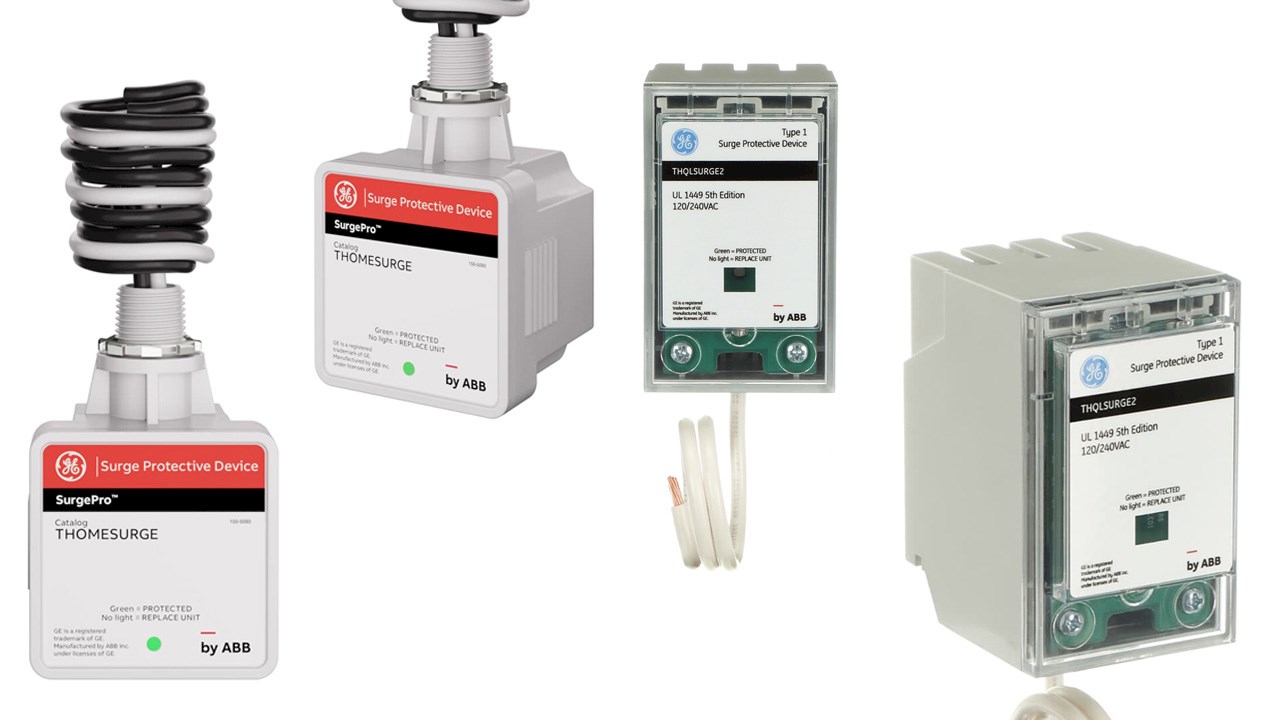
A dedicated home surge protective device is likely to have a higher joule rating than a regular point-of-use power bar. This means that an SPD can safely absorb larger surges of electrical energy than a power strip when voltage spikes occur. Dedicated residential SPDs such as ABB’s THOMESURGE and THQLSURGE whole house surge protectors can also offer additional features like an LED status indicator that standard power bars don’t normally include.
Why combining whole home SPDs and point-of-use protectors gives the best defence
It’s good practice to maximize protection for all of your household’s electronic devices with a combination of defences. A properly installed and grounded SPD provides essential first-line defence, with the ability to safely dissipate large amounts of electrical energy from high-voltage spikes. Plugging household devices into a power strip with built-in surge protection then provides a secondary layer of protection at point of use.
Whole Home Surge Protection Solutions from ABB
ABB panel-mounted SPDs
ABB offers a choice of high-quality, reliable and easy-to-install panel-mounted whole home surge protection devices.
THOMESURGE
Type 1 SPD offering 36kA per phase protection.
- Versatile design: Install with load centers of any brand to protect sensitive electronics throughout the entire home.
- CEC compliant: Industry-standard surge ratings to meet the requirements for new home construction and renovation.
- Contractor friendly: Installation is quick and easy without taking up breaker spaces on the main panel.
- Easy diagnostics: LED light indicates operational status, letting you know when it is time to replace the SPD.

THQLSURGE
Type 1 SPD offering 25kA per phase protection.
- Simple plug-on design: Conveniently connects inside Powermark load centres, similar to a 2-pole circuit breaker.
- Easy diagnostics: LED light indicates proper functioning.
- Code compliant: Industry-standard surge ratings to meet the requirements for new home construction and renovations.
What to look for when choosing the right SPD
Not all whole home surge protectors offer the same level of performance or long-term reliability. When choosing a surge protective device (SPD) for your home, it’s important to focus on specifications that reflect real-world protection rather than marketing claims.
Type rating
Whole home surge protectors are commonly classified as Type 1 or Type 2 devices. Type 1 SPDs are designed for installation at the main electrical panel or service entrance and can handle surges originating both inside the home and from the utility supply. For comprehensive whole-home protection, a Type 1 SPD is typically preferred.
Surge current rating (kA)
The surge current rating indicates how much surge energy the device can safely handle. Higher kiloamp (kA) ratings generally mean the SPD can absorb larger or repeated surge events without degrading as quickly. This is one of the most useful indicators of an SPD’s durability over time.
Voltage protection performance
Rather than relying on generic “clamping voltage” claims, look for how effectively the SPD limits voltage during a surge event. Standards-based performance ratings show how much voltage is allowed to pass through the device before it redirects excess energy to ground. Lower let-through voltage generally means better protection for sensitive electronics.
Nominal discharge capability
This rating reflects the SPD’s ability to withstand repeated surge events over its service life. Devices designed to handle frequent, moderate surges tend to offer better long-term reliability in areas with unstable power or frequent storms.
Short-circuit suitability
An SPD should be suitable for the electrical fault conditions at the installation point. Devices designed for residential panels are tested to ensure they can operate safely if a fault occurs, without creating additional hazards.
Status indication and diagnostics
Many modern SPDs include visual indicators that show whether the device is still functioning correctly. This makes it easy for homeowners or electricians to know when protection is active or when replacement is required.
Installation compatibility
Whole home SPDs are available in different mounting styles, including hard-wired and panel-mounted designs. The right choice depends on your electrical panel configuration and available space, and should always be assessed by a licensed electrician.
Grounding quality
Even the best surge protection device relies on a proper grounding system to function effectively. Without a low-resistance path to ground, an SPD cannot safely divert excess energy, reducing its ability to protect your home.
Installation & Compatibility Considerations With Home Surge Protectors
Does your home need electrical panel upgrades?
Generally, installation of a whole home SPD by a qualified electrician won’t require any upgrades or additional work to the main electrical panel. This is because modern panel-mounted devices are specifically designed to fit into your panel’s existing circuit breaker slots.
The main issue is to ensure that there’s sufficient room on the panel to accommodate the new device. If the panel’s already full, the installer may need to add a separate sub-panel to give space for the SPD.
Where should whole home SPDs be installed?
A whole home surge protector is normally installed at the property’s main electrical panel. It’s considered good practice to position the SPD within the first couple of slots on the panel, adjacent to the main breaker.
This ensures optimal protection by minimizing the distance travelled by the surge before it’s safely routed to earth. Alternatively, SPDs can also be installed between the panel and the household electricity meter.
Installing SPDs in your home
Whole home surge protection represents an important household investment. Without proper installation by a qualified professional, you’re running the risk of the SPD not performing as specified or failing to protect your home devices altogether. For maximum protection and peace of mind, always ensure that SPDs are installed by a licensed electrician.
SPDs and Canadian Electrical Code Requirements
What does the CEC say about surge protection?
Whole home surge protection is not currently obligatory for all existing homes under the Canadian Electrical Code (CEC). Note that these regulations can be subject to local variations: a qualified electrician will check with your provincial or municipal electrical authority that an SPD installation is code-compliant.
Giving Complete Protection For Canadian Homes
Whole home surge protection adds a practical, cost-effective layer of defence to today’s household tech, especially for smart homes and properties in storm-prone regions of Canada.
Professional installation of a reliable, certified residential SPD from ABB safeguards your valuable home electronics from damaging voltage spikes, giving whole-house protection that a standard power bar alone can’t provide.
Frequently Asked Questions
What is whole home surge protection?
Whole home surge protection safeguards electronic devices throughout the house from transient voltage spikes that can damage or destroy sensitive components. Common causes of voltage surges include lightning strikes during electrical storms and supply issues with the distribution grid.
Is whole home surge protection worth it for Canadian homes?
Yes. Whole home surge protection can be a very valuable investment, especially for houses in Canadian regions that are particularly susceptible to thunderstorms. The upfront cost of having a high-quality surge protection device installed by a qualified electrician should be balanced against the potential costs of repairing or replacing household electronics equipment damaged by voltage surges.
How long do whole home surge protectors last?
The lifespan of whole home surge protectors varies, typically over a range from around five to ten years. However, a surge protector’s working life can be significantly reduced by frequent or intense power surges due to lightning strikes or distribution grid issues, causing internal components to degrade faster.
Is whole home surge protection legally required in Canada?
Whole home surge protection is not legally required for all existing homes in Canada. However, the Canadian Electrical Code includes requirements for surge protective devices in certain new residential construction and renovation scenarios, subject to provincial adoption and local enforcement. A licensed electrician can confirm what applies in your area.
Does whole home surge protection prevent lightning damage?
Whole home surge protection provides protection for household electronics in the event of sudden voltage spikes, caused by events such as lightning strikes to overhead power transmission lines and transformers in the distribution grid. However, whole home surge protection will not prevent the risk of damage or fire caused by direct lightning strikes to a property.
Does surge protection require proper grounding?
Yes, proper grounding is essential for the safe operation of any home surge protection system. The purpose of grounding is to limit voltage spikes by providing a low-resistance pathway that safely diverts excess electrical energy to earth. Without it the surge protector cannot operate effectively, putting household electronic equipment and the surge protector itself at risk of damage.
How can I tell if mine needs replacement?
Many whole-home surge protection devices, such as ABB’s THOMESURGE SPD, feature an LED indicator to confirm the device’s operational status. A green light confirms your home is protected. If the indicator light goes out, that means it’s time to replace the SPD. Also, watch out for other tell-tale signs that immediate replacement is necessary. These can include physical damage like scorch marks or cracks, unusual noises or the smell of burning.
Important Disclaimer
This article is intended for general informational and educational purposes. Electrical work should be performed by licensed electricians in compliance with local codes and regulations. Consult with qualified professionals for assessment of your specific electrical system needs.


