
|
To size a transformer, calculate the design demand in kVA, account for how the loads will operate, allow for approved future growth and choose an available transformer rating that is not below the resulting requirement. For basic load calculations: Single-phase: kVA = (V × I) ÷ 1,000 The calculation is only the starting point. Motor starting, harmonics, continuous loading, ambient conditions and future expansion can all affect selection. Overcurrent protection and conductor sizing are separate design steps governed by the Canadian Electrical Code as adopted in the province or territory where the equipment will be installed. |
Choosing the right low-voltage dry-type transformer is not simply a matter of adding up equipment nameplates and picking the closest kVA rating. The designer first has to establish the expected demand, then confirm that the transformer can carry the load under the actual operating conditions.
Transformer capacity, conductor ampacity and overcurrent protection are related, but they are not the same calculation. Keeping them separate makes the process clearer and helps prevent a correct kVA figure from being paired with unsuitable conductors or protection.
Transformer Sizing at a Glance
- List the loads. Record phase, voltage, current or kW, power factor, duty cycle and whether each load is continuous, intermittent, motor-driven or non-linear.
- Convert the loads to kVA. Use nameplate kVA where available. Otherwise calculate it from voltage and current or convert from kW using the appropriate power factor.
- Establish the design demand. Apply the demand, diversity and continuous-load requirements that apply to the installation. Do not assume every connected load runs at full output at the same time.
- Check operating conditions. Account for motor starting, harmonics, ambient temperature, altitude, ventilation and any planned expansion.
- Select and verify the transformer. Choose an available rating that is not below the final design requirement, then complete conductor and protection calculations separately.
How Do You Calculate kVA for Transformer Sizing?
Transformer capacity is stated in kilovolt-amperes, or kVA. It represents the apparent power the transformer must carry. This is why kVA, rather than kW alone, is used for transformer sizing.
Single-phase: kVA = (V × I) ÷ 1,000 Balanced three-phase: kVA = (V × I × 1.732) ÷ 1,000 |
In the three-phase formula, V is the line-to-line voltage and I is the line current. The formula assumes a balanced load. Where phase loading is uneven, each phase and the neutral must also be checked rather than relying only on the total three-phase kVA.
Single-phase example
A 240 V single-phase load drawing 100 A requires:
kVA = (240 × 100) ÷ 1,000 = 24 kVA
Three-phase example
A balanced 600 V three-phase load drawing 28.9 A requires approximately:
kVA = (600 × 28.9 × 1.732) ÷ 1,000 = 30 kVA
What if the load is given in kW?
Where a load is stated in kW rather than kVA, power factor must be considered:
kVA = kW ÷ power factor
For example, a 40 kW load operating at a power factor of 0.80 represents 50 kVA. If voltage and RMS current or nameplate kVA are already known, do not apply the power factor a second time.
Connected Load, Demand and Future Capacity
Connected load is the sum of the equipment that could be connected. Calculated demand is the load expected after the applicable demand factors and operating assumptions have been considered. These figures can be very different.
Demand factor accounts for equipment that does not normally operate at its full rating. Diversity accounts for loads that reach their peaks at different times. The applicable Canadian Electrical Code rules and the operating profile of the facility determine how these factors should be used.
Future capacity is a separate design decision. Some projects allow an additional 15% to 25% for expected expansion, but this is not a universal code rule. The allowance should reflect a realistic growth plan and be approved by the engineer of record.
|
Avoid double-counting headroom. Do not add a generic safety margin to the total connected load and then apply another future-growth allowance without checking how the demand calculation was developed. |
How Much Spare Capacity Should a Transformer Have?
There is no single spare-capacity percentage that suits every project. A data centre with known expansion plans, a commercial building with stable tenancy and a manufacturing plant with large intermittent motors have different needs.
Too little capacity can cause overheating, poor voltage performance and limited room for future loads. Excessive oversizing can increase purchase cost, space requirements, no-load losses and inrush current, and it can affect protection and fault-current studies. The aim is suitable capacity, not simply the largest transformer the budget allows.
What Are the Standard Transformer kVA Sizes?
Transformers are commonly offered in established kVA ratings, but availability depends on phase, voltage, winding material, temperature rise and product family. Custom configurations may also be available. For this reason, a sizing calculation should be checked against the current manufacturer catalogue rather than an old generic standards table.
ABB's current Canadian catalogue lists the following common three-phase ratings for its ReliaGear General Purpose transformers. Not every primary and secondary voltage combination is available at every rating.
|
Common ABB three-phase ratings |
|
15, 30, 45, 75, 112.5, 150, 225, 300, 500 and 750 kVA |
For equipment and control applications, ABB's Small Power Transformers are single-phase units ranging from 0.05 to 3 kVA. These serve a different class of application from facility distribution transformers.
Always confirm the required voltage, phase and kVA combination in the current ABB low-voltage dry-type transformer catalogue before preparing a specification.
How Do You Convert kVA to Amps?
Once a transformer rating and voltage are known, the formulas can be rearranged to calculate full-load current.
|
Single-phase: I = (kVA × 1,000) ÷ V Balanced three-phase: I = (kVA × 1,000) ÷ (V × 1.732) |
Calculate primary and secondary full-load current separately because the voltage is different on each side of the transformer.
Example: 30 kVA, 600 V to 208Y/120 V
For a 30 kVA three-phase transformer:
- Primary current at 600 V = 30,000 ÷ (600 × 1.732) = 28.9 A
- Secondary current at 208 V = 30,000 ÷ (208 × 1.732) = 83.3 A
The 28.9 A and 83.3 A figures describe different sides of the transformer. They must not be treated as interchangeable when selecting conductors or overcurrent devices.
Full-Load Amps by Common Three-Phase kVA Rating
kVA | 208 V | 480 V | 600 V |
15 | 41.6 A | 18.0 A | 14.4 A |
30 | 83.3 A | 36.1 A | 28.9 A |
45 | 124.9 A | 54.1 A | 43.3 A |
75 | 208.2 A | 90.2 A | 72.2 A |
112.5 | 312.3 A | 135.3 A | 108.3 A |
150 | 416.4 A | 180.4 A | 144.3 A |
225 | 624.6 A | 270.6 A | 216.5 A |
300 | 832.7 A | 360.9 A | 288.7 A |
500 | 1,387.9 A | 601.4 A | 481.1 A |
750 | 2,081.9 A | 902.1 A | 721.7 A |
Figures are theoretical full-load currents for a balanced three-phase load and are rounded to one decimal place. They are not conductor or breaker selections.
Sizing for Motors, Harmonics and Non-Linear Loads
A basic steady-state kVA calculation does not capture every operating condition. Large motors can cause a short but substantial starting current and voltage drop. The transformer must be checked against the motor-starting method, starting frequency and acceptable voltage dip.
Non-linear loads such as variable frequency drives, LED drivers, servers and other electronic equipment draw harmonic currents. These currents can increase transformer heating and neutral loading even when the fundamental-frequency kVA appears acceptable.
ABB's ReliaGear K-Factor transformers are designed for harmonic-rich applications and include a 200% rated neutral and electrostatic shielding. ABB offers K4 models for moderate harmonics and K13 models for higher concentrations of non-linear load. Selection should still be based on the expected load profile and the transformer's stated K-factor capability.
Other Conditions That Can Change the Required Size
- Ambient temperature and ventilation: Dry-type transformers rely on suitable airflow and have stated ambient-temperature limits.
- Temperature rise: Different temperature-rise options affect heat, life expectancy and available product configurations.
- Impedance and fault current: Transformer impedance affects voltage regulation and the available short-circuit current on the secondary.
- Enclosure and location: Indoor, outdoor, dusty, damp or corrosive locations may require a different enclosure or transformer construction.
- Load balance and neutral current: Uneven single-phase loading and triplen harmonics can require closer phase and neutral assessment.
What Overcurrent Protection Rules Apply in Canada?
Transformer kVA selection does not determine the final breaker, fuse or conductor size on its own. For dry-type transformer circuits rated 750 V or less, Canadian Electrical Code Rule 26-254 addresses overcurrent protection, Rule 26-256 addresses conductor ampacity and Rule 26-258 coordinates continuous loading with the requirements of Rule 8-104.
Under the 2024 Canadian Electrical Code, Rule 26-254(1) generally limits the primary overcurrent device to no more than 125% of the transformer's rated primary current. If that value does not correspond to a standard device rating, Subrule (3) permits the next higher standard rating. Subrule (2) provides a different arrangement where secondary overcurrent protection is installed and specified conditions are met.
Primary overcurrent example
The 30 kVA, 600 V three-phase example has a rated primary current of approximately 28.9 A. Multiplying that value by 125% gives 36.1 A.
28.9 A × 1.25 = 36.1 A
That result is a primary-side code limit used as part of the protection study. It is not the transformer's secondary current and it does not, by itself, select a breaker. The designer must also consider standard device ratings, transformer inrush, conductor protection, continuous loading, equipment ratings, interrupting capacity and the applicable local requirements.
|
Code note: The Canadian Electrical Code is adopted and may be amended by provincial and territorial authorities. Always use the edition in force for the installation and confirm the design with the authority having jurisdiction. |
Canadian Energy-Efficiency Requirements
Dry-type transformers within the scope of Canada's Energy Efficiency Regulations must meet the applicable federal efficiency levels. The regulations define which products are covered and exclude certain transformer types. For transformers manufactured from 2016 onward, the regulations set efficiency values by phase, voltage class and kVA rating and specify the applicable test procedure.
ABB identifies its Canadian ReliaGear General Purpose models as NRCan compliant. Product compliance and the applicable efficiency level should be confirmed for the exact catalogue number. See the Government of Canada Energy Efficiency Regulations and current ABB product documentation.
Choosing the Right ABB Transformer
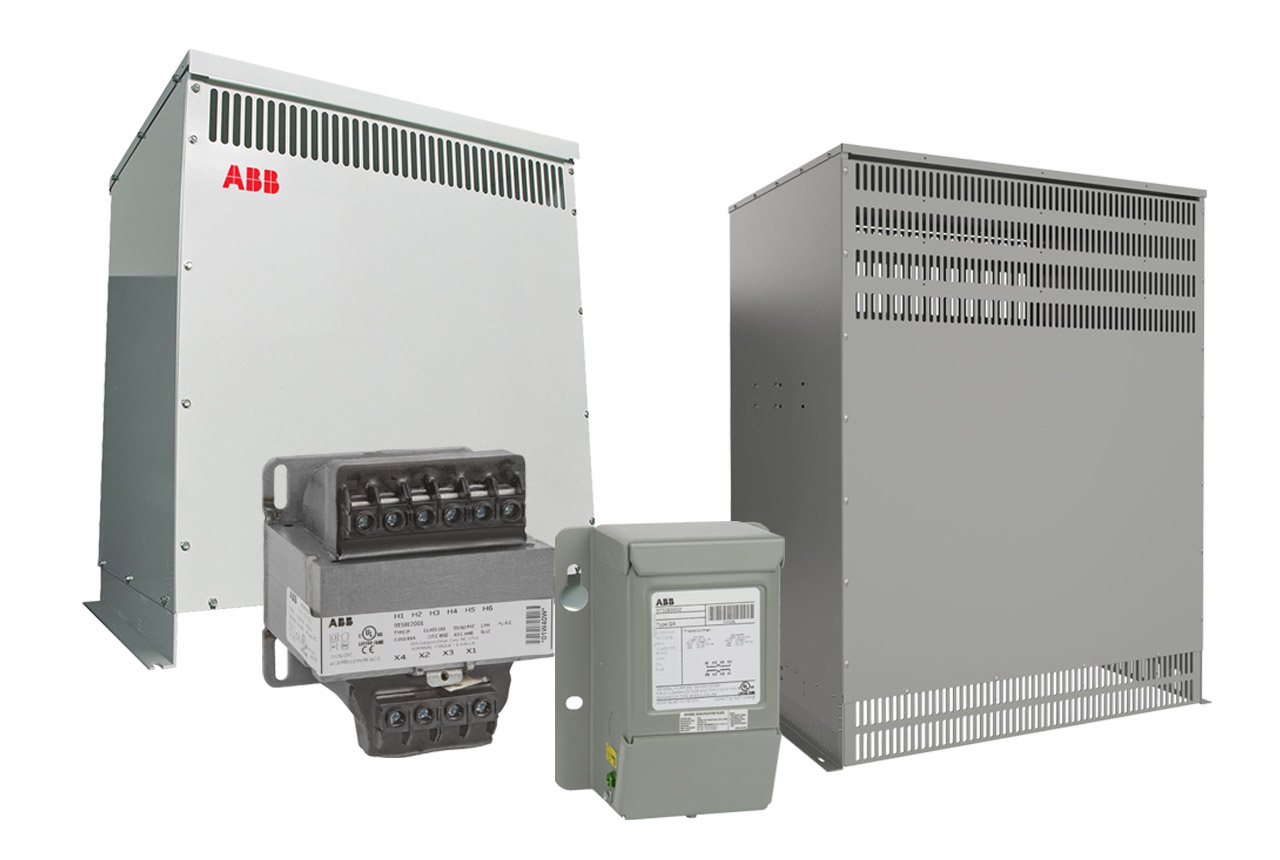
A reliable selection starts with the load, not the product list. Establish the design demand, confirm the primary and secondary voltages, check the operating conditions and then compare the result with current product configurations.
For conventional commercial, residential and industrial distribution, review ABB's ReliaGear General Purpose transformers.
For harmonic-producing electronic loads, consider the ReliaGear K-Factor range.
Smaller equipment and control applications may suit ABB's Small Power Transformers.
For help confirming the appropriate ABB product for a project:

Frequently Asked Questions
How do I calculate what size transformer I need?
Calculate the expected load in kVA, apply the demand and continuous-load requirements relevant to the installation, account for operating conditions and planned growth, then choose an available rating that is not below the final design requirement. Conductors and overcurrent protection must be calculated separately.
What is the difference between kVA and kW when sizing a transformer?
kW measures real power, while kVA measures apparent power based on voltage and current. Where a load is stated only in kW, divide by the appropriate power factor to determine kVA.
Should I always add 25% when sizing a transformer?
No. A 15% to 25% growth allowance is sometimes used for planned expansion, but it is not a universal transformer-sizing rule. The allowance should reflect the project's demand calculation, operating profile and realistic future loads.
Do I always round up to the next transformer size?
Choose an available rating that is not below the properly calculated design requirement. Do not round down below that requirement, but also avoid adding unnecessary capacity without considering losses, inrush, cost and the wider electrical design.
Can an online transformer sizing calculator select the breaker too?
A calculator can convert kVA and amps, but it cannot assess every code and coordination requirement. Breaker, fuse and conductor selection must use the Canadian Electrical Code edition adopted locally, along with the transformer's inrush and the installation details.
Do Canadian transformer rules differ from US rules?
Yes. Canadian installations follow the Canadian Electrical Code as adopted by the relevant province or territory. US National Electrical Code percentages should not be copied into a Canadian design without checking the applicable Canadian requirements.
Does a transformer need to be resized for harmonic loads?
It may. Harmonic currents can add heat and neutral current that a basic kVA calculation does not show. A K-factor transformer or a detailed harmonic assessment may be required, depending on the amount and type of non-linear load.
What standard sizes do ABB dry-type transformers come in?
ABB's current Canadian ReliaGear General Purpose range includes common three-phase ratings from 15 to 750 kVA, but available voltages and configurations vary by rating. ABB Small Power Transformers cover single-phase equipment applications from 0.05 to 3 kVA.
Important Disclaimer
This article is intended for general informational and educational purposes. Electrical work should be performed by licensed electricians in compliance with local codes and regulations. Consult with qualified professionals for assessment of your specific electrical system needs.


