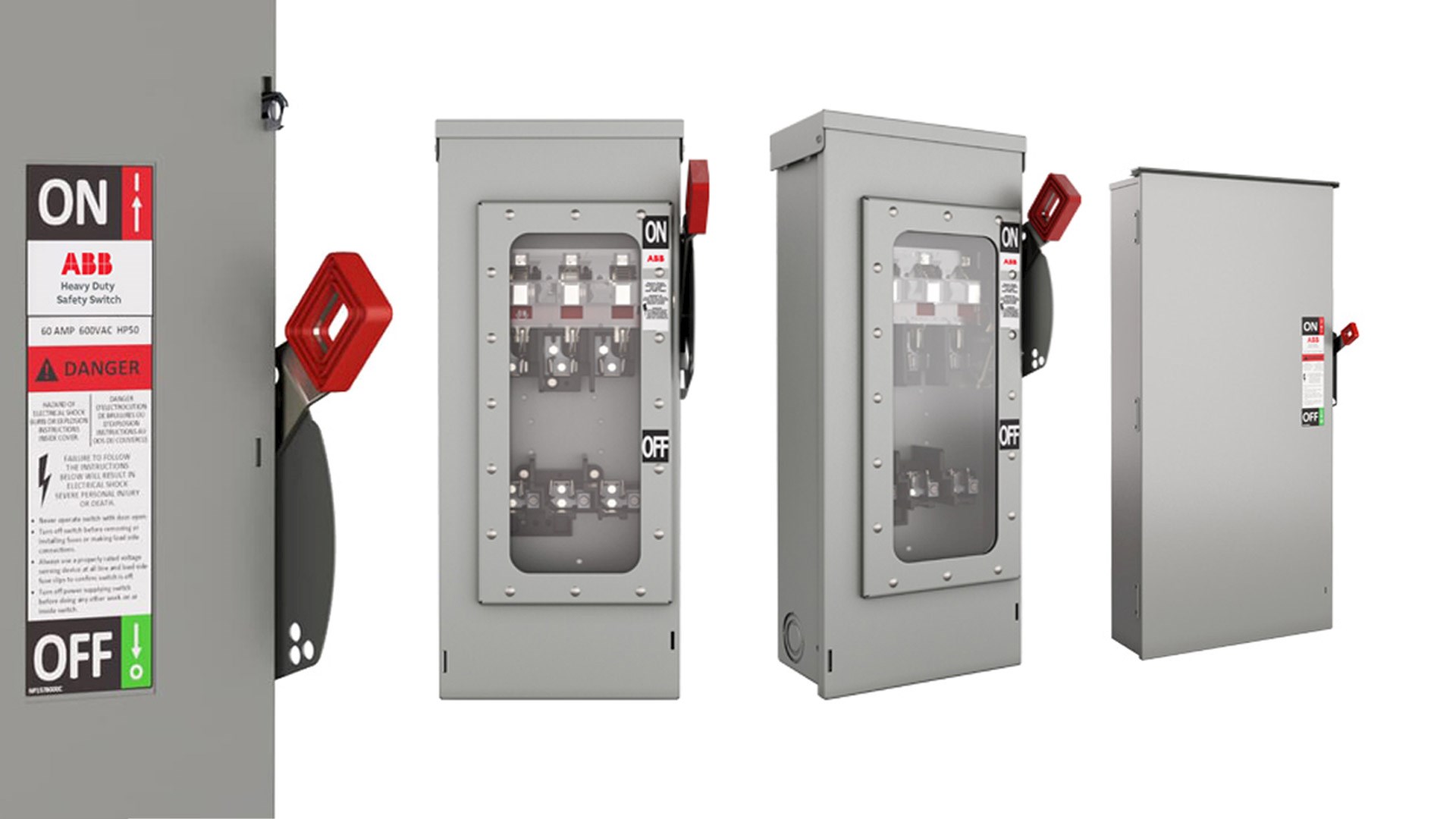
The Safer, the Smarter, the Better
A safety switch is a manually operated electrical device that provides a visible means of isolating an electrical circuit. It allows power to be quickly shut off in emergency situations and ensures circuits remain de-energized during maintenance or repair work. By creating a visible air gap when open, a safety switch helps protect workers from electric shock and accidental equipment start-up.
Safety switches are used across residential, commercial, industrial, and utility applications where reliable, manual power isolation is required for both emergency response and routine servicing.
ABB’s award-winning Spec-Setter™ line of cUL- and CSA-certified safety switches is designed to deliver dependable isolation performance, with options such as large viewing windows for immediate visual confirmation of switch status.
What is an Electrical Safety Switch?
The core function of a safety switch
A safety switch provides a visible means of manually isolating electrical circuits to prevent accidental energization. Safety switches allow isolation of circuits with a lockable lever or switch that allows rapid power shutoff, helping safeguard workers and equipment in emergency situations. They also eliminate the risks of electric shock or accidental operation during maintenance or repairs of electrical equipment.
Why are safety switches needed?
Safety switches are widely encountered in many industrial, commercial, utility and residential settings, where they’re used to protect workers as well as electrical equipment and systems. Safety switches are also critical for LOTO (Lockout/Tagout) compliance, where the switch is physically locked in an OFF position, often with a secure padlock and/or an identifying tag. This ensures that equipment remains electrically isolated and inoperative during maintenance and repairs.
How Does an Electrical Safety Switch Work?
Opening and closing the circuit
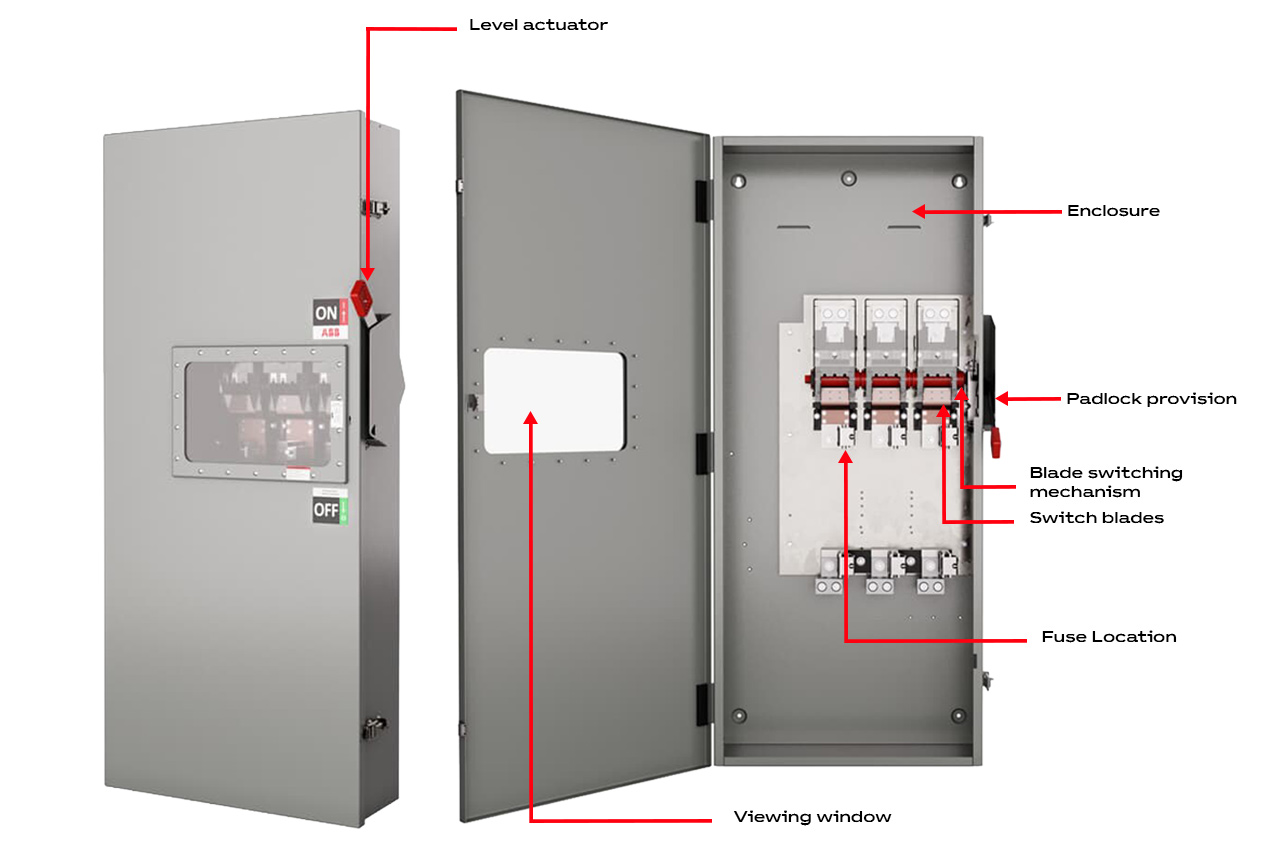
A safety switch gives workers manual control over whether an electrical circuit is in an open state (with no power flowing through the circuit) or in a closed state with power flowing through the circuit. This control is performed with a manual lever that physically opens or closes the internal blades of the switch.
With the switch in its open position, the metal blades are separated by a visible air gap. This non-conductive gap ensures that no current flows, while simultaneously giving visual confirmation of the switch’s open state. When the switch is closed by an operator, the blades make contact and current flows through the circuit.
Visible isolation, and why it matters
Visible confirmation that a safety switch is in its open position and that the circuit is therefore isolated, ensures worker confidence during maintenance or repair work of electrical machines. This contrasts with other switching systems, such as automatic circuit breakers, that may not provide a visual indication of disconnection to workers.
Emergency accessibility
Canadian electrical safety standards require that a safety switch be installed where it’s readily accessible to permit rapid equipment shutdowns. Switch status must also be clearly visible to workers in the vicinity, ideally within 50ft of the electrical machine.
ABB Spec-Setter safety switches can be specified with a large optional viewing window that gives unambiguous, clearly visible confirmation of contact blade position and switch status. This contrasts with disconnect switches whose primary purpose is to allow routine circuit isolation for maintenance and other purposes, rather than rapid disconnection in an emergency situation.
Safety Switches vs. Disconnect Switches: Understanding the Difference
The terms ‘safety switch’ and ‘disconnect switch’ are often used interchangeably. However, there’s a distinction between these terms. As its name suggests, the primary role of a safety switch is to allow rapid isolation of an electrical circuit in emergency situations. This is reflected in a user-first focus on the physical design and ergonomics of the switch, enabling workers to perform very rapid shutdowns using an easily accessible lever.
The main purpose of a disconnect switch, in contrast, is to safely de-energize machinery and electrical systems, for example, during routine maintenance.
Use case differences
As the name suggests, the primary use case for a safety switch is to prioritize worker safety by providing emergency protection in potentially hazardous situations. The main use for a disconnect switch, in contrast, is to support process/maintenance control and optimization where equipment maintenance or repairs are typically performed as part of routine business operations.
Why both exist
While their roles are frequently confused, safety switches and disconnect switches serve quite distinct functional purposes. Used to isolate electrical equipment and circuits, there’s nonetheless a difference of emphasis in how and when they’re used.
The primary role of a safety switch is essentially reactive, allowing staff to quickly and visibly disconnect the supply in potentially dangerous situations. This contrasts with disconnect switches that are used proactively to support everyday equipment maintenance and repair schedules.
Introducing ABB Spec-Setter Safety Switches
Engineered for reliability and safety
Rugged, reliable and easy to install, ABB’s award-winning family of Spec-Setter safety switches offer dependable isolation performance in a broad range of electrical installation applications, spanning commercial and residential buildings, manufacturing and industrial sites, utilities, HVAC systems, and more.
ABB’s portfolio of general duty, heavy duty, double-throw, and emergency power transfer safety switches meets varied application requirements for reliable electrical protection in a wide range of operating environments, both indoors and outside.
Types of ABB Safety Switches
General Duty Safety Switches 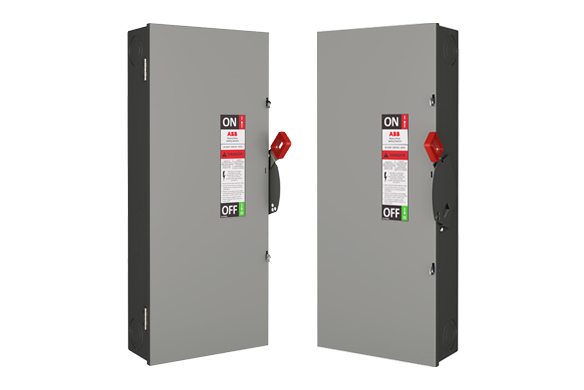
Heavy Duty Safety Switches 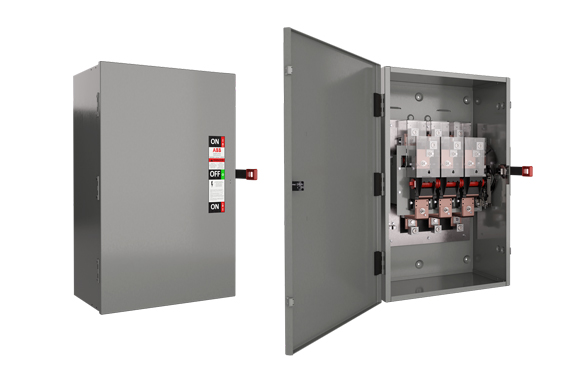
Double-Throw Safety Switches 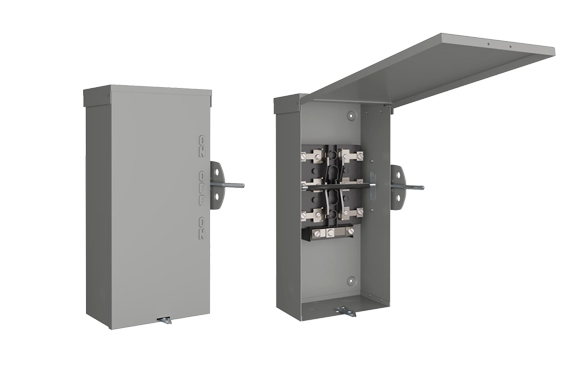
Emergency Power Transfer Switches
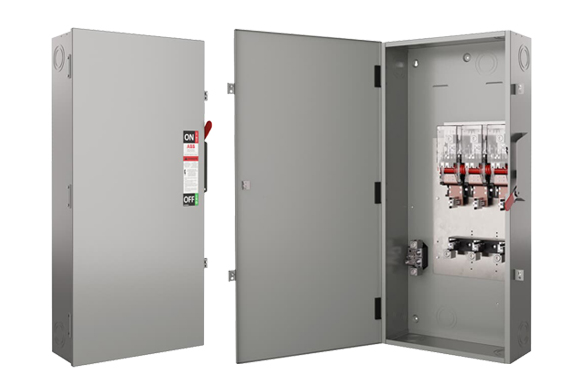
General Duty: Spec-Setter Type TG general duty safety switches are intended for use in everyday residential and light commercial installations. Designed for applications where duty isn’t severe, they support Class H, K, or R fuses and can be specified with either indoor or outdoor enclosures.
Heavy Duty: For more demanding commercial, industrial, and utility applications, Spec-Setter Type TH heavy-duty safety switches deliver reliable, high-performance safety controls. They’re available with a range of water, dust, drip, and corrosion-resistant enclosure options for use in harsh indoor and outdoor environments.
Double-Throw: Spec-Setter Type TC and Type TDT double-throw safety switches are designed for applications with two sources of power. Their ‘stacked’ fusible design saves money and simplifies handling by using one common set of fuses for either source of incoming power.
Emergency Power Transfer: Spec-Setter Type TC emergency power transfer switches are designed to allow rapid switchover to a stand-by generator or other emergency power source. Available in non-fusible form only, they feature a resilient, enclosed design that’s suited to outdoor applications, including rural dwellings and farm buildings.
Industry applications for ABB Safety Switches
ABB Spec-Setter safety switches are an ideal choice in a wide range of industrial, commercial and other applications where electrical safety and dependable operation are prerequisites. Environments where safety switches are typically used include:
- Commercial and residential buildings
- Manufacturing
- Utilities
- HVAC systems
- Utility service entrances
- Food and beverage
- Water and wastewater
- OEM/e-house
Key Features of ABB Spec-Setter Safety Switches
Largest viewing window
ABB Spec-Setter Safety Switches can be specified with an optional viewing window that gives clear, bright, unambiguous visual confirmation of switch position. Offering the largest optional viewing window on the market, it’s a valuable contributor to rapid verification of switch status that gives greater peace of mind for workers.
Durable construction for dependable operation
Ruggedly constructed in heavy-gauge steel, Spec-Setter Safety Switches are designed for ease of installation and long, reliable service life. Optional corrosion-resistant outdoor enclosures (Type 3R and/or Type 4/4X) make Spec-Setter ideal for gruelling commercial, industrial and rural/farm applications.
Certified for safe, dependable performance
Spec-Setter Safety Switches are cUL and CSA certified for industrial operation in Canada and the US. Always consult the Spec-Setter catalog to confirm exact certification ratings for your specific application and region.
When Should You Use a Safety Switch?
Maintenance isolation
A safety switch affords critical protection for technicians and other plant staff. It ensures that electrical machines and other equipment are visibly isolated during planned shutdowns for routine maintenance, repairs, upgrades or replacement.
Emergency shutdown
A safety switch provides a vital ‘first call’ response mechanism in emergency situations, where workers may be placed in immediate danger due to circumstances including fire, faults, and equipment failures.
Generator/Backup power applications
Double-throw emergency power transfer switches are designed specifically for transfer switching applications. Their design allows safe, rapid switchover from the main electrical supply to a stand-by generator or other emergency power source.
Circuit Breakers vs. Safety Switches
They’re not the same thing
Circuit breakers and safety switches play complementary roles as separate elements within a comprehensive electrical safety system. Breakers provide protection against overloads, typically due to fault conditions. Safety switches, in contrast, allow workers to isolate electrical equipment in an emergency situation, while also giving visible confirmation that circuits are de-energized to provide valuable peace of mind for workers.
Why breakers don’t replace safety switches
Circuit breakers aren’t designed with the primary goals of giving workers emergency access, control and visible confirmation of electrical isolation status. Since the breaker’s internal mechanism is typically hidden inside an enclosure, the device’s open/closed state cannot be immediately seen by workers in the vicinity. Nor is the physical design of a breaker intended to allow the device to be safely locked in its open state, as typically needed in LOTO (Lockout/Tagout) procedures.
Choosing the Right Safety Switch
Picking the right safety switch depends on your operating environment and use case.
As well as considering electrical load, enclosure type and certification ratings, another key question is whether you require a safety switch that’s fusible. In addition to providing circuit isolation, fusible switches also include overcurrent protection as an additional safety measure. Non-fusible safety switches, in contrast, are normally used in conjunction with an upstream circuit breaker to provide overcurrent protection.
Environmental ratings
Selecting the optimal safety switch for your needs depends on considering how and where it’s intended for use. Safety switches intended specifically for use in outdoor environments may feature tough all-weather housings that can withstand prolonged exposure to rain and the elements without corroding.
Similarly, ABB’s Spec-Setter Type TH heavy-duty safety switches are designed for use in gruelling industrial and commercial environments where high performance and continuity of service are mandatory.
Load requirements
Selecting a safety switch requires matching the device to the electrical characteristics of the circuit it controls. Key load considerations include:
Voltage rating
The switch must be rated for the system voltage (for example, 240 V, 480 V, or 600 V), as defined by the electrical distribution system and applicable Canadian Electrical Code requirements.
Current (amperage) rating
The switch must be capable of carrying the full load current of the connected equipment without overheating. This includes consideration of continuous loads and motor starting currents where applicable.
Number of poles
The number of poles corresponds to the number of live conductors that must be disconnected simultaneously. Single-phase applications typically require two poles, while three-phase systems require three or more poles to ensure full isolation.
Correctly sizing a safety switch ensures dependable operation, minimizes thermal stress, and supports long-term reliability in both routine and emergency use.
Situations requiring a double-throw safety switch
Double-throw safety switches - such as ABB’s Spec-Setter Type TC and TDT models - are designed for safe, dependable switching between two sources of power. Here, the most common application is load switching between the main utility supply and a secondary source of back-up power, such as a generator. Required for compliance with Canadian electrical safety codes, a double-throw switch avoids the potentially hazardous risk of both power sources being connected at the same time.
Installation and Maintenance Considerations for Safety Switches
Professional installation required
In Canada, safety switches must be installed by a licensed electrician in accordance with the Canadian Electrical Code (CEC) and any applicable provincial or local regulations.
The CEC requires that safety switches used for electrical isolation must:
- Be properly rated for the connected load and system voltage
- Be installed in a readily accessible location
- Provide clear indication of ON/OFF status
- Be suitable for the environmental conditions in which it operates
Incorrect installation can compromise both safety and code compliance, potentially leading to inspection failures, insurance issues, or unsafe working conditions. For these reasons, safety switches should always be selected and installed by qualified professionals familiar with Canadian electrical standards.
Lockout/Tagout best practices
Safety switches are an important component of lockout/tagout procedures to ensure worker safety during the maintenance, repair, upgrading or replacement of electrical machinery. Physically secured in its open (off) state by a padlock or other lockout device, a safety switch provides visible reassurance to workers that the circuit is de-energized. It also serves as a barrier to prevent others from closing the switch and re-energizing the circuit.
Routine inspections
Professional installation of a safety switch by a licensed electrician must be complemented by regular inspection to confirm safe, reliable operation. Verification of optimal operation includes regular viewing window checks and inspection of external enclosure integrity, especially for safety switches deployed in outdoor or harsh industrial environments.
NB: More specific information requested on inspections
Safety First, Built to Last
Safety switches provide a rapid means of visibly isolating electrical machinery, providing essential protection and ensuring worker safety in emergency situations or during routine maintenance.
Whatever your application needs, you’ll find the right safety switch from ABB - the industry leader in delivering rugged, long-lasting, code-compliant protection for workers, equipment and electrical systems.

Frequently Asked Questions
What is the primary purpose of a safety switch?
The primary purpose of a safety switch is to provide a visible, manually operated means of isolating an electrical circuit. It allows power to be quickly shut off in emergency situations and ensures equipment remains de-energized during maintenance or repair work.
Are safety switches required by the Canadian Electrical Code?
Yes. The Canadian Electrical Code (CEC) requires an approved means of electrical isolation for many types of equipment and installations. Safety switches are commonly used to meet these requirements because they provide manual control, visible isolation, and support lockout/tagout procedures.
Can safety switches be used outdoors?
Yes. Safety switches can be specified with outdoor-rated enclosures designed to withstand exposure to weather, moisture, and corrosion. The enclosure rating should always match the environmental conditions of the installation site.
Where are safety switches typically installed?
Safety switches are commonly installed close to the equipment they control, such as motors, HVAC units, pumps, compressors, or service entrances. Their placement allows workers to quickly isolate power at the source without having to return to a distant electrical panel, particularly in emergency situations.
Do safety switches interrupt power automatically?
No. Safety switches are manually operated devices. Unlike circuit breakers or protective relays, they do not trip automatically in response to faults. Their purpose is to provide workers with direct, physical control over circuit isolation when power needs to be intentionally shut off.
Important disclaimer
This article is intended for general informational and educational purposes. Electrical work should be performed by licensed electricians in compliance with local codes and regulations. Consult with qualified professionals for assessment of your specific electrical system needs.


